


Louis XIV. Period. Part 6
Description
This section is from the book "French And English Furniture", by Esther Singleton. Also available from Amazon: French And English Furniture.
Louis XIV. Period. Part 6
This was bombe in front and contained three drawers, the locks, handles and other ornaments of gilt bronze. Its dimensions were 31 inches high; 3 feet, 8 inches long; and 24 inches wide.
Berain and Lepautre designed many commodes of excessive richness, which even the magnificent examples of Boulle, one of which is given on Plate XIV., did not surpass.
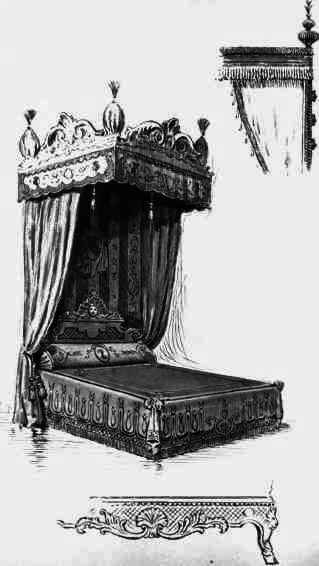
The Duchess of Orleans owned a walnut commode 3 feet, 7 inches long, and 2 feet wide, containing three drawers with iron rings. The Duke had a bureau en com-mode, 3 feet, 5 inches long, and 25 inches wide, containing two large drawers with iron rings.
Madame de Gaudry (1708) had an oak bureau containing three drawers with iron rings. It was 3 feet, 4 inches long, and 2 feet, 1 inch wide. It was covered with a leather carpet lined with green serge. She also had a pine bureau containing two large drawers with copper rings. This measured 3 feet, 3 inches by 26 inches. A red leather carpet lined with red serge covered it.
Madame de Maintenon owned a veneered walnut bureau inlaid with threads of ebony. It had seven drawers on each side with copper gilt key-plates. This piece was 5 feet long and 2 1/2 feet wide, supported by eight small columns. It was covered with a carpet of red velvet bordered with a narrow gold braid.
The Duchess of Orleans had a walnut table in the form of a bureau with two large drawers. It was 3 feet, 4 inches long and 25 inches wide. There were two covers for it: one of red leather and the other of red damask and gold moire. Both covers were trimmed with gold braid and gold fringe.
The dressing-table as a separate piece of furniture seems to have been unknown. All the contemporary illustrations of ladies at their toilettes show them seated before a rather low table which is covered with a cloth, sweeping the floor, over which is spread another cloth probably of linen or leather. Upon it stand a small mirror and all the vases, pots, cushions, and small articles for paint, patches and perfumes. Sometimes the dressing-table was arranged like the one on Plate XXIII., No. 1, or again a commode, or table with drawers, was placed under a mirror, as shown in No. 3 and Nos. 5 and 8, also on Plate XXIII.
The handsomest tables of the day were of marquetry, ornamented with mascarons, or of carved and gilded wood. Many of them have the hind's foot, or the term leg, and are connected with straining-rail's. However, tables were also made of violet-wood, walnut, pine, cherry, or other woods, with simple turned feet. These were always covered with a carpet, or cloth, that matched the hangings of the room. The card-tables were sometimes three-cornered and sometimes cut into five faces. The gueridon, the shape of which was a stem, bearing a small round top and ending in three feet, was often used for cards. Typical tables are shown on Plates XIII and XVI.
Madame de Maintenon's tables included two tables of violet wood each 2 feet, 8 inches long, by 2 feet wide. Their covers were black velvet trimmed with gold braid. She also had a little table of cherry, 2 feet, 3 inches long, and 17 1/2 inches wide, with a drawer and compartments. It was inlaid with ebony in a design of lozenges and foliage and stood on four term-shaped pillars. The Duke of Orleans had a walnut table inlaid with ebony. It stood on four twisted legs and contained a drawer. The dimensions were 2 feet, 11 inches long, by 23 inches wide.
The console is somewhat squarer than that of the former period, and stands frequently with its back against a pier glass. The slab is of marble and sometimes of rich mosaic. The hind's feet here give place to the termed legs, which are joined by straining-rails. Some of them have eight feet, that is to say, four double feet.
Another form of the console is shown on Plate XVI., No. 1, the leg of which appears also on Plate XVI. as No. 4. This is decorated with the ram's head, heavy swags of flowers, the cartouche with the double L and the woman's head. The curved scroll under the slab proclaims the advent of the new style.
Cabinets, desks and armoires were sumptuous. A typical marquetry desk, 3 feet, 10 inches long, and 2 feet, 4 inches wide, inlaid with many coloured woods on a background of ebony, contained seven drawers and a door on which fleur-de-lis was represented. The drawers were furnished with gilt bronze key-plates. On the top of the desk, the design was a vase of flowers, foliage, birds and butterflies, all surrounded by a border of marquetry between two bands of violet wood and threads of white. Each desk stood on eight termed pillars with capitals and feet of gilt wood.
A marquetry cabinet inlaid with bright flowers on ebony and ornamented with bands of violet-wood and white was composed of two sections, each having three doors with gilt copper locks.
The Duchess of Orleans owned a cabinet of marquetry in two parts, containing three wings and three drawers of marquetry of copper and pewter on ebony, enriched with columns, pilasters,squares, bands and pyramids of lapis; in the centre of each of the three wings were masques of men and women in copper-gilt carrying on their heads baskets of flowers and fruits, also copper-gilt. The feet were four consoles; on the two central ones were two children of gilded wood, and on the straining-rail a little child holding a blue shield in a cartouche of gilded wood. The dimensions of the whole were 5 feet, 4 inches long, 18 inches deep, and 4 feet, 3 inches high.
The favourite clock is Boulle's. It stands on the mantel-piece, or upon a pedestal, or term. The tall clock in the long pedestal-shaped box was also in use.
Some of the frames of the clocks follow the designs shown on Plate XVII., Nos. 2 and 3.
The pedestal that Boulle makes for his clocks have almost an architectural form; they are like a kind of small pavilion, at the top of which is the dial. The legs are most frequently formed by a scroll of foliage terminating in a clawed paw. The subject on top is usually Time with his scythe, or some mythological symbol.
Continue to:


My Books

