


The Jacobean Period. Part 3
Description
This section is from the book "French And English Furniture", by Esther Singleton. Also available from Amazon: French And English Furniture.
The Jacobean Period. Part 3
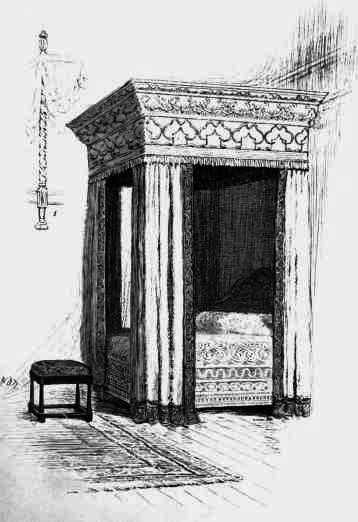
The illumination is obtained by means of lamps, lanterns and candlesticks. The latter are very ornate. Some of them are branched and hang from the ceiling. Others have sconce-arms and are placed on the walls. Tall standing candlesticks of metal are also used, and are moved about the room at pleasure. The illumination is also helped by means of small mirrors, with frames carved and gilt, or else made of ebony or olive-wood.
The furniture consists of one large table, several small round or oval tables, side tables, chairs, settee, couch, stools, a "court," or "livery cupboard" (and sometimes both), a screen, cabinets, chests, and coffers; while the decorations are pictures, antlers, armour, vases and other ornaments of porcelain, gold, silver, or pewter, and table-clocks.
There has been much discussion regarding the "court cupboard" and the "livery cupboard," mentioned above, but it is now generally accepted that the "court cupboard," which may have derived its name from the French word court (short), to distinguish it from the high standing cupboards, corresponded to the French dressoir, and was used for the display and keeping of plate, glass, etc., etc. The "livery cupboard," on the other hand, still found in the farmers' and labourers' cottages in England, where it is sometimes called the "bread-and-cheese cupboard," received its name from the French livrer(to deliver) and was used both for service and as a receptacle for broken victuals. The difference between them is well defined in fanua Linguarum (London, 1673), as follows: "Golden and gilded beakers, cruzes, great cups, chrystal glasses, cans, tankards and two ear'd pots are brought forth out of the cupboard and glass case; and being rins'd and rubb'd with a pot-brush are set on the livery cupboard."
The "court cupboard" corresponded, in a measure, to the modern sideboard. It was a great feature at festivals and it rose in several receding stages or shelves, upon which the plate was displayed. The number of stages varied according to the rank of the master or mistress of the house. In Les Honneurs de la Cour, we learn that two steps were allowed to the wife of a baronet, three to a countess, four to a princess, and five to a queen.
At Cardinal Wolsey's entertainment to the French Ambassadors at Hampton Court, Cavendish relates: "There was a cupboard for the time in length of the breadth of the nether end of the same chamber, six desks high, full of gilt plate, very sumptuous and of the newest fashions; and upon the nethermost desk garnished all with plate of clean gold were two great candlesticks of silver and gilt most curiously wrought." When the same Ambassadors were entertained by Henry VIII. at Greenwich, there was a "cupborde seven stages high and thirteen feet long, set with standing cuppes, bolles, flaggons and great pottles all of fine golde, some garnished with one stone, and some with other stones and pearles."
When Queen Elizabeth was entertained at Hatfield House (the present seat of the Salisburies) in 1556, and there was a great and rich "maskinge in the great halle at Hatfield," at night "the cupboard in the halle was of twelve stages, mainlie furnished with garnish of gold and silver vessels and a banket of seventie dishes, and after a voide of spices and suttleties, with thirtie spice plates, all at the charges of Sir Thomas Pope."
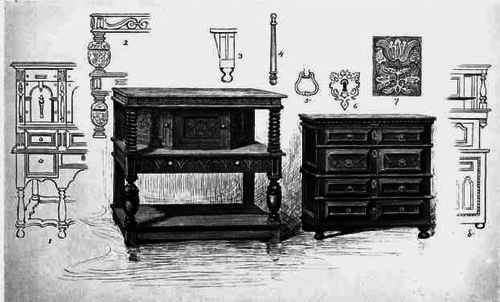
PLATE X.
A good example of a "court cupboard" with five degrees of stages ornamented with plate is shown in a picture printed in Laurea Austriaca (Frankfort, 1627), representing an entertainment given by King James I. of England to the Spanish Ambassadors during the negotiations for the marriage of the Prince of Wales to the Infanta of Spain. The stages rest upon a frame of turned baluster legs connected by straining-rails. Below the first stage there is a drawer. The "carpets" hang over the front of the cupboard instead of over the sides, as was more usual. This picture would seem to prove that an ordinary side table of the period might be converted into a court cupboard by simply placing the requisite number of shelves above it. However, in the inventory of Sir Thomas Kytson (1603) the following occurs: "At ye Great Chamber Dore one little joined boarde w' a fast frame to it, to sett on glassis. Itm, a thing like stayres to set plate on."
In the early days, before the "livery cupboard " was brought from behind the screen into the hall, the "court cupboard" was removed from the lower end of the hall. The "livery cupboard" took its place. The "court cupboard" was then placed on the dais, at the " Lord's borde end," or in a recess at the back of the high table. Sometimes it was placed in front of the bay window at the end of the dais, where it acted as a kind of screen.
The "livery cupboard" was not only used for service, but for "liveries" of food and drink, served at night and in between meals. Smaller livery cupboards were sometimes found in the bedrooms, and these were usually furnished with doors and locks. As food was kept in them, the panels are frequently perforated for the sake of ventilation.
Occasionally, especially in later times, the uses of the "court" and "livery" cupboards were combined. Between these pieces of furniture, one difference long existed: a portion of the court cupboard was enclosed at a very early period, while the livery cupboard remained with its open shelves.
If we may believe the old inventories, there were many varieties of the cupboard, or many names for it. We find cupboard and chest-of-drawers, great cupboard, table and cupboard, table-cupboard, livery cupboard, side cupboard, press cupboard, sideboard cupboard, half-headed cupboard, standing cupboard, "cort" cupboard, etc., etc.
Its use was universal, as it was an article of convenience, beauty and ceremony. On Plate X. a characteristic specimen of a Seventeenth Century "court cupboard" of oak is shown. This is preserved in the Vestry in Jams-ton Church, Nottinghamshire. The lower part would resemble the ordinary side table of the day, if the back supports were like the two turned baluster legs in the front. The long drawer with carved panels is appropriated for linen, or cutlery. The enclosed cupboard is cut in the form of half a hexagon, - a favourite device of the period for cupboards, and has three doors enriched with carved panels and mouldings. The top slab or "cupboard head" is supported by spirally turned columns. The proper way to adorn this piece of furniture is to place a cupboard cloth, or "carpet" (of damask with fringed ends, or a strip of the same material as the hangings of the room) upon the top, allowing the ends of the scarf to fall over the sides (but not the front), and then to arrange on it a few choice pieces of plate, or porcelain. It is interesting to compare this example with No. 8 and No. 1 on the same plate. No. 8 is a portion of a cupboard of later date. This has a "double head," and under the first stage the ornament is a pendant, instead of a column or pillar.
Continue to:


My Books

