


The Jacobean Period. Part 4
Description
This section is from the book "French And English Furniture", by Esther Singleton. Also available from Amazon: French And English Furniture.
The Jacobean Period. Part 4
This stands on a ball foot, of an older form than the foot of No. 1 or No. 3. This example, moreover, has its lower portion enclosed with panelled doors. The earlier specimens of the "court cupboard" are generally (and often richly) carved. Sometimes the pillars have Ionic capitals, sometimes they are ornamented with the swelling bulb or acorn enriched with the acanthus leaf, as exhibited in No. 2, Plate X. The devices for the mouldings and panels open to the carver were innumerable. Towards the close of our period, cupboards were decorated with applied ornaments of ebony (or an imitation of it) in the form of eggs, spindles and lozenges, as shown in the cabinet No. 1 on Plate X.
The cabinet is a development of the enclosed cupboard. The characteristic cabinet of James I.'s time is adorned with pillars, arch panels and spindle ornaments. The specimen just referred to on Plate X., No. 1, has these decorations. It stands on a frame of six legs, - a frame that was also used for the lower part of the high case-of-drawers that was coming into fashion towards the end of our period.
The cabinet was always a handsome piece of furniture equipped with shelves, drawers, compartments, and doors, - a repository for jewels, documents and curios. It was sometimes defined as a set of boxes, or drawers for curiosities, and from it the cabinet-maker, "one whose business it is to make cabinets and the finer kind of joiner's work," took his name.
The cabinet was known in England at an early date. In 1550, we read of a "fayre large cabinett covered with crimson velvet with the King's arms crowned." In the Seventeenth Century, the cabinet was panelled and carved, adorned with turned pillars, pendants or swelling bulbs, or it was of the newer style with applied ornaments and turned supports. Frequently also an imported cabinet was to be seen in the English home of this century, - a beautiful specimen of Dutch marquetry, of Italian inlay, of Oriental lacquer, or, indeed, of Boulle work, to say nothing of the splendid examples of Flemish carving.
Some of these cabinets were very ornate specimens of workmanship. Inlay or marquetry was the leading feature of decoration for them. Natural flowers, birds, animals and foliage in bright colours, or in the colours of the exotic woods, undyed, were in use. Ivory and mother-of-pearl, as well as shell were also employed. Even before the days of William and Mary, when the Dutch marquetry became universally popular, there was much inlaid furniture.
In 1697, John Evelyn notes:
"Emblema, continued to this day by the Italians in their Pietra Comessa. ... St. Lawrence at Florence, where the pavement and all the walls are most richly encrusted with all sorts of precious marbles, serpentine, porhirie, ophitis, achat, rants, coral, cornelian, lazuli, etc., of which one may number thirty sorts, cut and laid into a fonds or ground of black marble (as our cabinetmakers do their variegated woods) in the shape of birds, flowers, landskips, grotesks, and other compartments."
The above reference shows that the English cabinetmakers were accustomed to work in inlay.
One of the designs of marquetry that came into vogue in the Seventeenth Century was the "herring-bone" pattern. A clock made by Daniel Quare late in the Seventeenth Century, and preserved at Hampton Court Palace, has its case inlaid with a border of herring-bone pattern.
The characteristic table of Jacobean days is the "drawing-table, a solid piece of furniture with massive legs, often carved, and connected with rails near the floor. The top is a large slab of oak and beneath it are two other slabs or leaves; when these are drawn out at each end, the large slab falls into the space they occupied, and the table is thus lengthened.
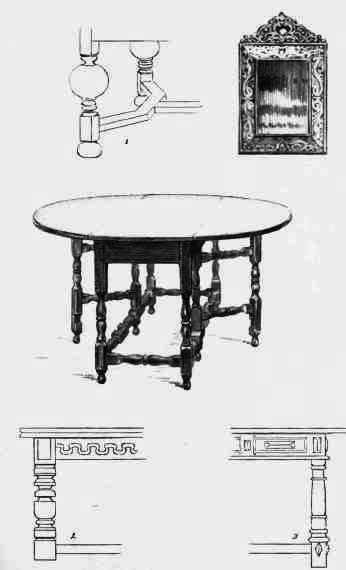
Another typical table, called either "round" or "oval," is shown on Plate XI. This is an eight-legged table provided with flaps, or falling leaves, supported by legs that can be pulled forward. When not in use, they fold into the frame. Sometimes this variety of table has six instead of eight legs. A popular modern name for these is "the gate-legged" and "the thousand-legged tables." Frequently the legs were turned spirally. There was another round, or oval table, whose falling leaf was supported by a bracket, shaped something like the wing of a butterfly, from which it has received the modern and popular name of "butterfly table." The square table was also in use. The table was always covered with its "carpet"; indeed, in the inventories of the period, the "table and carpet" are often mentioned together.
On Plate XI. are three specimen table legs. No. 1 shows legs that are ornamented with a round globe, which like the round ball foot, is of ebony or wood stained black in imitation. The stretchers and rest of the frame are oak. Frequently the table leg was decorated with the carved bulb or acorn, as is shown in No. 2, Plate X. A similar leg to No. 1, Plate XL, occurs on the table in Plate V., but the stretchers here are different. No. 2 and No. 3 on Plate XI. are good types of the ornamentation of the period and their legs are also connected by stretchers. The latter would be used as side-tables or placed in the centre of a room.
The furniture of the parlour in the late Tudor period consisted of high-backed carved chairs, joined stools with cushions covered with rich material and fringed, foot-stools, turned chairs, "lyttle guilt chairs for the women," high folding screens with many leaves, long, square and round tables with "carpets," "conversation stools " with ornamented ends and backs, chests, cabinets, coffers and all the ornaments of the period. A wood fire gives warmth, and silver candelabra and sconces light to the room, while further comfort is added by the tapestries, curtains and innumerable cushions. Often, indeed, a bed occurs.
The Jacobean parlour differed but little; indeed, in some houses this exact room survived; but the new styles were gradually driving out the heavy chairs and cabinets for the lighter varieties with turned frames and cane webbing or their upholstered backs and seats; and the old carving was being rapidly supplanted by the newer decoration of the black mouldings and applied ornaments. The high-backed and richly carved settle had to give place to the "couch and squab," a handsome specimen of which appears on Plate VIII. This is also called a settee or a "chaise longue." Our particular example is composed of a walnut frame covered with cane, upon which are placed a mattress or long cushion and a round bolster, both of which are covered with green silk damask bordered with a narrow fringe. The back, resembling the back of a chair, is enclosed in an ornamental frame of scroll-work, somewhat similar to that of No. 1 on the same plate, and turned side pillars. The top rail is surmounted by a pedimental scroll with a crown in the middle. The six legs have projecting knees and feet connected lengthwise by ornamental rails upon which scrolls and crowns are carved.
Continue to:


My Books

