


The Chippendale Period. Part 3
Description
This section is from the book "French And English Furniture", by Esther Singleton. Also available from Amazon: French And English Furniture.
The Chippendale Period. Part 3
Another bed has pillars "composed of reeds with a palm branch twisting round," the pillars being 8 feet, 6 inches high; and the bedstead 6 feet, 7 inches long and 6 feet wide.
The "Field" or "Tent beds are heavily draped, but the curtains and festoons are made to take off", and the laths are hung with hinges for the convenience of folding up."
Another, is a "Chinese Bed," the "curtains and val-lens are tied up in drapery, the tester is canted at each corner, which makes a sort of an elliptical ornament or arch, and if well executed will look very well." Another bed " may be gilt, or covered with the same stuff" as the curtains."
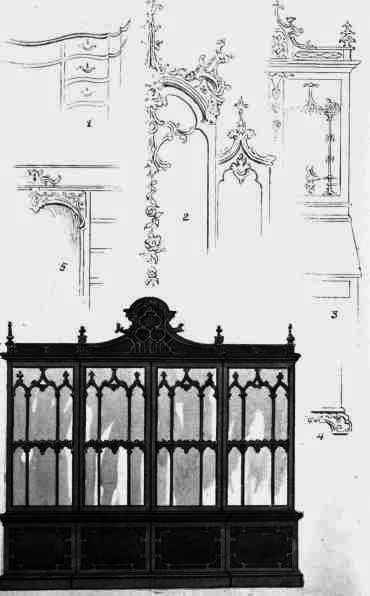
Before dismissing the four-post beds, the question of cornices must be considered. Chippendale gives numerous designs for "Cornices for Beds or Windows." These are carved and are supposed to be gilt, or painted, or japanned, brightened with gold. Such designs as the scroll and leaf are frequent, as shown in No. 1 on Plate XL. while other ornaments are the crown, the urn, the shell, the eagle, the draped urn, the grotesque dog or monkey's head holding the ends of two garlands in his mouth, the long-tailed and open-beaked bird.
Turning now to the Canopy, Couch and Sofa beds, we find Chippendale describing a "Couch with Canopy. The Curtains must be made to draw up in Drapery, or to let down, when it is occasionally converted into a Bed. This sort of Couch is very fit for alcoves, or such deep Recesses as are often seen in large Apartments. It may also be placed at the end of a long gallery. If the Curtains and Valances are adorned with a large gold Fringe and Tassels, and the ornaments gilt with burnished gold, it will look very grand. The Crane at the top of the Canopy is the Emblem of Care and Watchfulness: which I think it not unbecoming in a place of rest. The length of the bed cannot be less than 6 feet in the clear, but may be more if required. The Breadth is 3 feet or more, in proportion to the length. The height may be determined by the place it is to stand in." -
Another "Couch bed," he tells us, "was made for an alcove in Lord Pembroke's house, at Whitehall." This bed is a sofa of sweeping curve, three short cabriole legs supporting it in front. A stiff rolled bolster is placed at each end of the sofa crosswise. Four slender posts hold a canopy draped and decorated with a Chinese feeling, only tassels are used for ornaments instead of bells. The drapery is arranged in four symmetrical festoons, caught back gracefully at the sides and falling nearly to the short leg of the sofa. This was really a kind of lit de repos rather than a bed properly speaking; but there is one that can be used either as a sofa or a bed. He describes it as follows: "A Chinese Canopy with Curtains and Valances tied up in Drapery, and may be converted into a Bed by making the front part of the seat to draw forward, and the sides made to fold and turn in with strong iron hinges and a proper stretcher to keep out and support the sides when open. The curtains must be likewise made to come forward, and when let down will form a Tent."
Another of his designs is a "Chinese Sopha with a canopy over it, with its curtains and vallens all tied up in drapery. This design may be converted into a bed, by having the Sopha so made as to come forward, the curtains to draw to the front of the Sopha, and hang sloping, which will form a sort of a tent, and look very grand. The ornaments are designed for burnished gold." Another "is a Chinese Sopha, intended for the same use as the former; the design is different from the other, and if well executed by an ingenious workman, it cannot fail of giving content."
Another "Chinese sopha" is represented on Plate XLI., which is purely a sofa and not a bed. This has a pagoda-shaped canopy decorated with bells and the drapery arranged in formal festoons. At the back is a piece of silk ornamented in the style of Boucher, and the sofa, which is a French canape, bears a design reminiscent of Watteau, - a "gallant scene" showing a lady in a large hat and flowing gown seated on a bank while her companion is a gentleman in a cocked hat.
Specific directions accompany four designs of Sofas. "When made large, they have a bolster and pillow at each End," and Cushions at the Back, which may be laid down occasionally and form a mattress. The upper sofa is designed to have the Back Corners Circular, which must look well. The Sizes differ greatly; but commonly they are from 6 to 9 or 10 feet long; the Depth of the Seat from Front to Back from 2 feet, 3 inches, to 3 feet; and the Height of the Seat 1 foot 2 inches with casters. The scrolls are 18 to 19 inches high. Part of the carving may be left out, if required."
The chaise longue also appears, and of it the designer says: "This is what the French call 'Pecb'e Mortel'. They are sometimes made to take asunder in the middle: one part makes a large easy chair and the other, a stool, and the feet join in the middle, which looks badly." This, of course, is the duchesse, consisting of a fauteuil and a tabouret (see pages 208 and 209). Chippendale recommends for this a "thick mattress, 6 feet long in the clear; and 2 feet, 6 inches to 2 feet broad."
Turning now to the chairs, a close examination will show almost double the number actually represented; because Chippendale often gives different motives for carving on the two sides of the special chair. He draws French chairs, Gothic chairs, Chinese chairs, Garden chairs, Hall chairs and his favourite "Ribband Back chairs." The latter, one variety of which appears to the reader's left on Plate XXXVIIL, is one of "three Ribband-back Chairs, which, if I may speak without vanity, are the best I have ever seen (or perhaps have ever been made). The Chair on the left hand has been executed from this Design, which had an excellent effect, and gave satisfaction to all who saw it. I make no doubt but the other two will give the same content, if properly handled in the execution."
Continue to:


My Books

