


The Louis XV. Period. Part 5
Description
This section is from the book "French And English Furniture", by Esther Singleton. Also available from Amazon: French And English Furniture.
The Louis XV. Period. Part 5
"This play-room leads into another one where coffee is served. Here Indian and Chinese plants and figures have full licence to take part in the decoration: here they are naturally befitting; and, in my opinion, this is the sole place where they should be admitted.
"Next we enter a cabinet en niche, oval in form, which is lighted by a glass door that leads into a little bosquet, which serves as a private promenade for this chamber. Opposite this door is a chimney-piece in an arcade which matches the arcade in which the lit en niche is contained, and opposite which another of the same form is imitated, or the door leading into this room. In this doorway is a staircase leading up to the entresols that are over this room and a little room behind it, which are intended for the servants' sleeping-rooms.
"From the coffee-room you enter a gallery that terminates the right side of this building. This gallery is symmetrically decorated, and the spaces between the windows are enriched with mirrors and consoles on which are placed various curios, such as bronzes, crystals, porcelains, etc.
"From this gallery you enter the garden.
"To the right of the Salon is a billiard room of a shape appropriate to its use. Ornaments, mirrors and pictures rarely form part of the decoration of this kind of a room on account of the accidents incidental to this game; and the walls are simply covered with large panelling.
"This billiard room leads into a room which in turn leads into a chambre en niche; it may be ornamented with tapestries above a wainscot. As for the chambre en niche, its walls should be covered with carpentry work all the way up. This will preserve it from the humidity it might have, being on the ground floor, and which always attacks apartments that are not constantly occupied. The decoration is perfectly symmetrical. To combine pleasure and convenience, I have arranged close to it a small garde-robe that is lighted from and opens into a little court. On each side of the niche that contains the bed, there is a door; one serves as a passage into the garde-robe, and the other opens into a recess for keeping the linen in and keeping under key whatever the master desires.
"The little court communicates with the kitchens.
"The dining-room on the right of the vestibule is of an irregular form. The chimney-piece faces the two windows; the angles of the superfices on which it is placed are rounded, and in them I have placed niches for marble tables, on which can be set the silver, crystal and dessert, during the repast, and afterwards be put away in the closet next to this room.
"On the other side of the vestibule, is the common room in which the servants dine. Next to it come the kitchens."
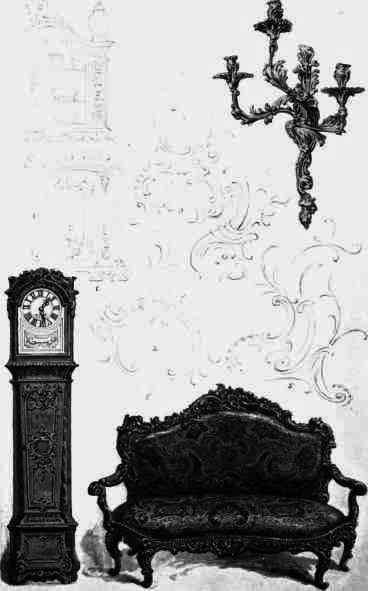
When the dining-room is separate from the suite, it is usually situated on the ground floor, near the large stairway. The architects of the day insisted that it should be well lighted, and, if possible, open upon a garden. The floor was of parquetry, and the walls wainscotted in oak and sometimes carved; yet it was not unusual to have the panels carved, painted white and gilded. The buffet with its fountain and wine-cooler was the centre of attraction. The curtains were of silk, the chairs were upholstered and the floor warmed by a carpet or rugs laid. On the mantel-piece stood a clock and candelabra, and sconces and chandelier holding many candles brightly illuminated the rooms.
One of the changes of this reign was the appearance of the petit salon and boudoir, smaller rooms beautifully and comfortably furnished, which were more adapted for intimate social life.
"In order to find useful furniture," says Jacquemart, "we must pass to the reign of Louis XV., the king who deserted the state apartments for by-places with secret doors and back staircases."
The Palais Soubise in Paris, the ancient home of the Guises, and the home of the Prince de Soubise, a favourite of Louis XV. and a devoted friend of Madame de Pompadour, is happily extant. The Prince de Soubise took for his second wife, his cousin, Anne Julie Charbot de Rohan, so celebrated for her beauty and her intrigues. The embellishments at the Hotel de Soubise were begun by them in 1704 and continued by their son, the Due de Rohan, who died in 1749, and the decorations of this mansion are considered among the triumphs of the "elegances raffinees" of the Eighteenth Century. Germain BofFrand, a pupil of Mansart, is responsible for the interior architecture.
The two floors in which the Prince and Princess had their apartments were laid out identically. The Prince occupied the rez-de-chaussee, or ground-floor, consisting of a bedroom, a Salon oval and ante-chambers, etc.
The bedroom communicated directly with the Salon oval and the many windows and glass doors of the latter opened upon a formal French garden. The decorations of these rooms were in the pale grey tone known as gris de lin. There were no bright colours and no mythological pictures of love and gallantry. The panels were laden with beautiful wood carvings, and in the upper part between the archivolts of the doors and windows were eight allegorical groups representing the arts and sciences. Music, Justice, Painting and Poetry, History and Fame were painted by Lambert Sigisbert Adam; and Astronomy, Architecture, Comedy and the Drama by Jean Baptiste Lemoine.
The Princess's apartments above consisted likewise of a bedroom, Salon oval, and an antechamber. The bedroom was lighted by two windows that looked upon an interior court. In the cornices and in the centre of the panels were groups of figures inspired by the stories of Greek mythology. On the piers, a skillful carver related the amorous adventures of Venus and Adonis, Semele and Jupiter, Europa and the Bull, and Argus and Mercury. In the four corners of the ceilings, the gilded medallions represented Diana, Leda, Ganymede and Hebe; and, finally, in the cornice, stucco figures of almost natural size stood out boldly. They formed four groups. Between the windows, Bacchus and Ariadne were represented; in the depth of the alcove, Diana and Endymion, and at the side of the Salon Oval, Pallas and Mercury, - opposite to Venus and Adonis. Innumerable little Cupids, bearing attributes of sciences, arts and letters were everywhere. Over each door was a painted panel: one, by Boucher represented the Graces presiding at Cupid's Education, the other, signed Tremolieres and dated 1737, Minerva teaching a Young Girl the Art of Making Tapestry. In the back of the room, standing out from the red damask of the alcove, were two pastorals by Boucher, with shepherds in satin garments, and shepherdesses in panier-skirts, and be-ribboned sheep.
Continue to:


My Books

