


Louis XVI., The Revolution And The Empire. Part 2
Description
This section is from the book "French Furniture", by Andre Saglio. Also available from Amazon: French Furniture.
Louis XVI., The Revolution And The Empire. Part 2
When Jeanne Becu became Com-tesse du Barry she wished to find an artist who would work exclusively for her, and she was advised to choose Gouthiere as designer and decorator. There is nothing to show that he was known to the public before, but we may reasonably suppose that it was Gabriel, the first manager of Louveciennes, or Le Doux, who rebuilt the pavilion, both great admirers of the pseudo-antique style, who recommended their young collaborator, Gouthifere, who was then but thirty years old, as the best person to decorate the interior of the building in the style they had chosen for its architecture.
This is, of course, but a mere suggestion, for scarcely anything is known of the life of this artist, who was said by his contemporaries to have acquired such extraordinary skill as a chaser as to have been able to make bronze look like gold. Between 1771 and 1773 he executed all, even the most minute, decorations in metal after the designs probably of Le Doux, Jean Denis Dugourc, architect to Monsieur, brother of the King, combined with some of his own, in this exquisite retreat of the last mistress of the King. Unfortunately, the royal accounts enumerate them at too great length for us to quote the lists here, for it would have been full of interest to a history of costly furniture to give the descriptions of such things as candelabra or sconces, wreathed with roses in flower and bud and myrtle foliage, that were probably modelled, to begin with, in wax and finished off separately with the greatest possible care; of door-handles decorated with a wreath of roses, the monograph of the Comtesse, a rosary, and a sunflower; of window fastenings shaped like a lyre or a flowering branch of lilies. All this leaves little doubt that Gouthiere was also the chief designer of many furniture decorations in brass that are now lost.
We have indeed a list of such designs in the proces-verbal drawn up in 1794 by the so-called Commissaires artistes chez la nommee Dubarry. For instance, amongst paintings by Watteau, Vanloo, Fragonard, Greuze, and Boucher, sculptures by Pajou, Falconnet, and Coysevox, and all manner of costly trinkets, we find mentioned a round table in Sevres porcelain, divided into six pastoral subjects, and having in the centre a picture in enamel representing a concert in a seraglio, the whole upheld by a single bulbous support of Chinese wood decorated with gilded bronze; a commode enriched with paintings in enamel and finely chased gilded bronze on a table of white marble; a piano with a marqueterie top, etc.
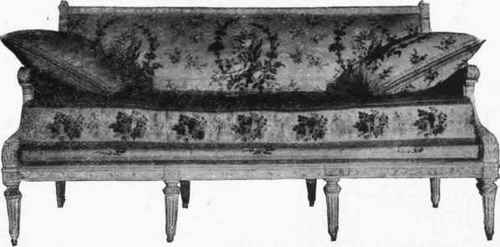
Plate L. LOUIS XVI SOFA. Palace of the Petit Trianon, Versailles.
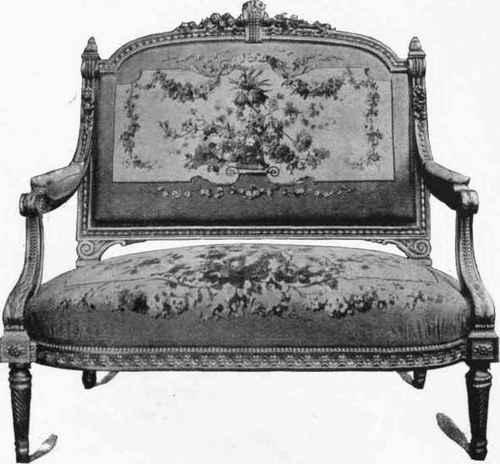
Plate LI. SOFA. Epoch Louis XVI. Palace of the Elysee, Paris.
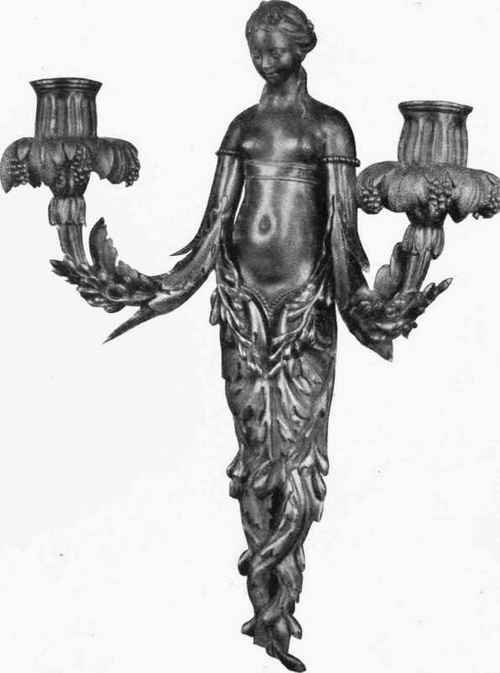
Plate LII. APPLIQUE. By Gouthiere. Epoch Louis XVI. Grandjean Collection.
The memoirs of various furniture-dealers add many other items to this legal list, any one of which if it came into the market now would be bid for at very high sums - an armoire and secretaire, in one, of French porcelain, with a green ground strewn with flowers and sea pieces in miniature; a commode of antique lacquer, the central panel decorated with grotesque figures very richly dressed, with friezes inlaid with ebony and enriched with bronze, chased and gilded with dull gold, the whole surmounted by white marble; a French porcelain table with shelves, with a green ground and floral cartouches richly decorated with gilded bronze, the top covered with green velvet, on which stood gilded inkstands; with many other masterpieces of the ebenist and chaser, the description of which, however brief, gives us an opportunity of classifying an immense number of works in museums and private collections as imitations of the dainty, delicate, fairy-like creations that made up the furniture of the Chatelaine of Louveciennes. It will now be understood how impossible it was in a history of French furniture to dismiss hastily the short-lived but wonderful luxury that surrounded the beautiful Madame du Barry.
It must not, however, be supposed that Gouthiere was the most celebrated of the makers of furniture of the latter part of the eighteenth century. He had one rival, who in all histories of French decorative art under Louis XVI. is spoken of as chief amongst his contemporaries, and whose life is fortunately well known, proving him to have been equally skilful as an ebenist and a chaser. This was Riesener, whose career is, moreover, of special interest, in that it makes it possible to trace accurately the transition between the rocaille and so-called Classic styles, as well as the decadence of the Louis XVI. style when France was verging on imperialism.
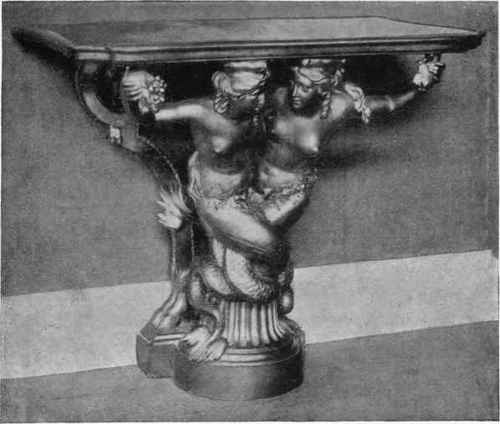
Plate LIII. CONSOLE. Beginning of Louis XVI Epoch. Garde Meuble National, Paris.
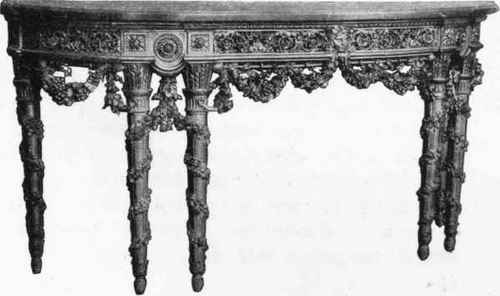
Plate LIV. CONSOLE. Epoch Louis XVI. Ministry of the Interior, Paris.
Born at Gladbach in Germany, in 1735, Riesener went to Paris when still quite young, and became apprenticed to an ebenist named Oeben, whose career presents one of the problems such as we have met with again and again in the course of this study. This Oeben was, there is every reason to suppose, of German extraction, though his Christian names were Jean Francois and he enjoyed all the advantages of French nationality. He had a namesake, Simon Oeben or Hobenne, who was also ebenist to the King, and after the deaths of both of them their widows carried on their businesses, so that it would not be surprising to hear of two widows Oeben living at the same time, if we did not happen to know that one of them married again, becoming the wife of Riesener. There is yet another puzzle - the works signed with the name of Oeben, such as the corner-cupboards of the great bureau of the Jones Collection at South Kensington, are of very simple construction, recalling the manner of Boulle, as modified by that of Cressent, but with decorative bronzes greatly influenced by the Italian Rococo style.
Continue to:


My Books

