


Louis XVI., The Revolution And The Empire. Part 4
Description
This section is from the book "French Furniture", by Andre Saglio. Also available from Amazon: French Furniture.
Louis XVI., The Revolution And The Empire. Part 4
Not only did the great Riesener borrow, as we have seen, from contemporary metal founders and chasers, but also, in spite of his having been - as proved by his marqueterie work - a remarkably clever designer, he thought no shame of using the drawings of architects such as Jacques Gondouin, who was director of the royal residences. Moreover, Gouthiere executed designs by Le Barbier and Boizot, as attested by inscriptions cut in the wood of certain pieces of furniture, and it is no longer doubtful that he aided the ebenists Saunier, Leleu, and Pasquier at the chateaux of Madame du Barry, and there seems to be some reason to suppose that he also worked with Riesener.
It would be unfair to pass over without a word of notice Jean Francois Leleu and Claude Charles Saunier, who lived at the end of the eighteenth century, and took high rank on account of the whimsical, though, it must be owned, somewhat restricted, imagination they displayed in their marqueterie work, of which the lavish use of copper was a chief characteristic. Their contemporary Martin Carlin was specially skilful in lacquer-work, which he decorated with such beautiful bronzes that one is tempted to ask whether they were not really from the hand of Gouthiere, or of his best pupil Thomire. Carlin worked with Riesener at the furniture of the Chateau de Saint Cloud, bought by Marie Antoinette in 1785. Fortunately, a good many examples of his skill are preserved in the Louvre and the Wallace Collection, proving by their charming delicacy of execution how fitted was their author to cater for the caprices of the graceful and beautiful Queen. Pages would be filled with the mere list of the names of the ebenists and sculptors who flourished during the last years of the glories of the monarchy, and brought the Louis XVI. style into high repute.
We must, however, content ourselves with naming Montigny, Levasseur, and Sverin, who imitated the old motives of Boulle with a skill that has led to mistakes; Guillaume Beneman, who was one of the first to make the use of mahogany fashionable, and who is chiefly famous for his collaboration with such rare masters of decoration as the sculptors Haurd and Martin; the inlayers Girard, Kemp, and Bertrand; the chasers Bardin and Thomire; and the gilder Galle.
The mention of Beneman indicates that the task of tracing the evolution of French taste is nearing its conclusion. No doubt we might note en passant certain clumsy architectural ornaments designed of recent years, certain affected freaks in copper, in which the scrupulous attention to trifles of Gouthiere is mimicked without being understood, certain lifeless and naive imitations of antique Greek, Roman, and even Egyptian motives imperfectly comprehended; but these are mere mistakes of little importance which should herald a revival, not a rapid decadence, such as that now about to take place. The necessary men were there, most of them in the prime of their age and of their powers, and it is the men who are the real factors, in spite of fashion, in all the great art periods. All we have hitherto written goes to prove this, and that to bring about the artistic catastrophe with which we shall end this study, the extraordinary coincidence of three historical fatalities - which we will name before we comment upon them - was needed.
The first and least important was the invasion during the last eight years of the reign of Louis XVI. of the workshops of the ebenists of the Faubourg St. Antoine by Germans, who came, not, like Oeben and Riesener, to learn their art in Paris, but to turn their national skill and taste to account, by sharing in the high prices paid in France for articles of luxury. Unfortunately, the French Court was attracted by the foreign novelties introduced; a kind of art paralysis ensued, and the political events which supervened led to the mischief having become irreparable by the time a new and luxurious court gathered about the Emperor Napoleon I. The second fatality was the suddenness with which the Revolution, in its zeal for universal enfranchisement, destroyed the corporations with their protective privileges, their stringent rules for the careful execution of commissions, and their regulations as to serving a long and obligatory apprenticeship to a trade, before the right could be won of selling the work done.
By the suppression in a single sentence of an institution which, we admit, had its tyrannical and unjust side, the competition and rivalry so prolific of good results were arrested, and the salutary collaboration of artists of different gifts was put an end to, with the result that the door was opened for the manufacture of cheap objects of luxury, and an element of demoralisation was introduced from which the whole civilised world is still suffering, far more than is generally supposed. The case would not, however, perhaps have been so desperate but for the rise of the Empire, which, with the absorbing interest of its magnificent campaigns, withdrew public attention from the creations of artists, and brought all the vitiated talent which had survived the ancient monarchy under the control of a single man of iron will, who was educated during those years of Republican supremacy when to own beauty as well as wealth was to fall under the suspicion of being an aristocrat.

Plate LVIII. CHEVAL-GLASS. First Empire. Garde Meuble National, Paris.
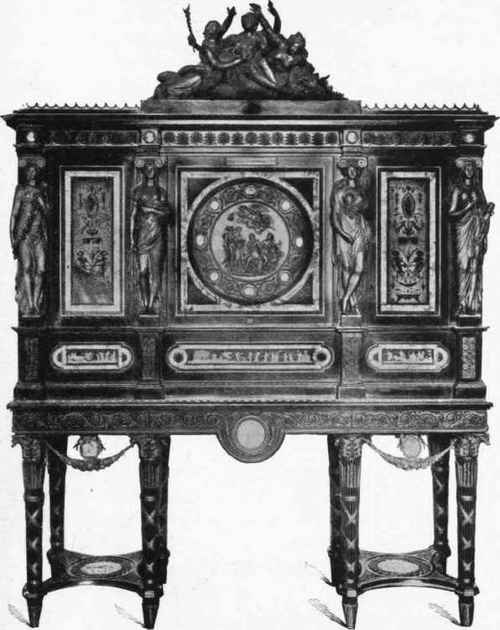
Plate LIX. JEWEL CABINET OF QUEEN MARIE ANTOINETTE. Designed by Schwerdfeger, Degault, Roentgen and Thomire. Palace of Versailles.
After Beneman, then, the decline set in rapidly. His mahogany coffers would be nothing but clumsy chests were it not for the decoration added to them by his French collaborators. The fellow countrymen who gathered about did little more than crudely emphasise his peculiar interpretation of the pseudo-antique style, their aim being rigidly to suppress the affected but charming naturalism of the French school. Joseph Stoekel, Birkle, Charles Richter, Feuer-stein, Peter Schmitz, Gaspard Schneider, Frost, Bergeman, Blucheidner, and many others were favoured by the Queen because they spoke her native language, but the most celebrated of the foreigners were Weis-weiler, who worked chiefly at furniture for ladies' boudoirs, Schwerdfeger, the chief author of the famous Jewel Cabinet of Marie Antoinette, which we reproduce here, and which would be at once assigned to the Empire period, without the lifelike caryatides with which it was decorated by Thomire, and Roentgen, better known by his Christian name of David, or as David of Luneville, although he really came from Neuwied, near Coblentz. The last-named merits special notice, not so much on account of his art talent, as the position he and his fellow countryman Beneman managed to obtain at Court. It is impossible to help admiring the audacity with which he competed with French artists of commercial acumen inferior to his own, for he managed to be manufacturer of furniture to the Queen, and a member of the Municipality of Paris, without giving up his workshops at Neuwied, where, moreover, he spent most of his time.
Continue to:


My Books

