


The Regency And Louis XV
Description
This section is from the book "French Furniture", by Andre Saglio. Also available from Amazon: French Furniture.
The Regency And Louis XV
NOTHING checked the evolution of French decorative art in the direction so vigorously given to it by the artists patronised by the munificence of Louis XIV. and the wise judgment of Colbert; not even the death of the great minister, which occurred in 1683, nor that of Le Brun, who died seven years later; not the ruinous wars which occupied the whole of the closing years of the reign, and necessitated the closing for a long time of the royal Gobelins manufactory, nor the religious zeal with which the King was inspired, through his love for Madame de Maintenon, and which introduced at Court at least a semblance of simplicity and economy. All that occurred was the logical modification of public taste in a manner scarcely perceptible to contemporary observers until the decadence and final extinction which resulted from the introduction into society of ideas and interests absolutely novel. By this we mean less the crisis of the Revolution than the military despotism of Napoleon I., which turned the thoughts of the nation completely away from matters artistic, that had seemed of such vital importance in the society of the eighteenth century, and concentrated all eyes upon the enthralling and terrible drama of the conquest of Europe on which depended the very life of France. We shall be able to prove beyond a doubt, by the examples we give in this closing section of our work, that what is known as the Empire style was due to the last surviving artists of the Monarchy, and that the so-called style of the Restoration represents but the final anguish of their traditions, as interpreted by pupils who were in no sense artists, but ignorant artisans without so much as any manual skill.
These preliminary remarks are necessary to show that in our opinion the French school to which Louis XIV. had the honour of giving his name is one and the same with that we are now about to study, though it is not possible to divide it into distinct and well-defined periods, still less to give to arbitrary sections the deceptive titles in general use of the Regency style, Louis XV. style, Louis XVI., Directory, Empire, or Restoration styles.
It is easy to quote examples of much earlier date than the death of the Grand Monarque, which took place in 1715, which have all the peculiarities supposed to characterise the new reign inaugurated under the regency of Philip of Orleans. These peculiarities consist in a greater suppleness of the general design of furniture, the more constant use of sculptures in metal in its decoration, and the introduction of the shell and of lines derived from it in ornamentation. When we consider the graceful arabesques of Berain, the drawings left behind him by Oppenordt, by the architect Robert de Cotte, who was already fifty years old when Louis XIV. ascended the throne, the so-called singeries of Gillot, who was the master of Watteau, it is easy to see that the quaint whims, supposed to be the exclusive characteristic of the subjects of the great-grandson of Louis XIV., were already indulged in during the best time of the artistic domination of Le Brun, and that they were by no means confined to the works produced in the royal manufactories. The modification of style that was really accentuated during the greater part of the reign of Louis XV. was the use of inharmonious decoration, to which the name of rocaille was given.
Two considerations readily explain this - the first, a purely moral one, illustrating an historical law,namely, the increasing need of some reaction for minds weary of academic rules in the sense in which they were then understood, which governed all art production, and took it for granted that symmetry was the leading principle of all noble form, that of the human figure not excepted. The second explanation is more definite and scientific, being merely the growing taste for certain forms of Chinese art, appreciation for which was first started by Mazarin, who owned a good many examples of Chinese lacquer-work and porcelain, as proved by his Inventory. There is no need here to dwell on the caprices indulged in by designers of the remote Orient, on the carelessness with which they repeat the same motives side by side, and the habit they have of constantly breaking off the curved line instead of rounding it off. These are fundamental peculiarities recognised in the most cursory examination; and, on the other hand, in studying the most rococo examples of the furniture of the Louis XV. period, such as some of the works of Meissonnier or Jacques Caffieri, for instance, there will be no difficulty in discovering quite similar decorative ideas.
It remains to point out how the taste for Chinese work spread amongst the people after the death of Mazarin, but we can only do so briefly within the limits of this book, which prevent us from quoting examples of this taste in painting, ceramic ware, tapestry, and embroidery. Collectors of foreign art work, such as Mazarin, would naturally try to get manufacturers to imitate works, the acquisition of which proved their own good taste and had cost them so much money. The Dutch began this imitation, the Parisians followed suit. The latter at first gave their whole attention to trying to reproduce Chinese lacquer and varnish, as may be seen from one of the items of the Inventory of Moliere's possessions quoted above. Under the date 1692, Pradel's "Livre Commode" notes that there were three manufactories of lacquer-work and furniture in the Chinese style, flourishing in Paris, one in the Faubourg St. Antoine, one in the Grande Rue St. Antoine, and one in the Rue de la Tixeranderie, but their proprietors had been anticipated by others long before, for, according to the "Comptes des Batiments du Roi," a certain Louis le Hongre was actually at work in 1655 at decorations in lacquer in the King's palace at Versailles. At first French workmen were content to imitate Chinese designs and colours, then they tried to produce equivalents of them, but it was not, it would seem, until the first quarter of the eighteenth century that they had the audacity to introduce in their decorative carvings dragons exactly like the Oriental type, such as, to quote but one example, those on the handles of a fine commode by Charles Cressent in the Wallace Collection. This was the important step, and as soon as French ebenists had taken it, they never left off turning for inspiration to examples brought from China, not only for details of ornamentation, but also for the general scheme of decoration, which completely modified the structure of the furniture they produced.

Plate XXXVIII. CONSOLE. Epoch Louis XV. Carnavalet Museum, Paris.
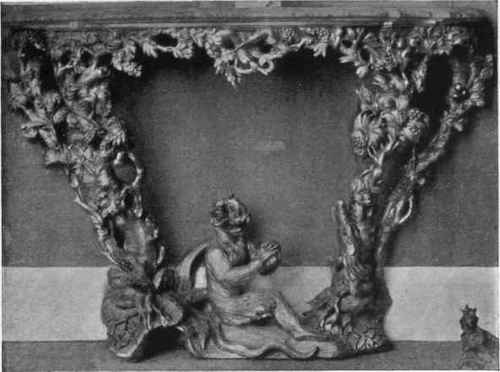
Plate XXXIX. CONSOLE. Epoch Louis XV. Collection of M. de le Breteche.
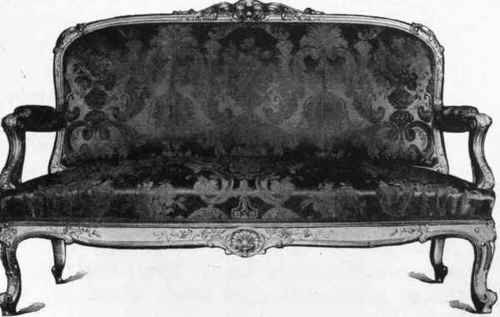
Plate XL. SOFA. Louis XV. Palace of Versailles.
Continue to:


My Books

