


How To Make Knitting Needles
Description
This section is from the book "Furniture A Girl Can Make", by William W. Klenke. Also available from Amazon: Furniture A Girl Can Make.
How To Make Knitting Needles
Are you fond of knitting or do you have a friend who is? Well then you will surely want to make a pair of these attractive knitting needles and thereby be the envy of all your girl friends.
The little old cabinet making shop in town will no doubt be able to cut out for you a few pieces of ebony, rosewood or any good hard wood, from the scrap pile, that has a close grain. You may have some old discarded furniture that will have plenty of fine wood in it that will be suitable for this project.
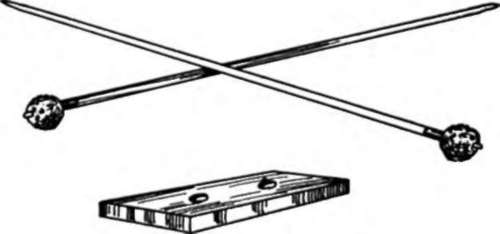
TWO HOLES ARE DRILLED IN AN IRON SCRAP PIECE.
Now ask the auto repair man or machinist to drill two holes in a scrap piece of iron or steel—one hole seven-thirty-seconds inch and the other three-sixteenths inch in size. If you wish to make other size needles of course change the sizes of these holes.
Method Of Procedure
Step No. 1: With any small plane (block plane preferred), plane off the corners of both strips, making the pieces octagonal (8 sides) in shape. Now, again with just a few strokes of the plane, cut off the sharp corners making a sixteen sided object; finally a few more strokes of the plane will almost produce a true cylindrical (round) strip.
Step No. 2: Slightly taper one end of each piece; then working the strips back and forth, while turning them at the same time, work in and out of the first hole (the larger one that is seven-thirty-seconds inch in diameter), that you drilled in the metal block. This will soon smooth up the irregularities made by the plane. After the pieces have been worked down to slide into hole No. 1 freely, repeat this operation by working both pieces through hole No. 2. You will now have two round strips of wood uniformly three-sixteenths inch in diameter the entire length of the strips.
Step No. 3: Sandpaper the strips smooth by first using a No. 0 sandpaper and then No. 00 sandpaper. The one end can be brought down to a taper (as shown on the drawing), with a medium coarse grade of sandpaper as
No. 1/2.
Step No. 4: The ornamental tip or bead on the upper end of the knitting needle is fastened in place with glue. The beads can be purchased in your local five and ten cent store. It will enhance these needles greatly if you put a small german silver or brass band just below the bead; this however, is not necessary.
Step No. 5: Finish the job by applying a coat of boiled linseed oil to the needles; then when dry, apply two thin coats of white shellac. Rub down both coats gently with No. 00 sandpaper or steel wool. If you do not have boiled linseed oil, use any machine oil.
If you make these needles out of a light colored wood and wish to imitate such woods as ebony, walnut, etc., this can easily be accomplished by first applying a coat of the proper stain. A coat of black India drawing ink will often do very well to imitate ebony.
By this same method of procedure, you can make any size knitting needle you desire.
Continue to:


My Books

