


Chapter I. Historical Furniture
Description
This section is from the book "A History Of Furniture", by Albert Jacquemart. Also available from Amazon: A History Of Furniture.
This section is from the "" book, by .
Chapter I. Historical Furniture
In treating of furniture, we must begin by defining the value of the word according to the different periods to which it is applied. In its natural and general meaning, furniture (French "mobilier") represents everything that is' moveable, transportable, and easy to place in security.
In the early ages of our history, man was, to a certain extent, nomadic. If the necessity of defence caused castles and fortresses to be erected, fitted for repelling a hostile incursion, and for protecting the humble dwellings which gathered round them, lords and vassals, rich and poor, providing against a victorious invasion, or the necessity of going to fight in distant parts for their country's cause, held themselves prepared to pack up, in chests kept ready for the purpose, all the articles composing their possessions; these chests are therefore the first and most ancient furniture.
By degrees, as public security increased, and society, growing more condensed, found support in its legal organisation, ease began to develop itself, and with it, luxury, that innate want of intelligent races, who require the satisfaction of the eye in proportion to the enlightenment of the mind.
Strictly speaking, therefore, it was not until after the strifes of the middle ages that furniture, such as we understand it in our day, could have existed; that is, an assemblage of objects placed in the principal divisions of the habitation to satisfy the different requirements, and present at the same time an agreeable, elegant, and even splendid appearance.
It is difficult, therefore, at the present day, to compose a really historical set of furniture, even by seeking its elements in the periods nearest to our own. Customs and wants have altered; ancient pieces have been destroyed in quantities, and when they are discovered offer but incomplete fittings as regards comfort - a modern invention - but an absolute necessity in every luxurious dwelling.
Some persons have, it is true, conceived the idea of transforming old furniture so as to adapt it to present exigencies; this is a barbarism against which all sensible men will protest. Let us respect the waifs of past times, and beware of touching them with sacrilegious hands. It is only thus that valuable relics can retain their prestige, and add lustre to the galleries of their fortunate possessors. Neither do we admit the compromise adopted by some, which consists in completing a furniture characteristic of a period, with modern imitations. Few persons would be deceived by it, and a false specimen introduced into a collection confuses the mind of the visitor, and makes him doubt the authenticity of the whole.
Let us now glance rapidly at the periods whence the connoisseur may seek, with some chance of success, the various parts of a choice set of furniture.
In the fourteenth century, Charles V. and Jeanne de Bourbon had collected at the Louvre and in their chateaux countless marvels, of which a detailed inventory has preserved us the description. It was absolutely necessary that suitable apartments should be fitted up to contain these treasures, and indeed all contemporary writings prove the admiration with which visitors were impressed, and which was shared by the emperor Charles IV. and his son Wenceslaus, King of the Romans, when they came to Paris in 1378. These princes even felt great pleasure, the writers say, in receiving from the king some magnificent jewels, "such as they knew how to make in Paris" Christina of Pisa has sung the splendours of the royal residences, " les aornemens des sales, chambres d'estranges et riches bordeures a grosses perles d'or et soye a ouvrages divers; le vaissellement d'or et d'argent, et autres nobles estoremens (meubles) n'estoit se merveilles non." But if she finds such language to praise the magnificence of the sovereign in the Tresor de la cite des dames, she can rise up in vigorous opposition to the immoderate luxury that has introduced itself among all classes, bringing disorder in their fortunes. She thus points out for criticism the furniture and elegance of a merchant's wife, not those merchants who go beyond the seas, have their factors in all countries, and are designated as "nobles marchantz mais celle dont nous disons achapte en gros et vend a detail pour quatre souz de denrees (se besoing est), ou pour plus ou pour moins (quoiqu'elle soit riche et portant trop grand estat). Elle fist a une gesine d'ung enfant qu'elle eut n'a pas longtemps. Car ains qu'on entrast en sa chambre, on passoit par deux autres chambres moult belles, ou il y avoit en chascune ung grand lict bien et richement encourtine, et en la deuxiesme ung grand dressoir couvert, comme ung autel, tout charge de vaisselle d'argent. Et puis de celle-la on entroit en la chambre de la gisante, laquelle etoit grande et belle, tout encourtinee de tapisserie faicte a la devise d'elle, ouvree tres richement en fin or de Chippre, le lict grand et bel, encourtine d'ung moult beau parement, et les tappis d'entour le lict mis par terre, sur quoy on marchoit, tous pareilz a or, et estoient ouvrez les grands draps de parement, qui passoient plus d'ung espau par soubz la couverture de si fine toile de Reims, qu'ilz estoient prisez a trois cents francs (3,240 francs), et tout pardessus ledict couvertouer a or tissu estoit ung autre grand drap de lin aussi delie que soye, tout d'une piece et sans cousture, qui est une chose nouvellement trouvee a faire, et de moult grand coust qu'on prisait deux cents francs (2,160 francs) et plus, qui estoit si grand et si large qu'il couvroit de tous lez le grand lict de parement, et passoit le bord dudict couvertouer, qui traisnoit de tous les costez. Et en celle chambre estoit ung grand dressoir tout pare, couvert de vaisselle doree. Et en re lict estoit la gisante, vestue de drap de soye tainct en cramoisy, appuyee de grandz oreillez de pareille soye a gros boutons de perles, atournee comme une damoyselle. Et Dieu scet les autres superfluz despens de festes, baigneries, de diverses assemblees, selon les usaiges de Paris a accouchees, les unes plus que les autres, qui la furent faictes en celle gesine; et pour ce que cest oultraige passa les autres (quoiqu'on en face plusieurs grands) il est digne d'estre mis en livre. Si fut ceste chose rapportee en la chambre de la Royne . . . qui gueres plus n'en feroit".
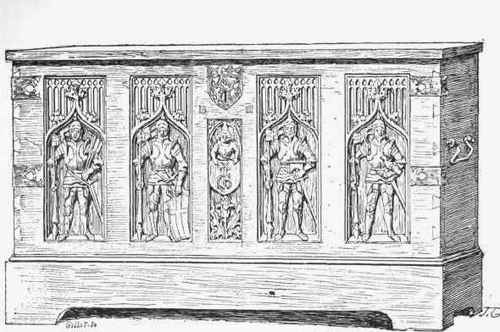
Walnut Chest of the Fifteenth Century. (Collection of M. A. Queyroy).
Continue to:


My Books

