


Gems of The East. Part 3
Description
This section is from the book "A History Of Furniture", by Albert Jacquemart. Also available from Amazon: A History Of Furniture.
This section is from the "" book, by .
Gems of The East. Part 3
Vitreous quartz is frequently worked in all its spotless purity. But whenever the lapidary happens to light upon a mass in contact with heterogeneous substances, or accidentally discoloured by infiltrations coeval with its formation, he spares himself no pains to give full effect to its rareness and peculiar character. In the case of a partially-smoked piece of crystal, he will conjure up a statuette whose head, animated by a brownish and warm tint, contrasts effectively with the hyaline purity of the dress. He will employ the same cunning with amethysts and camelians passing from red to white. Elsewhere we see a rock crystal, certain nodules of which have been coloured by chrome or delicate green; here the artist has so disposed the components, that the green portions appear as foliage raised on the ground, or perhaps give life to the wings of a cricket alighting on a flower of the magnolia (yu-lan).
Rut the skill of the Chinese lapidary achieves its greatest triumph in dealing with masses of chalcedony, in combination with all the other varieties of quartz. By ingenious touches he will contrive to carve out a cup of light chalcedony, shaped like a pomegranate with brown stems, upon which is perched a bird of a dull white hue, for which a vein of camelian has been utilised, while further on are creeping snails found in the crystal nodules, or some of those green-winged crickets above mentioned. In all this there is something more than mere Art; there is an audacity in facing and overcoming difficulties of a far more arduous nature than that needed for cameos of various layers. For has not the workman been compelled, day by day, hour by hour, patiently and bravely to adapt his imagination to the caprices of the raw material? In dealing with such materials, no design can be thought out beforehand, it being impossible to know whether the principal nodule will prove of regular form, or whether the veins accompanying it are constant or merely accidental. Ready for all emergencies, prepared to take advantage even of faults in the stone, the artist thus gropes his way for months and years over a pebble, whose real value he will ascertain only after the last stroke of the chasing hammer has been delivered. Such objects can accordingly have no appreciable market value. Each is a treasure in itself, necessarily of a unique character, the owner of which is confident that it can never be rivalled.
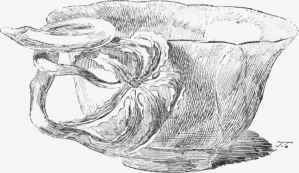
Milk white Jade Cup, cut to the form of a flower. Ancient Chinese work. (Paris Geological Museum.).
But we must leave these miracles of ingenuity to return to more ordinary topics. Here are multitudes of charming little figures of deities intended for the domestic altar, enshrined in portable lacquer chapels, whose study, both as regards their workmanship and material, might detain us, and supply subject matter for pages of interesting descriptions Then come articles of the toilet, necklaces of mandarins, with emblematic pendants, expressing the rank of the dignitaries by whom they are worn, girdle plates of a similar nature, where on one side are produced on a perforated ground the emblems of the order of nobility, while the reverse, also perforated, shows some ornamental work of quite a different character. This is doubtless all very wonderful, yet it is surpassed by the delicacy of the female trinkets, more especially the hair pins and other arrangements for the head.
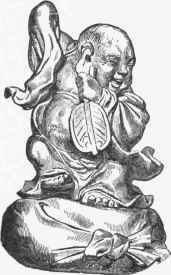
Figure of Pou-tai, God of Contentment.
From all this we see what a boundless field is opened to the curious in such things, what a rich harvest is promised to the collector by the gem engraving of the eastern nations. After handling and examining these interesting objects, on which may at times be read complimentary or votive legends, one cannot but regret never having in any instance met with the name of an artist inscribed on them. We should naturally like to pass beyond that general feeling of vague admiration inspired by all these specimens of Chinese workmanship, and reward the actual authors of the more striking objects, by perpetuating their renown, and teaching posterity to venerate their names.
Continue to:


My Books

