


Objects Of Art Derived From Statuary. Chapter I. Marble - Stone - Alabaster
Description
This section is from the book "A History Of Furniture", by Albert Jacquemart. Also available from Amazon: A History Of Furniture.
This section is from the "" book, by .
Objects Of Art Derived From Statuary. Chapter I. Marble - Stone - Alabaster
In order to sketch a history of monuments sculptured in marble or stone, it would be necessary to go back to remote times, to examine the ruins of temples and palaces, reconstitute extinct civilisations, and seek the influences which manners, religions, events themselves, have exercised on the genius of artists.
Such a history is to be done; and materials begin to accumulate, thanks to the modern spirit of inquiry, and to the analytical spirit of present criticism. But this is not the place to approach such a subject, and we must confine ourselves to casting a rapid glance upon such objects of reduced dimensions as are suitable for the interior of houses, whether to furnish and enrich their galleries, or to decorate the etageres of the collector. Busts, rare bas-reliefs, statuettes of genii, are the objects most frequently met with.
The middle ages, doubtless more rich and more varied, can offer their marble and their stone, in which the richness of painting is often combined with excellence of form. As soon as the churches began to be covered with paintings or hangings, it is easy to understand the contrast between the building thus decorated, and the white and cold reliefs of sculptured stone. Efforts were accordingly made to adorn the works of the chisel. There is at Cluny an Italian bas-relief of the eleventh century, representing St. Panta-leone, in which the white marble has been relieved by incrustations of coloured pastes. There is, further, a bas-relief of the twelfth century, in the Byzantine style, representing Christ seated on his throne, his left hand resting on the Scriptures, his right raised in the act of benediction; in this case the black marble has been heightened with gildings and vitreous pastes.
Shall we speak of the statues and bas-reliefs of the thirteenth and fourteenth centuries, cut in marble or stone, and entirely covered over with paintings? No, the list would be too long. We would only refer to the altar-piece (retable) of the Sainte-Chapelle of Saint-Germer, constructed by Pierre de Wuessencourt in 1259, but now unfortunately much multilated. From it an idea may be had of the exquisite grace attained by artists in the disposition of the figures, all delicately coloured and raised on a ground of gauffered and gilded paste, applied to the stone. We may also refer to the celebrated figures of Carthusian friars, sculptured by Claux Sluter, painter of sculpture (imagier) to Philip the Bold, Duke of Burgundy, and which formerly adorned the tomb of that prince in the Carthusian Monastery at Dijon. The monument was destroyed in 1793, together with the mausoleum of Jean sans Peur and Marguerite of Bavaria, constructed in 1444 by their son Philip the Good.
Before going further, let us say a word on alabaster, a material much in vogue from the thirteenth century, and which has since been often employed. It is nothing but a variety of the carbonate of lime, which furnishes statuary marble and other more or less compact materials, from the ordinary calcareous stone of the builder to the compact limestone, properly so-called, and which is more specially known as the lithographic stone, or of Pappenheim, Speckstein, and Kehlheimerstein. Alabaster is therefore the stratified carbonate of lime, vulgarly called stalagmite, which is formed in undulating layers by water dropping on the floors of caverns, and perpendicularly beneath the stalactites. These compact masses, when sufficiently bulky, are employed in the arts, where their fine grain and translucent appearance adapt them for the most delicate works. When the layers are variously coloured, that is to say, alternately white and honey yellow, it is called oriental alabaster, and this species is reserved for ornamental vases. The Egyptians employed it particularly for their canopic vases with heads of divinities.
Alabaster groups are somewhat rare, but one may be seen at Cluny, representing the Virgin carrying the Infant Saviour. In the same museum are also a considerable number of bas-reliefs of the fourteenth century, one of them, the Coronation of the Virgin, very remarkable for its intricate design. There may also be mentioned a Holy Trinity, a fragment from St. Denis, the Virgin in her glory, an ex-voto with the figure of the donor, and a quantity of other religious subjects which formed parts of altar-pieces. Many of these sculptures are adorned with fillets and ornaments of gold. There is even one representing St. Ursula, in which the material has disappeared beneath the colouring and the gold.
At these remote epochs it is naturally difficult to discover signatures or monograms; it may not therefore be uninteresting to quote the few names that have been handed down to our time:-
1300. Andrea Pisano, † 1345,
1364. Andrieu Biauneveu, "ymaigier" of the Duke of Burgundy.
1379. Jehan Duffle, Hannequin Godefroy. Tassin Croiz, carvers of images.
1382 Henry of Brussels, Michelin. masons.
1397. Gille de Gult, of Lille, statuary.
1399. Jehan de Marville, Claux Sluter, Jacques de Baerze, called "de la Barse ;"
Claux de Verne, called " de Vouzonne," nephew of Sluter, all " ymaigiers," in the service of the Duke of Burgundy.
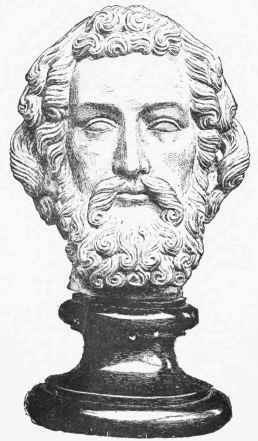
Head of St. Mark, carved in stone: thirteenth century. Fragment from the Sainte-Chapelle, Paris. (M. Ed. Bonnaffe's Collection).
The fifteenth century, a period of transition, presents the remarkable spectacle of an open struggle between the past and the new ideas. In the north the pointed style, now in its full development, continues to offer us its long figures, with their elegant and intricate draperies, but utterly divested of careful study in the forms. Coloured sculpture also still holds its ground even in marble, so that certain works of the same date might be supposed to be separated by a century.
Continue to:


My Books

