


Sec. 3. - Ebony Furniture Encrusted With Ivory, Or Carved
Description
This section is from the book "A History Of Furniture", by Albert Jacquemart. Also available from Amazon: A History Of Furniture.
This section is from the "" book, by .
Sec. 3. - Ebony Furniture Encrusted With Ivory, Or Carved
At what period ebony came to be used in cabinet work is a point which remains to be decided, but which is of little importance; oak and walnut satisfied the wants of sculpture, and gave a suitable ground to incrustations of coloured wood, and it is precisely at the time when these incrustations appeared to gain favour, and show themselves accompanied by brilliant stones, that ebony makes its appearance, - a rebellious material to work, of sombre effect, and which, especially when associated with ivory, assumes a truly mourning aspect.

Ebony cabinet in two parts, carved with various subjects, among which are the continence of Scipio and the twelve months of the year, French work of the period of Louis XIII. (Collection of Baron de Boissieu).
Yet it is Italy, the land of supreme elegance, which gives the first impetus not only in the working of this wood, but also in the idea of those white incrustations on a black ground called scagliuola, which formed the tops of tables similar to that of which a fragment exists at Cluny.
It is at the end of the sixteenth century that we must place this peculiar manifestation of art. What could then have been passing in the minds of the people ? Was it not towards this period that the court of France adopted funereal trinkets, and that cross-bones and death's-heads appeared on the dresses of ladies devoted to the pursuit of pleasure?
Whatever may be the cause of this innovation, its first manifestations are of exquisite delicacy and taste. The charming cabinet, Italian " stipo," lent by Baron Alphonse de Rothschild to the Exhibition of the Corps Legislatif, will not be forgotten; of architectural structure, like all the furniture of the period, it had a projecting centre with triple pediment, supported by engaged columns; numerous drawers filled both sides, and were hidden by the middle door. The refined beauty of its construction is lost, so to say, as compared with the details of its ivory incrustations of incredible delicacy; every frieze, every panel, however small, represented episodes of mythology or of sacred or profane history; there was even a place for simple hunting scenes. These subjects, cleverly cut, and heightened by engraving of remarkable talent, seemed to have been treated by the petits maitres of the Renaissance themselves, so elegant was their freedom of style, so firm and pure their design. The cabinet of the Cluny museum represents this style in a more ordinary form; but in one of its details, it seems still more to heighten the melancholy type of which we spoke at the beginning - its bronze ornaments are silvered. Nevertheless, M. Foule's cabinet contains an interesting variety of ebony and ivory work. There the two materials are equally balanced, and the general aspect becomes soft to the eye. Ivoried figures placed in the niches or on the rise of the pediments, first attract the light and illuminate the whole; the columns with their fine and close graving assume a grey shade which harmonises between the black of the ebony ground and the base, boldly overlaid with ivory with black incrustations. This curious piece is also Italian, for the closed panel bears a map of the peninsula and plans of Rome and Naples.
Is this incrusted ebony work special to Italy ? We do not think so, and we have seen many works which appeared to indicate the taste and style of France. Still, the monuments are too scarce and the duration of the fashion too ephemeral to admit of any positive opinion being given upon them.
Ought we to connect a neighbouring invention which contained the germ of Boule marquetry with the period and the idea of ivory incrustations? We mean the rare articles in ebony incrusted with large branches of scrolls and arabesques in graved pewter or white metal. The effect is still more gloomy than that of ivory, the two shades contrasting more harshly with each other. We have seen pieces in this style, the elegant decoration of which might equally express Italian taste or French genius; the foliage was abundant and choice, the masses well poised; it was not the Renaissance with its ancient reminiscences, and it was not yet the art of the century of Louis XIV. with its palms, shells, and hanging festoons, its canopies and its draped masks. It seems to us possible, therefore, to attribute these works to the beginning of the reign of Louis XIII., and to see in them the dawn of a taste peculiar to the seventeenth century.
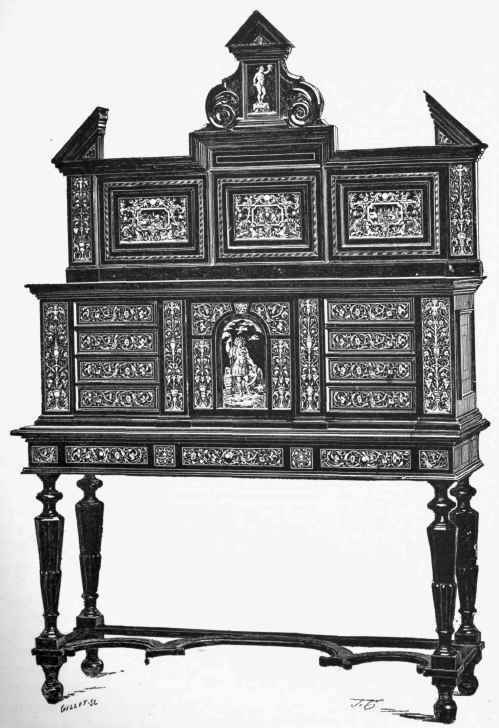
Ebony cabinet incrusted with ivory; Italian work of the end of the Sixteenth Century (Milan).
This is one of the difficulties inherent to archaeological research; at every step intermediary specimens are to be met with, leading from one style to another, verging on the same periods, and preventing a clear and positive classification. We wish to discover the inventors of styles, determine the character of new decorations as a whole - and we find that an uninterrupted chain connects human conceptions, that nothing has been conceived entire, and that Time, from one modification to another, and from progress to progress, is the great artisan of these changes, the complete evolution of which constitutes fashion, and which are in fact but the adaptation of things to the wants as well as to the tendencies of each age.
Ebony incrusted with ivory represents the last expression of the taste of the Renaissance; graved pewter was analogous, employed for inlaid work in furniture of large dimensions; ebony alone, carved and graved, is a sort of transition between different customs and a new art, feeling its way. When it makes its appearance, - that is to say under Henry IV. and Louis XIII. - furniture begins to acquire stability and development, the cabinet becomes a cupboard (armoire); the chest (bahut), furnished with doors, has increased in bulk, and will soon receive the name of commode. On beholding at Cluny these masses which are as heavy in reality as they are ponderous in appearance, it can be understood that it is no longer a question of removing all this on the back of mules. There are also to be seen amongst them some works which are very remarkable for their skilful sculpture; animated combats framed with garlands carved with a boldness which seems to defy the hardness of the material. In the larger pieces of furniture we trace the influence of contemporary architecture; there are the twisted columns brought into vogue by the famous altar of St. Peter's at Rome, or else columns fluted at the top and covered at the base with that capricious vegetation which we find again at the Tuileries, and in the Louvre of Catherine de Medicis.
Hans Schwanhardt, a German artist (died in 1621), had invented the undulated mouldings which became multiplied to an excess. On the lateral panels of the furniture appear in deep cut graving, large bouquets of natural flowers in which tulips and double anemones predominate, bouquets which we see represented in the goldsmith's work, in enamelling, and embroidery and in everything connected with furniture or costume.
There are some pieces in this style, however, which are very commendable, and above the ordinary level; we may quote the magnificent looking glass frame of M. Foulc's collection, and another exhibited at Cluny. Failing other names, we mention that of Pierre Goler, a Dutchman, who was specially attached to the service of Mazarin, and who proved his superiority in the handling of a wood so difficult to manipulate.
We must repeat that ebony carved like that incrusted with ivory has a melancholy appearance; about the first third of the seventeenth century, therefore, the idea originated of lighting up the interior of cabinets by veneered tortoise-shell forming frames to paintings; if some writers are to be credited, Rubens himself did not disdain to use his pencil in this style of decoration; we have seen many pieces of furniture which, if they were not his, at least belonged to his school. But it was in Flanders that this description of furniture was most particularly in repute, and it is quite natural to trace in it the style and gorgeous colouring of the greatest artist of the age.
Continue to:


My Books

