


Sec. 6. - Furniture Overlaid With Tortoise-Shell And Metal
Description
This section is from the book "A History Of Furniture", by Albert Jacquemart. Also available from Amazon: A History Of Furniture.
This section is from the "" book, by .
Sec. 6. - Furniture Overlaid With Tortoise-Shell And Metal
Of all sovereigns Louis XIV. is certainly the monarch who best knew how to surround the majesty of royalty with the most dazzling splendour. He required sumptuous edifices for his habitation, and if Versailles as a palace realised his dreams, he still required that the furniture destined to fill those galleries glittering with glasses, gildings, pictures, and sculptures, should be worthy of such companionship, and should exhibit a magnificence unknown until that day. Logical in his conceptions, the king understood that he must entrust the manufacture of the carpets, furniture, and plate to real artists. In order to gather round him the most talented, he at first granted apartments in the Louvre to each of those who had distinguished themselves by works of uncommon merit; then, in 1662, to create a necessary harmony amongst the different works, and submit individual compositions to the guidance of one common intelligence, he centralised the various workshops at the Gobelins, placing them in 1667 under the direction of Lebrun, his first painter; who, when he died in 1690, was succeeded by Mignard; this was the decline.
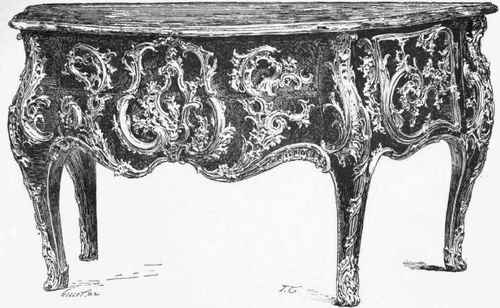
Largo Commode with "bombe" front of rose and violet wood, decorated with bronzes chased by Caffleri, period of Louis XV. (Collection of Sir Richard Wallace).
Amongst those whose conceptions of furniture were such as Louis XIV. and Lebrun desired, we must mention above all Andre-Charles Boule. Had he previously tried his skill in styles already known, as he was afterwards to try it in those which were to become the fashion after him? This may be probable. But he did not find in them the splendour he aimed at attaining; he therefore conceived the idea of constructing furniture in ebony, and covering the large surfaces with inlaid work of tortoise-shell, cut out and incrusted with arabesques, branches of foliage, and ornaments in thin brass and white metal, and sometimes enriched by elaborate graving of the burin. This brilliant mosaic work was also accompanied by bas-reliefs in bronze chased and gilt, masks, scrolls, mouldings, entablatures, encoignures, forming a framework for the whole, and distributing luminous points of attraction calculated to prevent the eye from being bewildered in a dangerous glare.
To give the desired exactness to the work of incrustation, the artist imagined the plan of superposing two plates of equal size and thickness, one of metal, the other of tortoise-shell, and after having traced his design, cutting them out with the same stroke of the saw; he thus obtained four proofs of the composition, two at the base where the design appeared in hollow spaces, two ornamental, which when placed in the spaces of the opposite ground piece, inserted themselves exactly, and without any perceptible joining. The result of this practice was seen in two different and simultaneous pieces of furniture; one, designated as the first part, was the tortoise-shell ground with metal applications; the other, called the second part, was appliqu6 metal with tortoise-shell arabesques. The counterpart therefore being still more rich than the type, the pieces were arranged with crossed effects, as may be seen in the Galerie d'Apollon, where the consoles are of the two descriptions. Boule did more, and in his great compositions, he found means to add to the splendour of the effect, by simultaneously employing the first and second parts in suitably balanced masses. This assemblage was seen in all its perfection in the great piece of furniture belonging to Sir Richard Wallace, which appeared at the Exhibition of the Corps Legislatif.
While admitting the good effect as a whole of the two styles invented by Andre-Charles Boule, we must insist on the point that the first part should be held in higher estimation as being the more complete. Let us take for example, one of the beautiful types issued from the hands of the artist, and we shall see with what intelligence the elaborate graving corrects the coldness of certain outlines; the shells trace their furrows of light, the draperies of the canopies fall in cleverly disordered folds, the grotesque heads grin, the branches of foliage are lightened by the strongly marked nerves of the leaves, according to the importance of the masses; everything lives and has a language. Observe the counterpart; it is but the reflection of the idea, the faded shadow of the original.
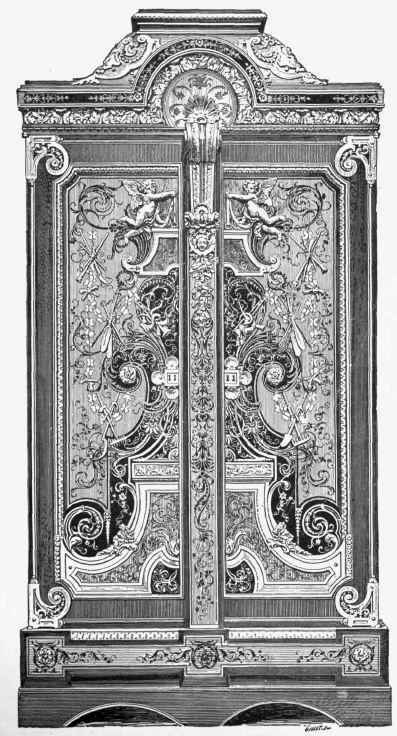
Cabinet of ebony with Boule marquetry. (Mobilier de la Couronne).
Boule furniture was that best adapted for the gigantic saloons and state apartments required in the reign of Louis XIV. Those large inlaid console tables admirably filled the piers between the windows, and were laden with vases of goldsmith's work, jasper and porphyry with gilt mountings, and chased garlands reflected back by innumerable mirrors.
As for real furniture, such as could serve for private life, it was most rare. We meet with tables, bureaux, and even medal cabinets in small number; a commode exists in Sir Richard Wallace's collection, but it is so far from meriting its name, its details are so heavy, that we feel the desire for display revealed beneath this concession made to ordinary furniture; a few caskets and inkstands, the necessary accompaniments of the bureau, armoires and bookcases, angle cupboards (encoignures) and this was all.
Boule, however, creates a school; Andre-Charles, designated in old catalogues as Boule le pere, had four sons, nephews, perhaps, in any case a great many pupils; the style and perfection alone of his works would cause them to be recognised and distinguished from counterfeits. The greatest choice lies in the innumerable religious time-pieces, either terminal or placed on hanging brackets; his are always surmounted by figures or groups of marvellous execution, and the bas-reliefs which appear underneath the dial, are no less remarkable, and in complete harmony with the incrusted decorations.
To acquire skill in recognising the hand of the learned inventor of this style, it will suffice to examine attentively the pieces which fill the Galerie d'Apollon, and others distributed in the Louvre in the salles of drawings which sheltered them after the destruction of the royal residences. Amongst others will be remarked a magnificent armoire, in which marquetry in camaieu occupies a considerable space; the two upper panels display vases filled with flowers, with mouldings of metal incrustations of the finest execution. The shades are so well combined that the brass and tortoise-shell do not spoil the effect of the wood marquetry, and the latter does not attract the eye to the detriment of other ornamental designs.
We feel pleasure in attributing this judicious taste to the eminent man from whom Louis XIV. acquired his royal furniture; and we place to the account of the sons and successors of Boule the over gaudy articles in which the tortoise-shell parts are replaced by horn, tinted blue or vermilion; this unseasonable polychromy takes from the compositions their severe majesty as well as their rich and serious harmony. Most of these deviations may be attributed to Philippe Poitou, an imitator of the master, who became the king's marquetry worker in 1683. It is rare, as we said before, for a continuator not to aim at greater perfection by exaggerating his model. Certain it is, that the style prevailed during the greater part of the eighteenth century; it was towards the middle of this century that Oebenne, a marquetry worker, who bad become celebrated more from his magnificent carved frames than from his furniture, also styled himself a pupil of Boule; he doubtless alluded to one of his sons.
At the present day connoisseurs have to be on their guard against different sorts of counterfeits; many of the old pieces of furniture in the Boule style have had their panels destroyed and replaced by pieces of lacquer, sometimes they have even been imitated by preserving and restoring the framework of incrusted ebony. There have been seen indeed some Boule pieces with oriental lacquer; but they are very rare, and the foreign pieces in them were selected with great care, and from amongst those of the first quality.
As for the complete imitations, it appears to us superfluous to dwell upon them; there is so little affinity either in style or workmanship between these pieces and the originals, that it would require a thorough novice to be deceived.
Continue to:


My Books

