


The Gobelins
Description
This section is from the book "A History Of Furniture", by Albert Jacquemart. Also available from Amazon: A History Of Furniture.
This section is from the "" book, by .
The Gobelins
Let us now return to the establishments of the city of Paris under the reign of Louis XIII. After having travelled from the Trinite to the Jesuits, from the Jesuits to the palais des Tournelles, then to the place Royale, and to the Louvre, the manufactory of Flemish tapestries ended by becoming established in 1630 in the house of the Gobelins: it was a dyeing house, the origin of which dated from the fifteenth century, and the reputation of which was immense; its works kept pace side by side with those of the royal tapestry weavers. At the time when the latter took possession of the house of the Gobelins, the workshops were directed by Charles de Comans, and Raphael de la Planche, sons of the Flemish workmen who were called by Henri IV. in 1607 to found the establishment of the Tournelles. But after some time, Raphael de la Planche quitted his associate and established himself in the faubourg Saint Germain* and in 1658 Charles de Comans sent to the contemporary expression, were issued? M. Francisque Michel is of the affirmative opinion, and relies in this instance on the following passage of the Memoires inedits de Louis-Henri de Lomenie, Comte de Brienne: " Who does not know that the finest tapestries of Flanders and Spain, Italy and France, were in his apartments (Mazarin's)? Suffice to
Could it be from this establishment that the tapestries faites a la Planche, according to Audenarde for Jean Jans, who four years later received the title of the king's tapestry worker.
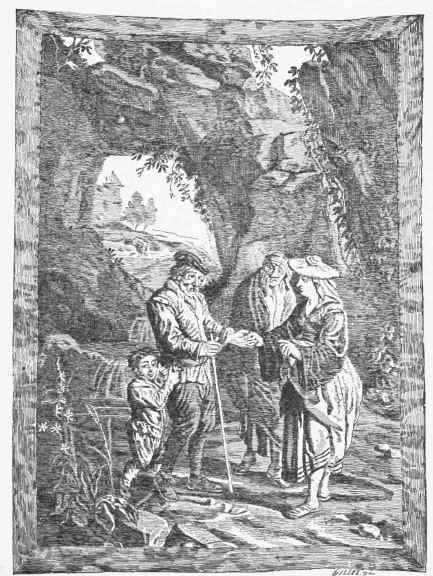
Gobelins tapestry, the Fortune Teller, after Teniers, leaf of a screen. (Collection of M. L. Gauehez).
During this time a new workshop was established in the gardens of the Tuileries, in favour of Pierre and Jean Lefebvre, father and son, high-warp tapestry weavers, sent for from Italy in 1642, and installed first at the Louvre.
It was in 1662 that Louis XIV. and Colbert centralised at the Gobelins all the workmen employed for the monarch, that is, not only the tapestry weavers, but the embroiderers, goldsmiths, casters, gravers, and chasers of metal, cabinet-makers, etc, so that the establishment took the name of "Royal manufactory of the Crown furniture." In 1663, Charles Lebrun was named director, but the edict of foundation was only published in 1667. M. Cousin has transcribed it in cxtenso in the "Archives de l'Art francais, Vol. VI.," in which may be seen what privileges were granted to our industrial artists.
The direction of the tapestry manufacture was at first entrusted to Jean Jans, to whom were successively added Girard Laurent, Pierre and Jean Lefebvre, high-warp weavers, Jean de la Croix, and Mozin, low-warp weavers.
It may possibly not be useless to explain here, in what consisted these two styles, which were at several different times united at the Gobelins, or separated in special workshops. We borrow here the excellent description of the looms given in the historical notice of M. Lacordaire. " In weaving tapestry, all the coloured threads necessary for the work cannot be carried from one end to the other of the warp, as in ordinary figured tissues. There would be too great a loss of thread, and too great a thickness in the tissue, as all the threads of each duite, although concealed, would have been imprisoned by the woof. It was necessary therefore to invent a partial weaving which economised the etoffes (it was thus they termed the woollen or silken threads destined to make the woof), and avoided the complications of ordinary weaving with a large number of threads, and lessened the thickness of the tissue. This work is executed on looms the warp of which is sometimes vertical and sometimes horizontal. The pieces of wood of the framework which are parallel with the warp, and which hold on one of the extremities the cylinder on which the warp is rolled, and at the say that the ' Scipio' of Marshal Saint-Andre, and the ' Acts of the Apostles' of the late Lopez, a Portuguese Jew, had come to him I know not how. The King of Spain made him a present of the ' Labours of Hercules,' executed after designs of Titian, and, if I am not mistaken, they were enriched with gold, and don Louis de Haro gave him an excellent hanging of tapestry, of Bruges mauufacture, representing the twelve months of the year, copied with much care from the designs of a Flemish artist, pupil of Raphael. . . Beside these, he had at least thirty other tapestry hangings, some painted at Rome on cloth of silver, others on gold brocade, with velvet flowers of various colours cut out at Milan, and applied to very rich velvet groundings, at great expense and wonderful cunning; Flemish 'verdures' in abundance; antique tapestries of every description, and modern ones made at the Louvre, d la Planche, at the Gobelins, etc" other end that on which the woven tissue is rolled, these pieces of wood, or 'lisses' rise vertically in the first case, and are parallel with the ground in the second. Thence arose the name of high-warp looms (metiers a haute lisse) for the first mentioned looms, and of low-warp looms (metiers a basse lisse) for the second, and thence the name of high, or low-warp weavers, according as the weaving was executed on one or the other description of loom." We have already said that the smooth carpets of both sorts of looms are worked on the reverse side; only raised velvet or high piled carpets can be worked on the right side, because each thread being stopped and cut on the upper part, the manipulation is the same for all, whether the same thread is frequently used, as in the groundwork, or that it varies from one point to another, as in flowers and ornaments.
Continue to:


My Books

