


Chapter III. Tissues - Stuffs
Description
This section is from the book "A History Of Furniture", by Albert Jacquemart. Also available from Amazon: A History Of Furniture.
This section is from the "" book, by .
Chapter III. Tissues - Stuffs
The weaving of textiles dates from the remotest ages of the world, and even now we are struck with amazement at the perfection of the works produced by the hands of the ancient Egyptian craftsmen. With the primitive looms and materials spun by the hand, they obtained most wonderful tissues, from that description of thread velvet which may be seen in the Museum of the Louvre, the fine long pile and fringed material, called "fimbria," to that transparent fabric styled by the Latins "nebula linea" (linen cloud), which we shall again meet with in the East at Mossul, whence it reaches us under the name of muslin.
The scope of the present work, it will be readily understood, will not permit of any extensive historical inquiry into the textiles of ancient times. For these we must refer the reader to the learned works devoted to such subjects, and more especially to the two valuable volumes of M. Francisque Michel : "Recherches sur la commerce, la fabrication, et l'usage des etoffes de soie, d'or et d'argent," and to the more recent work of M. Dupont Auberville.
In fact, had it been our intention to depart from the general plan sketched at the head of this volume, we should have commenced with the textiles, relegating tapestry and embroidery to a subordinate position, as dependent on or complementary of the other. But as regards furniture and its history, the reverse order having been imposed upon us, woven fabrics become an accessory. For our present purpose we are less interested in their nature and manufacture than in their ornamentation, and the influence that such ornamental work may have had on art in general.
Rearing on this point, the fact we would at the beginning establish is the early importation of painted or printed stuffs from India, which, spread throughout the Greek and Roman world under the names of "Othonia" and "Sindones," created such admiration that they began to be used as garments for the statues of the gods. It must however be confessed, that in ordinary life, the people of light conduct alone ventured so to adorn themselves. But the effect was produced, and the singular animals and capricious ornaments on these stuffs suggested the idea of the decoration which we call arabesque, and which, amongst the ancients, assumed an aspect at once serious and graceful.
Silk was undoubtedly the fabric which, excellent above all others, was destined to stimulate luxury by adapting itself to the most sumptuous uses. Coming originally from China through the trade with Phoenicia, Syria, and Persia, it aroused all the more enthusiasm from its true nature not being suspected; the mystery of its production thus enveloping it in the additional aureola of mystery. When the spread of her empire brought Rome in contact with the great emporiums of trade, silk achieved fresh and amazing triumphs, being at times sold for its weight in gold. Tunics of pure silk were called "holoserica" or " holovera," while "subsericum" was a silken fabric with a cotton weft. Towards the time of Ileliogabalus the taste for these materials was greatly developed.
When, after the invasion of Italy, the Empire became limited to Constantinople, its degenerate sovereigns, inclining more towards Oriental manners, adopted the luxury of the eastern nations, thereby increasing the fashion for rich materials, and creating for Persia an extremely lucrative trade.
In the fourth century, however, Justinian took measures to emancipate the empire from such an onerous burden. Learning that two monks had travelled in China, and there discovered the secret of the treatment of silkworms, he ordered them to return to that country and fetch thence the eggs necessary to attempt their acclimatisation. The envoys, with pains and perseverance, succeeded in their undertaking. They concealed some eggs in the hollow tube of bamboo canes; these eggs they kept warm by laying them on little beds of manure, and when hatched, they fed the young worms with the leaf of the wild mulberry. Thus, after enduring countless hardships, they at last reached Constantinople, and were privileged to endow Europe with the first elements of one of its choicest industries.
The breeding of silkworms succeeded very well in the neighbourhood of Constantinople, in Syria, Greece, and especially in the Peloponnesus. But in the war undertaken by Robert Guiscard against Greece, Roger of Sicily having made himself master of this country, is said to have brought away as captives Theban and Corinthian artisans employed in the weaving of costly fabrics enriched with gold. These he settled at Palermo, capital of Sicily, ordering them to instruct his subjects in their art. It was thus, says Otho of Friesingen, that this industry ceased at last to be a mystery for the Latin races. This generally accepted opinion, however, is questioned by several writers, and especially by Sig. Amari. If the Greek workmen were not really brought to Sicily till the year 1146, they must have already found the silk industry regularly established in Palermo. A proof of this is inscribed upon the magnificent mantle still preserved in the Museum of Vienna. The silken fabric is divided into two segments by an ornamental palm tree (the hom) laden with its fruit. At its foot are two groups composed each of a lion with his head thrown fiercely back, and falling upon a camel. Round the border runs this inscription in Cufic, or old Arabic characters: "(This mantle) forms part of what was made in the royal manufacture where reign happiness, honour, prosperity, success, merit and distinction, which can rejoice in a great aggrandisement and a glorious prosperity, great liberality, and great splendour, glory and splendid endowments as well as the fulfilment of hopes and desires; where the nights and the days ought to flow in pleasure without end or change, with the sentiment of honour, devotion, and participation in happiness, and the preservation of prosperity, of support, and of suitable industry (in the capital of Sicily the year 528 of the hegira)".
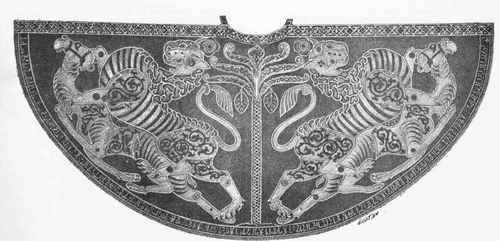
Coronation Robe of the Holy Roman Empire, preserved in the Treasury at Vienna.
Continue to:


My Books

