


Embroidery in the East. Part 2
Description
This section is from the book "A History Of Furniture", by Albert Jacquemart. Also available from Amazon: A History Of Furniture.
This section is from the "" book, by .
Embroidery in the East. Part 2
A type apparently peculiar to Persia is that in which the chain-stitch fixes and sets off a true mosaic in cloth of diverse colours. Here it is a chamois cloth bordered with arabesques, in which rich bouquets are finished with a foliage or expand into a sheaf. There we see porticoes and vases in pure embroidery, as on the devotional carpet. But the most curious specimen we observed at the Exhibition of Costume was a carpet, in the centre of which was represented a woman attired in a red dress with a rich head-dress, a poniard in her girdle and a rose in her hand. Here the artist had not found in stuffs and silks the materials needed to realise the elegancies he dreamed of, so for the head-dress, the hilt of the poniard and other accessories he had recourse to spangles, resembling gold, to diamonds and precious stones.
We have met with the same trick of fancied richness in certain Siamese embroideries. On a simple scarlet cloth there were attached ornaments cut out in gold paper, and embellished with large mica spangles. The effect was most dazzling.

Chain-stitch embroidery on delieatc blue ground ; Indian work, made for Portugal. (Collection of M. J. Jacqucniart).
Returning to the Persians, the chain-stitch embroideries are occasionally arranged as borders upon the simple cloth. Hunting scenes in this manner have been noticed, characterised by the presence of birds larger than the riders and their mounts together, one of them containing the symbolical figure of a bird with a woman's head.
Amongst the female attire, some dresses arc embroidered an passe with large red flowers, with ornamented foliage and portions set off in gold. This passe is worked very loosely with magnificent twisted silks, producing at the first glance the effect of an embroidery in chain-stitch.
We shall not dwell upon the Mussulman embroidery, although it is much in vogue in Constantinople, and widely diffused throughout the rest of Turkey, and although it contains the various kinds just described, that is to say, the chain and passe, and mosaic on coloured cloths. Rut these types arc here generally practised by Persians, who thus continue elsewhere their own national traditions, or by Italians, whose style has undergone no change since the beginning of the eighteenth century, when they first migrated thither. Hence the rococo taste continues still to flourish, notwithstanding the changes in the fashions of the West, and has contributed to that generalisation of bad taste, which has at last come to be regarded as the special characteristic of Turkish art. We have seen gorgeous porticoes with twisted columns, worked upon satin in gold relief, lit up with spangles and tinsel, sustaining a suspended lamp surmounting a larger vase filled with flowers. To judge from their style and manufacture, one might fancy that such things had come from the ateliers of the most eccentric embroiderers of the time of Louis XV. Quite recent pieces were characterised by a precisely similar style of art. These were little round cloths or mats in pink or sky-blue silk, which serve for a somewhat curious purpose. They are used to cover the trays on which are successively brought in covered vessels, the various dishes served up at an entertainment. This is the last trace of the dread of poison so universally diffused during mediaeval times, and which made it a matter of obligation to serve up the dishes to great personages in closed vessels, to be opened only in their presence, and even then they were further tested by talismans, unicorn's horns, and other wonderful specifics vaunted by superstition.
As regards the Arabs, their embroideries, done on linen, light or woollen fabrics, commend themselves by a very pure taste in which we seem to detect a remote reminiscence of the last Sassanides. Further on, in the chapter devoted to textiles, we shall have to describe the marvellous silken fabrics woven by the Arabs in Palmyra. This will suffice to enable the reader to form an idea of the style of their embroideries. It will be enough to give here the type of a charming piece of embroidery or linen in soft coloured silks. Pigeon-grey, blue and white suffice to reproduce, by means of various stitches, elegant foliage divided by ornamental stems, and from which spring a variety of flowers.
Nor did the Arabs neglect the mosaic work of divers textiles. We have seen a proof of this in the magnificent burnous of yellow figured silk, formerly belonging to the Dey of Algiers. Its front lining presented rich arabesques in bright red and blue silk, edged with twists of silver, black and gold.
The Arabs also seem to have been the first to have applied red silk to white cloth, in order to trace those groups of birds "affronted," and surrounded by ornamental foliage, analogous to the designs of the ancient woven fabrics of the East. This type seems to have subsequently passed into the islands of the Archipelago, thus ultimately reaching France through Italy.
We here reproduce the type of cushions embroidered in two colours in this style of ancient Morocco workmanship. The proof of their Arabic origin may here be detected; and the little lions of almost heraldic form disposed in the reserves, will also show the persistence of primitive designs and their faithful transmission from age to age.

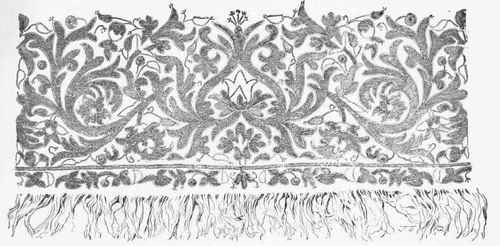
Embroidery in varied silks on cloth ground ; old Arab work. (Collection of M. J. Jacqucmart).
Continue to:


My Books

