


Chapter I. Tapestry
Description
This section is from the book "A History Of Furniture", by Albert Jacquemart. Also available from Amazon: A History Of Furniture.
This section is from the "" book, by .
Chapter I. Tapestry
WE will not here attempt to go back through centuries in order to find out what may have been those ancient Oriental or Egyptian carpets of which we have said some words; we will rather carry our investigations towards the West, and especially towards the periods which in some measure inaugurate our national history.
Dagobert, one of those kings who showed themselves ambitious for the progress of the arts, Dagobert, who caused the cathedral of St. Denis to be built, lavishing upon it marble, and all the wonders of the goldsmith's art, did not content himself with painting for its ornament; he had the walls and columns covered with hangings of gold enriched with pearls. D. Bouquet and Tritheme attest the fact of this magnificence, which, increasing with the progress of luxury, ended by completely substituting tapestry for painting.
It was, above all, through the monasteries that the modifications in the different branches of dawning industry were accomplished. They were to a certain extent the cradle of all human knowledge. Towards the year 985, Saint Florent, of Saumur, possessed an abbey where the monks wove tapestry ornamented with flowers and figures of animals. According to the text which recalls this fact, it would appear that they consisted of designs in red upon white ground, a style which was long kept up in the East, and which returned to Italy towards the commencement of the Renaissance.
In 1025, a manufactory of tapestry and carpets existed at Poitiers, to which place even the prelates of Italy sent their orders. In 1060, Gervin, abbot of Saint Ricquier, made himself remarkable by his purchases of hangings, and by the carpets he ordered to be made. These hangings already represented figures of animals, portraits of historical personages, and religious subjects.
Again, in the eleventh century, the north of Europe had progressed in the art of manufacturing carpets, and virtuosi may have noticed the reproduction of certain Scandinavian tissues in the Middle Ages and the Renaissance.
Saint Florent, on his part, had progressed; Mathieu de Loudan, abbot, in 1133, ordered hangings for his church representing scenes from the Apocalypse and wild beast hunts. Nevertheless, a formidable opposition was made against this manufacture by some establishments in Picardy and Flanders.
If we may believe a manuscript of the National Library, quoted by Francisque Michel, "Erec et Enide," the capital of the Limousin, also, had its manufactory :
Puis sen monta en unes loges lit fist un tapis de Limoges Devant lui a la terre estendre. . . Erec s'asist de l'autre part Desus l'ymage d'un lupart Qui el tapis estoit portraite.
Towards the close of the twelfth century, they began to make use in the Flemish manufactories of low-warp and high-warp looms, which they say dealt a mortal blow to the Saracenic tapestry.
What was this style of tapestry ? If we rely on what we have just quoted, we must believe that it was an embroidery in the Oriental style, which was executed without the aid of looms, and was especially copied from the works of the Saracens of Spain and Sicily. Some authors are of opinion, on the contrary, that the Saracenic tapestry was the work of the Orientals themselves, its importation being naturally lessened by the competition created by the French establishments. The following, however, are the indications which appear to testify in favour of the first hypothesis, which is also in conformity with the opinion of the Marquis de Laborde: in 1260, Estienne Boileau writes, in his "Livrc des Mestiers," "Quiconques veut estre tapicier de tapis sarrazinois a Paris, estre le puct franchement." Towards the year 1277, the low-warp looms were adapted to this fabrication, which succeeded in establishing itself and acquiring pre-eminence; so much so that in 1302, some high-warp workmen having requested that their trade should be placed under regularised protection, were incorporated in the Saracenic Guild. As for the style of workmanship, if it had been Oriental at first, it certainly became modified, as the following passage of the "Dues de Bourgogne" proves: "1389. A Jehan des Croisetes, tapicier sarrazinois, demourant a Arras, pour un tappis sarrazinois de l'istoire de Charlemaine." Robert Poincon was another Saracenic tapestry weaver who worked in 1390.
Nevertheless, tapestry kept on progressing; in 1348, Amaury de Goire delivered a most remarkable piece of tapestry to the Duke of Normandy; Charles V. ordered his from Arras, and they furnished him with the celebrated battles of Judas Maccabeus and of Antiochus. In 1396, Lebourebien, a citizen of Paris, executed for Queen Isabella of Bavaria, wife of Charles VI., a room of silken tapestry of several colours, which is one of the first works of purely civil and domestic use we meet with.
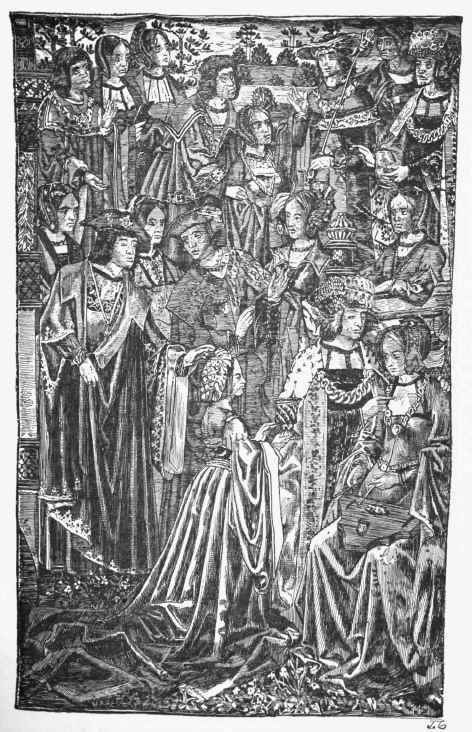
Flemish tapestry, the subject taken from a romance of chjvalry. (Collection of M. Dubonche).
At the end of the fourteenth century we still find some Parisian names among the tapestry weavers: that of Colin Bataille, who, in 1391, delivers the history of Theseus, and of the Golden Eagle to the Duke of Touraine; he also executes the histories of Penthesilea, of Beuves, of Anthone, and of the children of Renaud de Montauban, for the Duke of Orleans. Some years later, Jehan de Joudoigne and Jacques Dourdin or Dourdan, sent in a carpet of the Fountain of Youth to the same Duke of Orleans, and to the Duke of Aquitaine, the Credo, with twelve Apostles and twelve prophets, and the Coronation of Our Lady.
It is probable that most of the other names are those of merchants acting as intermediates between the buyers and the foreign manufactories.
In the fifteenth century, Lille, Arras, Valenciennes, Tournay, Audenarde, and Brussels, possess numerous establishments, and Philip the Good founds another at Bruges.
Continue to:


My Books

