


Hangings Tissues
Description
This section is from the book "A History Of Furniture", by Albert Jacquemart. Also available from Amazon: A History Of Furniture.
This section is from the "" book, by .
Hangings Tissues
WHETHER from a civil or religious point of view, the most ancient decoration of edifices and interiors consists in hangings, the accompaniment of statues, paintings, and mosaics. However far we go back into antiquity, we can trace their use; from the heroic ages, the Phrygian and Grecian women had succeeded in representing flowers and human figures, not only by means of embroidery, but in the tissue itself of elegant stuffs. The young girls summoned to take part in the procession of the Panathenaea, embroidered beforehand the veil or pcplum of Minerva, an enormous hanging which was to cover the hypaethron or roofless area in the temple of the goddess.
Homer shows us Andromache engaged in embroidery when the shouts from outside informed her of the tragic end of Hector. Finally, history has transmitted to us the memory of Helicon and Akesas, celebrated embroiderers, whose beautiful tapestries were preserved at Delphos; Akesas even introduced figures into his compositions.
We could endlessly multiply these examples of the use of, in ancient times, hangings ornamented with figures, but a confusion begins when it is necessary to determine the species of work. Herodotus, Strabo, and Arian leave us no doubt as to the existence in the West of painted linens manufactured in India long before the time of Alexander. Under the Ptolemies, Alexandria became the centre for the intelligent imitation of all the elegant tissues which the various nations of the known world produced. Under the direction of Greek artists, skilful workmen copied in high warp the smooth and velvet carpets, ornamented with figures, which were made at Babylon, and it is said they even surpassed the work of the Persians. Egypt also had its painted linens similar to those of the Indians.
Not having to follow the history of tissues through the course of ages, nor to inquire whether antique decoration could simultaneously employ the various species of which we find the names in ancient authors, we pass at once to the subject of this study, hangings used for the purposes of furnishing. We shall adopt, besides, a system in accordance with the importance of each style, that is to say, beginning with carpets and tapestries, followed by embroideries, which are almost connected with them, and ending with stuffs, which have had so visible an influence on the decorative arts since the first days of civilisation.
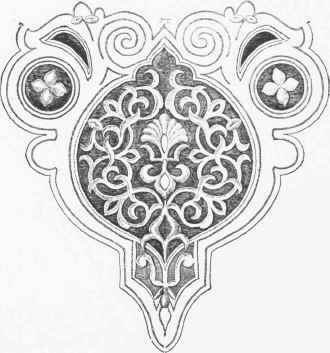
Oriental embroidery upon leather, with velvet appliques.
Continue to:


My Books

