


Sec. 10. - Furniture In Gilt Or Painted Wood
Description
This section is from the book "A History Of Furniture", by Albert Jacquemart. Also available from Amazon: A History Of Furniture.
This section is from the "" book, by .
Sec. 10. - Furniture In Gilt Or Painted Wood
In the rapid review we have just made of the principal descriptions of furniture, we have been obliged to neglect certain things, which it would have been difficult to classify regularly in general categories, and which it is more natural to collect in a sort of appendix, where all the accessories of furniture will be noted in order, from the framing of hangings, pictures, and glasses, to brackets and stands of every description, carved in wood, and covered with gilding or painting.
From the sixteenth century, hangings were modified; the carpets or leathers of Cordova, formerly moveable, were fixed in carved panels, on which either paintings or portraits were suspended, surrounded by their chassis (so they designated the frames) or by glasses with bevelled sides (a biseau), a Venetian work. Frames were then of primary importance in decoration; in Italy they were developed in redundant foliage, supporting' figures of geniuses; or crowned with a pyramidal composition on which appeared the escutcheon of the owner; sculptured in hard wood, such as oak, the most perfect of these works were gilded on the bare wood with a species of bright gold called ducat gold; others were coated with that white paste which is still used at the present day, and gilded on a light impression of vermilion. The beautiful frames of the Italian Renaissance are rare, and we must go back to the religious monuments, altar pictures, or triptychs, to see those in which the palmette borders, the pilasters with foliage and arabesques, display the genius of the initiators of the new style towards the end of the fifteenth century. The last years of the following century offer nothing more than redundant conceptions in which an exaggerated richness shows the decline of taste.

Lampholder (porte flambeau) of wood, gilded and Lacquered in colours. Louis XV. period. (Collection of M. Castellani, Rome).
In France on the contrary, this period is still remarkable; we owe to it the fine looking-glass frame of the Sechan collection, in which two geniuses support a medallion ornamented with interlaced cyphers, and surmounted by a coronet.
A great change took place under Louis XIV.; Venice and its mirrors were left far behind; and after having vainly endeavoured to bring over workmen from Murano to found a manufactory of glass in the faubourg Saint-Antoine, Colbert learnt that one already existed in regular working order at Tourlaville, near Cherbourg. The minister sent for Lucas de Nehou, the director, to take in hand the royal manufactory of glasses, and shortly after it was able to send from it the splendid decorations of the galerie des fetes at Versailles. Thenceforth it could no longer be a question of counterbalancing the minute dimensions of the mirror by the development of its frame; the latter therefore underwent a transformation, and, like the borders of wainscotings, was reduced to delicate arabesque combinations connected by wreaths of flowers, relieved by masks and palmettes or by shells and acanthus foliage. Notwithstanding the increased dimensions of the glasses, their effect was still more heightened by inlaid pieces: thus sections of glass were ranged at each corner of the principal sheet of glass, whether oval or rectangular, then pieces to form a border, and others forming a pediment at the top, and a pendent towards the base; gilded and carved wood united them all, hiding the joins by ingenious intersections, and furnishing the architectural framework with its chief designs, its stems and wreaths, its crowned masks, requisite for consolidating the masses, and giving points of attraction to the eye. These sculptures are of extreme elegance of composition, and great delicacy of workmanship.
The reign of Louis XIV. may in fact be termed the triumph of gilded wood : consoles covered with rare marbles or Florentine mosaics, tables with granite and porphyry slabs, were constructed with massive pillars, carved fronts on which suns, laurels, and different symbols stood out from grounds chequered in rosettes; cross stretchers in foliage, were raised in volutes bearing elegant vases. The same arrangements are seen in the legs of the seats, vast arm-chairs with high backs and curved and extended arms, immense couches covered with velvet, and tapestries with flowers and subjects, or silks figured in harmoniously assorted colours. Some of these seats, doubtless destined for more modest dwellings, were similar to the others in their carving, but simply hewn in the unpolished walnut wood, embellished by age with that fine brown polish, so warm in tint, and so well fitted to show off to advantage the delicacy of the chisel. These must have been perfectly adapted to the rooms which were ornamented with wood panellings in the arabesque frames which were already substitutes for hangings from the time of Henri IV., as may be seen in the library of the Arsenal. Carved and gilded wood nevertheless became general, and the period of Louis XIV. shows it partaking of all the eccentricities of bronze applied to furniture; it surrounds looking-glasses with its impossible endive foliage, is contorted into appliques for wall lights; raises fabulous vegetations interspersed with senseless dragons to support brackets; it cannot even become more sober when it frames pictures; and its foliage with detached branches, its festoons of flowers escaping from rocailles of extraordinary outline, frame portraits in prim toilettes, or the mythological compositions of Natoire and the Vanloos.
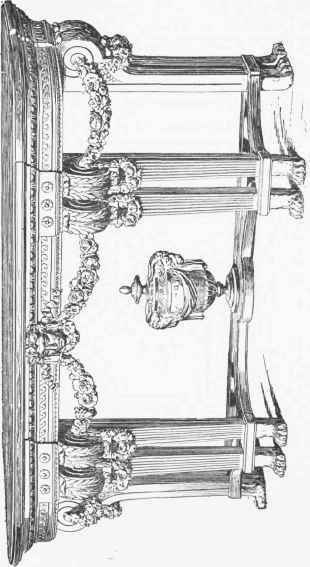
Console Table in carved and gilded wood, Louis XVI. period. (Collection of Baron Asselin).
Under Louis XVI, the period of refinement of every description, wood was to enter on a new phase : not only its forms are sobered down by being covered with delicate details, but it carries coquetry to the extent of abandoning gold ornamentation to show itself clothed with a simple coating of white paint, barely relieved in some cases by mouldings of pale lilac or sky blue. Nothing can be prettier than a little drawing-room in this style, in which the borders of the glasses, sometimes surmounted by an amorous trophy with its doves and torch, the console tables with white marble tops, furniture in pale figured satin or in striped silk with soft tints, have no other relief but the fine ornamented bronzes as delicate as jewelry, thus permitting the triumphant beauty and infinite elegance of the ladies who inhabited them, and enlivened them by their animated grace, to appear unrivalled. It must be admitted that this much-abused eighteenth century had in its latter days discovered the secret of the most refined taste, and the highest degree of politeness and bon ton.
In what precedes, we appear to have neglected one piece of furniture, the bedstead. And indeed, this, for itself alone, would merit an entire history, for it has played an important part both in public and in private life. In the Middle Ages, it already appeared in state on certain occasions; the "accouchee" there received congratulations, and the seat placed beside it received persons of rank who came to converse with the mother, and see the new-born infant.
Later still, the hour of rising was the time of giving audience; the bed, placed under a canopy and on a platform, had its head to the wall, and was accessible on both sides; the head-board alone and the pillars were visible to the eye with their sculptures; all the rest was drapery; at first the curtains used to be drawn, then came the fashion of the bedsteads "facon d'imperiale," of which the curtains lifted up. There was even a time when the hangings invaded the pillars of the bedsteads, which were surrounded by chossettes (sheaths of drapery).
These pillars were to disappear later on, under Louis XIV.; the canopy was to be suspended, allowing all the foot of the bed to be seen; and it was then that the bedside became the rendezvous of pleasant company, bringing the latest news, and sometimes scandalous gossip.
In the time of Henri IV., we see the alcove appear, tending to replace the canopied bedstead; in the salle of the Louvre where the dying monarch was carried, the curtains are represented in sculpture, and borne by geniuses.
The balustrade still exists in front of the platform (estrade) on which the bed rests.
This fashion may perhaps penetrate into modest habitations, but, as we have just seen, the formality introduced into the manners and habits of the seventeenth century prevented it from becoming general; sumptuous dwellings still had their bedsteads with canopies or baldachins.
These reappeared under Louis XV. and Louis XVI., sometimes cut out or circular, gilded, or painted grey, crowned with emblems or sculptured plumes, all of which did not prevent alcoves from affording a retreat for the simple night's rest. At this period, too, the beds assume a regular arrangement, that is, they have their extremities alike: silk, damask, or flowered calico covers the panels, leaving only the fluted pillars, the rounded pediment with wreaths and headings, etc., displayed to view, of which the carving is relieved by gold or pearl-grey tints. The bedchamber has an increasing tendency to privacy; the drawing-room and the boudoir become the only places of reception.
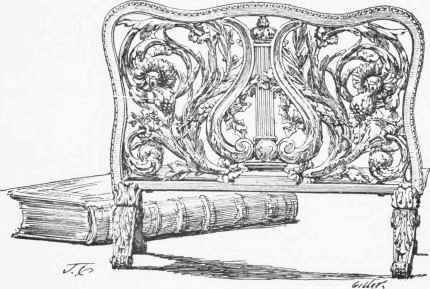
Reading Desk of wood, carved and gilded : period of Louis XVI. (Collection of M. L. Double).
We leave the bedsteads, therefore, and return to the smaller accessory furniture in gilded wood, which was in vogue during the seventeenth and eighteenth centuries - the hanging brackets. During the reign of Louis XIV. these had a positive importance; wherever the ecclesiastical time-pieces were affixed to the wall they required an accompaniment; busts, small bronzes, and porcelain vases naturally presented themselves to form the suite, and if the Boule clocks had their stands of incrusted tortoise-shell, gold was perfectly adapted to accompany articles which were less brilliant in themselves. The brackets of this period are often important from their composition; the shaped tablets are supported by figures of bold style and remarkable execution; or else acanthus foliage, masks, radiated heads of Apollo, remind us of the famous motto : Nec phiribus impar. These brackets are now becoming very rare.
The period of Louis XV. entirely abandons this soberness of composition. The rocailles and wreaths are, however, tolerably well adapted to this style of accessory furniture, and give it an importance which enables it to support weighty and bulky objects. Finally, under Louis XVI. elegant simplicity reappears; acanthus scrolls with slender stems support the tablets; the mouldings are bordered with pearl headings; in a word, we recognise again the delicacy we had pointed out in the bedsteads and seats.
Vignette, after Salombier.
Continue to:


My Books

