


Chapter IV. Leather And Paper Hangings
Description
This section is from the book "A History Of Furniture", by Albert Jacquemart. Also available from Amazon: A History Of Furniture.
This section is from the "" book, by .
Chapter IV. Leather And Paper Hangings
WE have already seen cow-hide employed in covering travelling boxes from which custom comes the French bdche or vache, afterwards given to the covering of leather used in securing the luggage on the top of coaches. Later on, there was introduced the practice of decorating leather by the embossing and gauffering process, or stamping, and using it in adorning the interior of houses. This was looked on at first as a refinement of luxury: "Leathers for laying down in the rooms in summer-time," say the inventories of the Duke of Burgundy. In 1416, Isabeau of Bavaria sent for "six leather carpets for the floor." This was one of the delicate devices of the German coquette, for, although on several solemn occasions the floors had been covered not only with tapestries, but even with the most costly materials, the general practice, continued down to the period of the Valois kings, as shown in many paintings, was to strew the apartments with flowers and foliage. This custom was not discontinued till the time when the velvet-pile or oriental carpets began to be multiplied, and especially when the looms of the West succeeded in imitating them, that the strewing of the floors gave place to the velvet fabric.
Returning to the fifteenth century, we find that in the same year, 1416, the Due de Berry possessed a large piece of red leather decked with several escutcheons in gules with three bends argent surrounding the shield of Castille. This was one of those highly-prized Spanish "Cordovans" which for a long time gave their name to the hangings known as "cordovan-leather," that is, of Cordova.
At first the leather hangings were painted with some uniform pattern, set off with designs produced by the hot iron on the roller. Large pieces made of square skins, sewn or glued together, formed the principal portions of the hanging, which was completed by means of narrower strips concealing the seams or joinings. We need not here dwell upon the style of decoration, identical as it was with the other pieces of furniture, and the very variety of which would, in any case, baffle all description. In subjects of this sort the pen must give way to the pencil. As regards the colours, the imagination could conjure up no visions more brilliant than the reality. The ground was most commonly of silver or gold, this last effect being produced by means of a coloured varnish laid over the silver. The arabesques and other ornaments vied in the brightness of their hues with this gorgeous ground.
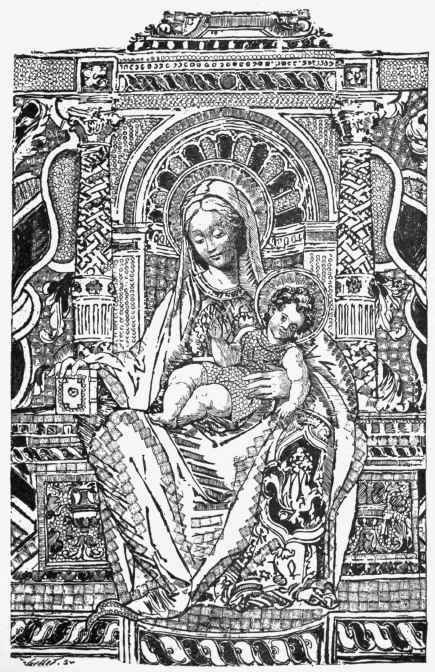
Piece of painted leather, gilded and ornamented with engravings produced by the hot iron; Venetian work of the sixteenth century. (M. Ed. Bonnaffe's Collection).
The inventory of Catherine de Medicis, published by M. Edmond Bonnaffe, gives some idea of the richness of these leathers at the close of the sixteenth century. Here are mentioned, gold and silver hangings on an orange ground, with the queen's cipher, others with orange mountings, gilded or silvered, on a violet ground; others again sea-green, with mountings similar to the preceding, or else red with gold and dove-coloured mountings; blue with gold, silver and red mountings, not to speak of the multifarious mourning hangings in which the background is relieved by silver alone.
All the leathers here described constituted moveable hangings. But, so early as the fifteenth century, leather of a different description had been introduced for the fixed hangings. Thus the Marquis de Laborde quotes the following entry from the royal accounts of Charles VIII.: "1496. To Jehan Garnier, saddler, residing at Tours, the sum of four livres, fifteen sous tournoys, granted to him for a large white ox-skin, delivered and consigned by him to a painter whom the king had sent for from Italy, whom the said lady (the queen) had ordered to make and paint the hangings of her bed- iiij liv. xv. S." The learned author adds: "The description of work was introduced, or re-introduced, into France at the end of the fifteenth century by Italian painters, and was continued throughout the whole of the sixteenth and the first years of the seventeenth century. The painting is raised on a gilded ground and keeps well." In the Cluny Museum is a series of paintings in this manner, coming from an old house in Rouen, and on a sheep-skin gilt, and worked with stamped dies, representing Rome seated and bearing Victory, besides six other pictures representing Scaevola, Torquatus, Cocles, Curtius, Manlius, and Calphurnius. This description of hanging was let into the woodwork of the panels.
In 1540, Sebastian Serlio, architect of Francis I., purchased some Levant skins and others for the use of Fontainebleau, and in 1557 two Parisians, Jehan Louvet and Jehan Fourcault, residing at the Hotel de Nesle, received what they were entitled to for the portions of gilded leather supplied by them to the queen. The latter received, moreover, four livres for a pavilion (tente de chambre) made of sheep-skin, silvered and enriched with red figures, for use in the king's cabinet at Mouceaux, besides ten livres in payment of nine skins, gilded, silvered, and figured to serve as models for "rentes de chambres," according to the picture and design of the said lady (the queen), for the use of her house, the Chateau of Monceaux, of which some are made with figures.
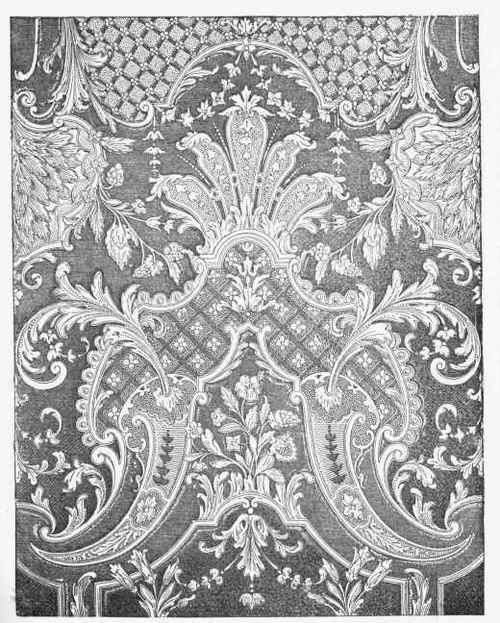
Gauffered leather hanging painted and gilded; Louis XIV. period. In the Collection of the Union Ccntrale des Beaux-Arts Appliques a l' Industrie).
Continue to:


My Books

