


Fabrics in The East
Description
This section is from the book "A History Of Furniture", by Albert Jacquemart. Also available from Amazon: A History Of Furniture.
This section is from the "" book, by .
Fabrics in The East
If order, one of the first conditions of all serious work, had not obliged us to treat of textiles in the same way as all other products of human industry, we should certainly have commenced this chapter with the East, which was the first to supply the models of all our sumptuous vestments and hangings.
We must go back to remote times in order to see the fabrics of India and of China brought through commerce to the knowledge of the Greeks and Egyptians, and exciting a spirit of rivalry amongst the latter people. Indian painted and printed cloths were sold in Egypt and some parts of Europe long before the time of Alexander, as already stated they were known by the name of Sindones and Othonia. From all the ports of the present Guzerat, from the Malabar and Coromandel coasts the mariners of those days brought to Berenicea, and thence to the general emporium of Alexandria, the painted and printed white cotton cloths of India.
Ptolemy Philadelphus sent Dionysius to gather in the various parts of that country such information as might help to establish in Egypt an industry calculated to compete with the Hindoo products. We may however conclude from the descriptions of Apuleius and of Claudian that the colours of the Egyptian cloths were not so fast as those of India, and this was doubtless the reason why St. Clement of Alexandria observes that the use of soft and delicate materials may be permitted to the women, but that cloths adorned with flowers coloured like paintings, must not be fabricated because such colours so soon fade and disappear.
The Indians, possessing the means of fixing the colours, were accustomed to use the brush in tracing the figures of flowers and animals on their cloths but they still more frequently printed off the pattern from engraved wooden blocks. It is of this process that Strabo speaks when he says of the Massagetae that "they produce various ornaments on their dress by impressing them with colours whose freshness remains unaltered." On the other hand Pliny dwells on the great progress made by the Indians in the chemical sciences, explaining how after tracing the designs on the cloths with various acids and alkalies they plunged it into a bath of blue, whence it was withdrawn dyed in three colours.
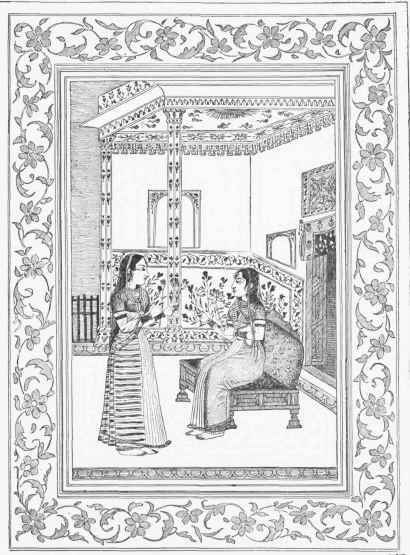
Indian Miniature, its border, and details of costume and furniture in the ornamental style of the sixteenth century.
The figures, according to Apuleius, were hyperborean dragons and griffins, animals of another planet, painted in a great variety of colours. Claudian also remarks in his turn that "nothing can appear incredible; they may offer us monsters of every description, winged turtles, vultures armed with horns .. all the whimsical conceptions of India, such as are reproduced on the cloths painted on the banks of the Nile." Who can fail to recognise in these descriptions not only the figures adopted by the Indians, but those also that the Chinese and the Persians produced in those days and still continue to produce? This has well been pointed out by Emeric David : "The works of the modern Hindoos," he writes, "are precisely similar to those executed by their forefathers for the nations of the north and the west of Asia, for Syria and for Egypt. On their cloths we find printed the very flowers and figures of animals, described by the classic writers, and, what is no less remarkable, the images of the still flourishing worship of Vishnu and Brahma".
Raynal points out the mistake that has caused these printed fabrics to be known in Europe as Persian stuffs The Armenians did formerly what they have ever since continued to do. They went to India, and, purchasing the cotton on the spot, distributed it to the spinsters, making them work them under their eyes. They then brought these goods to Bender Abassi, whence they reached Ispahan. From this place they were distributed throughout the various provinces of the empire, later on in the states of the Grand Seignior, and into Europe where the custom grew up of calling them Persian, though manufactured nowhere except on the Coromandel coast.
The silken fabrics of Great Serica or China were less known to or at least less carefully described by the ancients. Arrian, however, points out the highway that they followed from Thinae to Bactria, and thence to Barygaza, the modern Baroda, in the gulf of Cambay, where the Egyptian traders received them in exchange for the products of the Nile.
The growing luxury of the times had brought about the establishment of workshops in Alexandria, Tyre, Damascus, Antioch, where were produced the robes worn by the Christians in the fourth century. A tunic or a mantle sometimes contained as many as six hundred figures, and in a series of pictures illustrating the whole life of the Saviour. Or else they were figured all over with lions, bulls, panthers, bears, trees, rocks, huntsmen, all the conceptions of painters striving to imitate nature. Accordingly we find St. Asterius raising his voice against such customs, saying that "the garments of these effeminate Christians are painted like the walls of their houses." The factories where were produced these works continued to flourish after the conquests of the Saracens. The enlightened Arabs perceived all the advantages that their trade might derive from these remains of the industries of the ancients, and, notwithstanding the injunctions of the Koran, they continued to represent even the mysteries of the Christian religion, simultaneously with the real or fantastic animals handed down from ancient times.
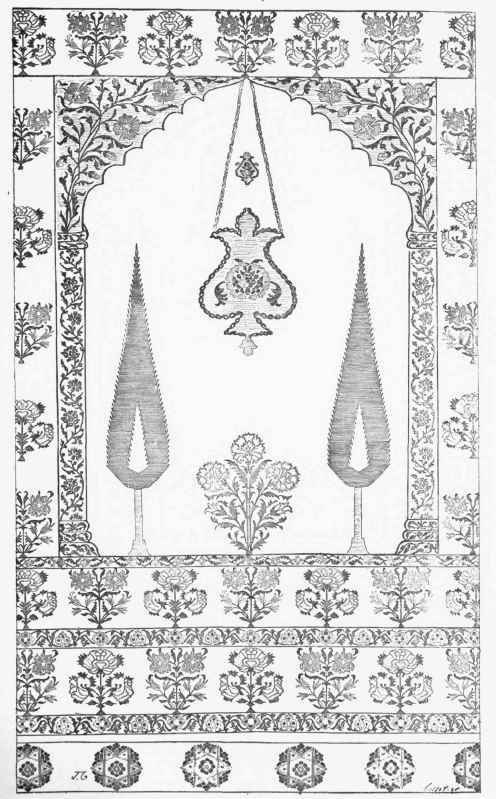
Portiere of gold and silver tissue and various silks; old Indian work. (M. J. Jacquemart's Collection).
At the same time, however, they did not neglect to follow the natural inspirations of their own taste, and this charming, conspicuous, and delicate taste acquired such predominance as entirely to efface the memory of the old traditions. In the eleventh century what the crusaders most admired in the East, and what they brought thence, besides the relics and other most highly prized marvels, were the Arabian silken fabrics. Rut before coming to a description of the precious specimens preserved in our museums, it may be well to endeavour to see whether there be no means of distinguishing several styles in the Oriental textiles. We need not dwell on those of China, now too well known to require any mention of them here. It will be enough merely to remark that, thanks to the conservative spirit in the Celestial Empire as well as in India, the modern textiles give the most complete idea of the more ancient creations.
Persia has for us a greater interest, because her contact with the old civilisation must have necessarily impressed a special stamp on her artistic productions. She had her own national silk manufactories, and in his travels Marco Polo is careful to mention the city of Toris (Tauris or Tabriz), where the people "live by trade and the arts, for they here elaborate diverse cloths in gold and in silk, and of great 'bravery.'" What the Persians must have given preference to in their productions are the traditional griffins of antiquity, the lions attacking bulls, emblematic of the struggle between the two principles of good and of evil, besides hunting scenes, reduced representations of those colossal pursuits of wild beasts indulged in by the kings and their nobles, in the parks called in the old language, by a term, which in Modern Persian, has become firdaus, and which under its Greek form of "paradise," has become the common property of the languages of the West. In a word, the Persian type, to be recognised especially by the presence of the iris, so accurately described in M. Charles de Linas' account of the fragment of a tissue belonging to the library of Rouen, is always easily to be distinguished from the pure Arabic style. This latter has applied special branches, the most important and interesting of which from the artistic point of view, is the Moorish school, which has left such brilliant specimens in Spain. Moorish art, is to Arabian, what the florid is to the pointed Gothic.
By the assistance of these summary indications, we shall be able to attribute with some degree of certainty, the specimens classed in cur museums.
Continue to:


My Books

