


Fabrics in Toulouse. Continued
Description
This section is from the book "A History Of Furniture", by Albert Jacquemart. Also available from Amazon: A History Of Furniture.
This section is from the "" book, by .
Fabrics in Toulouse. Continued
We shall pass rapidly over the monuments of the eleventh and twelfth centuries, merely quoting the fragment of the dalmatic worn by the Emperor Henry II. at the solemn ceremonies of the cathedral of Bamberg, and which presents medallions, foliage and chimerical animals; also the following piece, No. 3258, with a running border, the perfect workmanship of which is very remarkable; and lastly the specimen from Constantinople, No. 3264, which served to wrap up the relics brought from the Crusades to Cologne. We have already seen the sort of work that was being executed during this period at Palermo.
The thirteenth century will detain us a little longer, for we are now already able to distinguish the various types. From those wonderful Arabo-Christian workshops in Sicily we shall see, under the numbers 3270 and 3271, specimens of tissues with parrots, swans and dogs skilfully disposed in medallions. The chequered pattern will be already seen in a Saracenic fragment from Italy or Spain, in which the animals and the ornaments affecting this alternating disposition are of such frequent occurrence. Spain also (No. 3276) still shows animals and parrots of Oriental type.
But we now come to the famous Lucca cloth so long esteemed for its richness and beauty, and introduced by commerce into all the Courts of Europe. Here the design is simple, and it possesses the interest of having been specially made for France, being seme with fleurs de lis and lions. Not far off is another specimen, perhaps of the beginning of the fourteenth century, seme with deer and alerions heightened in gold upon an arabesque ground adorned with birds and dogs.
Passing to the fourteenth century, we will first refer to a beautiful Sicilian specimen embellished with gold, in which appears figures of women, lions and palm trees. The tissues with pseudo-Arabic inscriptions become frequent, and attest the presence of an increasing number of Christians in the workshops. Then Italy, yielding to her pictorial tendencies, begins to scatter her silks with constellations, amongst which will arise seraphs in adoration. A fragment of a veil of Florentine workmanship, and perhaps dating from the commencement of the fifteenth century, will show the same seraphs worked in gold on a blue ground, and figuring the hymn " Ecce panis angelorum".
With the close of the fifteenth century, as has been already remarked, there shows itself that noble display of the progress that had been going on for centuries and which is expressed by the term renaissance. The European looms are now emancipated from Oriental imitation; the emblems of knights and princes, and other distinctive marks of rank are about to become the type of the most beautiful materials. We shall see the helmet of the warrior introduced amidst Gothic arabesques, lopped branches interlaced among flowers, the oak as adopted by many of the great families, multiplied in various forms. Then follow certain flowers of Oriental origin, the asters and marguerites scattering their delicate rosettes amidst the meanders of the ornamental design. There, at Cluny, a zig-zag band of silk and gold, in which figure armorial shields with two arrows in saltier. Then Nos. 3290 and 3291, fragments woven by the guild of weavers at Cologne, showing an interlacing of thorny stems supported by light leaves and asters in gold, detached from a red ground, or fleurdelise crosses. Elsewhere are silks from Flanders, others from Italy with birds and foliage; and damasks also from Venice with oak branches and brilliant arabesques upon golden grounds.
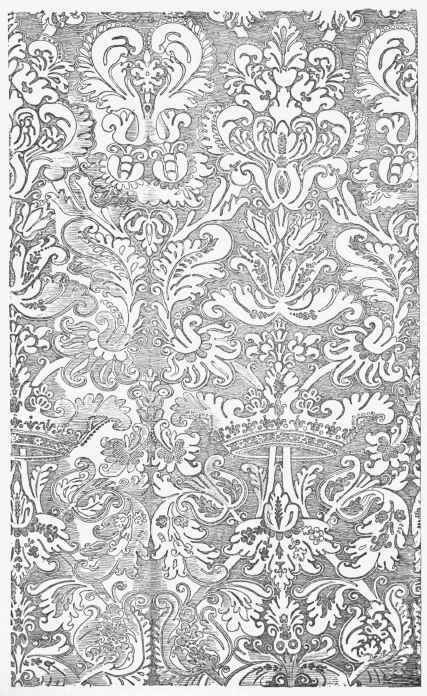
Piece of figured Silk, in yellow, gold, and green, called "a la couronne;" reign of Francis I. (Collection of M. H. Barbet de Jouy).
In a word, true art henceforth asserts itself, and we find ourselves already in the sixteenth century with its pure taste and superb audacities. Florence, Venice, Lyons, Tours, all arc about to enter into the competition and emulate each other in the production of master-pieces. Gold, velvet and silk now display their mosaics on the softest tissues, and in order to form an idea of the splendour and variety attained to by the artist, it is no longer enough to consult a few isolated specimens scattered amongst the collections. We must henceforth study the paintings of the masters, from those of the early period who rendered the cloths of gold and the damasks with a minuteness of detail enabling us almost to count each particular thread, to the grand scenes of Paul Veronese, who will show us the gorgeous effect, the luminous rustling of the brocades and figured satins, of the flowered velvets and brocatelles.
It is with a certain misgiving that we write these lines. For the reader may perhaps ask would it not be desirable to define the meaning of the obsolete names that occur in the old poems, inventories, and other records? What is "samit, cendal, siglaton, diaper, purple," which last must not be supposed to represent a colour so much as a fabric? It must unfortunately be confessed that the researches of science are far from having settled these points. Documents are contradictory, the sense accepted in one place being different from that given to the same word in another, while time and locality cause confusion and doubt where a satisfactory solution might have else been looked for. But it could scarcely be otherwise when in documents so recent as the second half of the seventeenth century we find such a nomenclature as the subjoined enumerating all the textiles retailed by the Parisian traders. "Draps d'or et d'argent frises, broches - lames d'or et d'argent - Gros de Naples - Poulx de soye - Satin - Damas - Venitienne - Damassin - Luquoise - Valoise - Velours a fond d'or - Serge de soye - Tabis a fleurs - Taffetas faconne - Brocatelle - Toile de pourpoinl - Echarpe de soye - Egyptienne - Satin de la Chine - Damas caffart - Camelotine - Modesne - Satin de Bruge - Legatine - Serge dauphine - Etamine du Lude, et autres camelots - Trippe de velours - Ostade - Demi-Ostade - Bazins - Fustaines - Moncayart - Burails ou Ferrandines.
These various materials might doubtless be more accurately defined, but this could be done only by means of technical descriptions foreign to our present purpose, and difficult to understand without seeing the loom actually at work.
The preference given to one fabric above another is also a mere question of time and fashion. In the sixteenth century satin was highly esteemed, and an idea may be had of the rank it occupied amongst the more costly materials by reference to the sumptuary regulations of the members of the Parliaments. The president was dressed in velvet, the counsellors and "maitres" in satin, the registrars in damask, and the ushers in taffeta.
Luxury, however, was not restricted to rank, and more cloth of gold and silver was often displayed at the marriage of a courtier than at state ceremonials. Private citizens even at times eclipsed royalty itself in their sumptuous displays. In 1507 Jean-Jacques de Tnvulzio, marshal of France, gave an entertainment to Louis XII. at his house in Milan, for which occasion he had built an apartment 120 paces long, hung all over with blue velvet seme with fleurs de lis and stars of gold. There were assembled more than 1200 ladies all dressed in cloth of gold or embroidered silk, and those who had been invited to the banquet were seated on cushions of cloth of gold and crimson velvet, of which from four to five hundred had been prepared expressly for the purpose.
On a previous occasion, when Charles VIII. made his entry into Lucca, the nobles, burgesses, and other inhabitants of the town went to meet him dressed mostly in fine cloth of gold and velvet.
All these gorgeous fabrics have caused us to overlook an industry of an essentially national character, that of woollen stuffs. From the time of St. Louis the workshops of Arras were famous, while Auvergne had developed this manufacture to an extraordinary degree. Among the French woollen textiles there are some of a very remarkable design, including a few worked with gold lama. If for our present purpose woollen fabrics have but a secondary importance, their value, from an economical point of view, can hardly be overrated; and it would on this account be unfair to refuse a passing allusion to the name of Cadeau, founder of the Sedan factories, and who, in the seventeenth century, earned privileges and immunities both for himself and his posterity in return for the services rendered by him to the national industries.
A few words may here be devoted to the fabrics of which some rare specimens may be seen in the Cluny Museum. There is, first of all, a printed linen tissue of the thirteenth century, on which are figured birds "affronted," of a highly ornamental character. It is doubtless no easy matter to point out the real origin of this piece, which has all the technical perfection of the Oriental painted cloths, while of a different style. The other specimen is a fabric worked in threads of two colours, grey and red, embellished with chimerical animals, lions "addorsed," and birds coupled face to face, exactly as in the silks of the fourteenth century. There is, however, no clue by which to ascertain the origin of this curious tissue.
But weaving and embroidery were not the only means employed to ornament silk. In his "Bibliotheque de l'Ecole des Chartes," M. Anatole de Montaiglon has described an altar ornament with pen and pencil designs, a species of work that seems to date at least from the fifteenth century. On the other hand, Vasari attributes the invention of painting on textiles to a Florentine painter, who, this writer tells us, was one of the first to whom the idea occurred of painting standards and other cloths in mosaics, as they are called, that is, by colours laid on side by side and not blended, so that the colour of the material remains partly visible. In this manner he painted the golden baldachino of San Michele, filled with figures of Our Lady all beautiful and varied.
Painting on silk was not a passing whim of the moment, for there may be seen at Cluny a fine specimen decorated with flowers made in the last century.
Continue to:


My Books

