


Chapter II. Wrought Iron, European And Oriental Arms, Brass Repousse Work, Damascened Metals
Description
This section is from the book "A History Of Furniture", by Albert Jacquemart. Also available from Amazon: A History Of Furniture.
This section is from the "" book, by .
Chapter II. Wrought Iron, European And Oriental Arms, Brass Repousse Work, Damascened Metals
THE art of working and casting iron is of very remote antiquity. Theodore of Samos, son of Telecles the younger, who lived between the fifteenth and twenty-second Olympiad (about 850 years B.C.), is believed to have been the inventor of works of sculpture in cast-iron. He was also an architect, statuary, goldsmith, and engraver of gems, and we find his name upon the ring of Polycrates.
As to the invention of wrought iron, the chronicle of Paros places its discovery in the year 215 before the Trojan War. However, it was not till after that war that the Greeks abandoned weapons of tempered brass in favour of iron, the working of which speedily aroused the genius of artists, since history has preserved the name of Hippasis, a celebrated chaser in iron. And, to go still further back, Pliny mentions statues of iron, especially that of Aristonides, and the Hercules of Alcon.
Among ourselves, with the exception of arms of which we shall presently speak, iron came slowly into use. In the eleventh century it was used in the fastenings of houses, and in the hinges and iron-works for hanging and strengthening doors. These hinges were extremely primitive; M. Viollet le Duc shows them to us, bearing a resemblance in shape to the letter C, the curves of which extended along the planks, and served to strengthen them. The art of welding iron with the hammer soon modified this simplicity, and made such rapid progress that in the twelfth century it had almost reached the highest perfection: nothing can be more elegant than those false hinges which then adorned the doors of the churches, and of which one of the most charming examples is still to be seen at Neuvy-Saint-Sepulcre.
It was, however, essential to the attainment of the desired result that this elegance should be combined with strength, and at the beginning of the thirteenth century the iron-workers at the head of the profession conceived the notion of doubling the hinges, and covering them with reinforcing bands supported by braces which should increase their strength without impairing the harmony of their effect. The ornamental iron-work on the doors of Notre-Dame, executed about the end of the century, presents one of the most beautiful examples of this description of work. We have already seen that it was also used to clamp travelling chests.
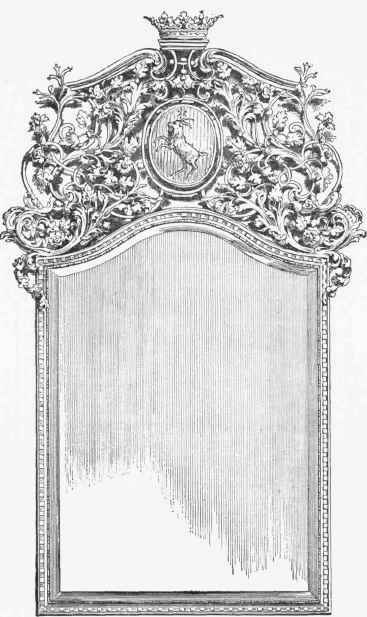
Looking-glass in wrought-iron frame, chased and polished. French work of the Sixteenth Century.
(Collection of M. L. Mahou).
As to hasps or locks, the most ancient date from the twelfth century, and improve progressively with the growing skill of the blacksmith: at the commencement of the fourteenth century, they have the same forms and open traceries as the hinges. Towards the end of this century, the Germans conceived the idea of completing the embellishments of doors and furniture by ornaments in hammered iron, or in repousse sheet-iron; a fashion which we adopted in the beginning of the fifteenth century, and this "hammered iron, cut in open patterns and mounted on red cloth, came to be employed on the plates of locks, latches (pallatres), and bolts. In the course of this and the next century, the iron-workers seem to sport with this rebellious metal, and to find a positive pleasure in bending it to their fanciful conceits; everyone has admired that curious lock in form of a triptych in the possession of M. Spitzer, which, in its various pictures framed by rich pinnacles and pierced galleries, represents the last judgment, the glorification of the just, and the punishment of the wicked, and how many other works there are which nearly approach this complicated perfection! In the sixteenth century again, to this skilled workmanship were added beautiful designs, and the interest of historical characters, such as the pieces blazoned with the salamanders of Francis I. with the escutcheons of the same prince and of his mother Louise de Savcie; and then the famous ciphers of Henry II. and his consort Catherine de Medicis so often discussed, and which formed the grounds for a scandalous equivoque.
But these locks, these bolts are as nothing when compared with the keys, - masterpieces, real jewels of iron; and one can understand why certain amateurs of the present day have made them the object of their special collection. There busts, monograms, coronets, historical enigmas are set in these lace-works of tracery, or enriched with delicate acanthus foliage, which causes the bows of some of these keys to rival the most delicate jewellery; the guillochures of their shafts, and the complication of their wards correspond to this elegance, and entitle some of these keys to take their place beside those of enamelled solid gold in the collection of the Baron Alphonse de Rothschild. We must not then be surprised to find the locksmiths combining with other branches of art in the decoration of interiors, and to see iron chased and polished serve as frames for mirrors of Venetian manufacture. A beautiful specimen of French work of the sixteenth century, in the possession of M. Mahou, shows us to what perfection this style was brought: nothing can be more elegant than the foliage mingled with flowers which forms a raised pediment, and surrounds the arms and coronet of the Marquis who ordered this work of art.
The connection of our subject has led us on regardless of dates, and we must here retrace our steps to notice several works in iron of a highly interesting character. But we must first say one word of those great fire-dogs (landiers) of twisted forms, the worthy precursors of the bronze chenets of the Italian Renaissance; we must mention, too, those wrought-iron tripods, so much sought after at the present day as stands for jardinieres, and which often forfeit their claim to that designation by having five or six principal branches resting upon ornamented circular zones, from the lower of which springs a bouquet of flowers and fruit in wrought or repousse iron, such as we see at the base of e pis and vanes, while the upper is intended to bear a receptacle of any sort, as in Italy a brasier (brasero), and amongst ourselves a basin of repousse copper. One may see to what ingenious complications these works in wrought iron attained by examining the signs which were placed over the gates of celebrated inns, or upon the facades of private houses or hotels. At this period when the system of numbering houses had not yet been adopted, some other means of distinguishing the dwellings of individuals was needed, and ornamental and elegant iron-work stands (potences) bearing emblems or well-known cognisances served to indicate the abode of the person one sought; but far beyond all examples are those magnificent balustrades of the staircases rampes d'escalier) of which the chateaux of the sixteenth and seventeenth centuries have preserved specimens. We must allude also to the ornamental iron stands (potences), which, on these staircases, or in the vestibules, served as supports for the lanterns of that period.
Continue to:


My Books

