


Chapter IV. Jewellery
Description
This section is from the book "A History Of Furniture", by Albert Jacquemart. Also available from Amazon: A History Of Furniture.
This section is from the "" book, by .
Chapter IV. Jewellery
It is scarcely credible that from amid these delicate memorials of personal adornment, antiquity should have afforded us so many examples of her art and good taste. The Egyptians and Greeks, actuated by a sentiment of pious reverence, used to surround their dead with all the various objects they had loved while living, and it was natural to suppose that, on opening their tombs, these precious evidences of the technical advancement of the ancients should come to light once more. But the truth must be told, cupidity had anticipated the investigations of science; sacrilegious hands, frequently those of contemporaries, had violated the sepulchres, in order to plunder them of their treasures, breaking, as they did so, all other objects such as the painted vases, which in those days possessed no intrinsic value. These acts of pillage gave the alarm and led sorrowing relatives to surround the departed dead by simple imitations of jewellery, made very often of stamped leaves of metal extremely thin. Our museums contain great numbers of these fragile imitations.
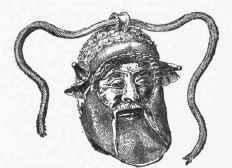
Head of Bacchus adorning- a necklace. Etruscan Jewellery of the Campana Collection. (Museum of the Louvre.).
As for the real jewellery, tombs concealed away, or lost to sight in semi-barbarous countries, have preserved for us sufficient to enable us to form an opinion on the skill of the goldsmiths of those days. The Crimea has been the principal theatre of these precious discoveries, and the Italian museums, as well as our own, contain some most interesting collections which have been preserved intact amid the barbarous Scythians.
The Egyptians, who were far advanced in artistic culture, knew how to chase gold with extreme delicacy and combine it with precious stones and enamels so as to form most exquisite ornaments. The marvellous specimens sent by the Viceroy of Egypt to the French universal exhibition have shown what the artists who worked under the Pharaohs, 1750 years before our era, were capable of.
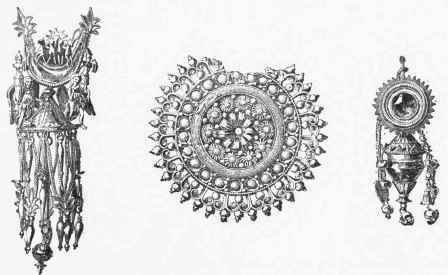
Gold brooch and Ear-rings in gold or set with garnets. Antique Jewellery from the Campana Collection.
(Museum of the Louvre).
The Louvre also can display some superb jewellery : necklaces plaited of fine gold threads with pendant knots and acorns, combinations of small chains and precious stones, bullas, finger-rings, plaques incrusted with enamels and a hundred things which show the advanced state of art among them. The Greeks, later, attained absolute perfection, and we stand in amazement before the works they have bequeathed to us. Is there anything in the whole museum of the Louvre more astonishing than those ear-rings where we see together the Sun on his chariot and two figures of Victory laden with trophies leaning against a pavilion from which depend finely woven chains wrought in palm leaves and with pear-shaped ornaments; or again these delicate buttons formed of rosettes of granulated gold or with numerous petals which support, here a swan in white enamel, there a cock or peacock surrounded by exquisitely delicate pendants. Then these clasps with rows of detached daisies, of filigree gold encircling pearls; these necklaces of twisted gold wire, pliant as a silken gimp and bearing a head of Achelous also of gold repousse and granulated; or these buckles (fibulae) ornamented with filigree and Etruscan inscriptions; these bracelets and these delicate crowns?
We have just been speaking of the Etruscans; let us then stop a moment, and say a word upon the influence which their art may have exercised over that of the Romans. The Etruscans, as we are aware, were of Oriental origin, and their great families which founded the Etrurian Colony retained the tradition of luxury and taste of Lydia, their ancient home. The artisans who came along with them, inspired from the same sources, and gifted with a special delicacy of execution, impressed always on their works the distinctive stamp of a somewhat meagre elegance, which might be taken for a refinement of archaism. Etruscan jewellery can then vie with the best Grecian work, in the perfection of its chasing; as we may see for ourselves by the caskets belonging to the Campana collection, and the articles preserved in the cabinet of medals. We may see there, necklaces with five pendants, a consecrated number, in which bullas of gold alternate with little vases without handles, of curious workmanship.
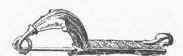
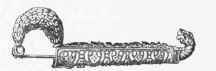
Golden Fibulae ornamented with designs in granulated work. (Campana Collection.).
The Romans, inspired by these masterpieces of the Greeks and Etruscans, and upheld in the path of good taste by intercourse with the numerous Grecian artists invited to Rome, could scarcely help excelling in the manufacture of jewellery.
A valuable discovery made at Xaix (Meuse), the ancient Nasium, capital city of the Leuci, has shown such to be the case. Among other articles is a necklace composed of five small columns, alternating with cameos and eight golden coins mounted "a belieres;" the workmanship indicates the third century of our era, and gives also a specimen of the manner in which the ancients mounted cut stones. Another necklace belonging to the same find, shows us eight knots of massive gold alternating with cylinders of Egyptian emerald, the origin evidently of our true lovers' knots. If, in the Roman jewellery, we lay special stress on those which were intended for ordinary wear, because they alone represent the exact condition of the art, this is no reason why we should pass over the numerous imitations made in repousse or stamped work, where we often find very curious designs. There is besides a special series in this style, which gives the key-note to an interesting but scarcely known epoch, and to a usage purely capricious : we allude to those plaques, Asiatic in their origin, with which the stuffs for wearing apparel, which the Romans called vestes auratas, or sigillatas, were heavily covered, and hence, those who wore them were said to be sewn with gold. These plaques, with all the figures of the pantheon, with masks of Bacchus, Apollo and the Medusa's head, or representing Hercules fighting with the Nemaean lion, etc, were pierced with four holes by which they were sewn on the part of the tissue they were intended to occupy.
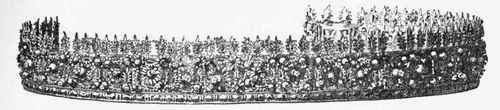


Diadem composed of plates of worked gold, enriched with glass pastes, and bracelet formed of plaques of gold with granlated and corded ornaments. (Camnana Collection, Tjouvre).
Continue to:


My Books

