


The Goldsmith's Art in The East
Description
This section is from the book "A History Of Furniture", by Albert Jacquemart. Also available from Amazon: A History Of Furniture.
This section is from the "" book, by .
The Goldsmith's Art in The East
There is no more interesting pursuit, than to seek among the remains rescued from the shipwreck of ages, for the evidences of the Arts among the Orientals. These grand civilisations, whose monuments still strew the ground with regular mountains of remains, had something else to show, besides the strange bas-reliefs which people the ground-floor of the Louvre, or the royal minotaurs or divinities, which supported the colossal porticoes.
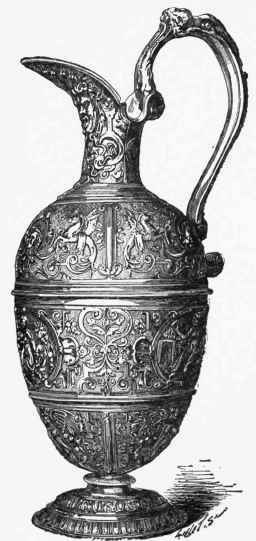
Pewter Ewer of Francois Briot. (Louvre, Sauvageot Collection.).
Ought we not ardently to search for the origin of these symbols, which, notwithstanding successive conquests, and religious revolutions, have survived the races which gave them birth, and have come down even to our own day.
Oriental relics are rare, and this is natural, especially as regards the precious metals; slender and fragile, possessing intrinsic value which invited their transformation, they have been preserved only in exceptional cases; however our museums contain a sufficient number to enable us to explain many things, and to certify the value of configurations which are perpetuated even in modern works.
Let us visit, then, the collection of medals, and examine, in the first instance, the small vase of massive silver, with bas-reliefs cast and chased, which seems to belong to the first century of the Christian era. This vase (No. 2879), presents a curious combination of the religious symbols of Rome and those of Asia Here we have an altar, in the shape of an hourglass, placed between two cypresses, which ever since the days of Zoroaster have been used to represent the soul aspiring to heaven; further on are groups of animals, a lioness devouring a wild boar, and a lion feeding on a bull, symbols of the eternal struggle between the opposing principles of Good and Evil; on the other side, between two analogous groups, we find the cinerary urn, a dove and other funeral symbols of paganism. A verdant laurel-bush and a pine tree, laden with leaves and fruit separate the two faces, and in a similar way, the vases with Bacchic subjects in connection with funeral rites are divided.
The second vase (No. 2880), belongs to a more modern period, and shows us a specimen of Persian Art under the Sassanian dynasty, about the fourth century. It is a species of oenochoe, of which the body is covered over with subjects in repousse work. On each face is a group of two lions, which cross each other as they rush in opposite directions; the sacred palm or horn, separates them, represented as a whole tree on one side, and on the other typified by two dried twigs.
A cup, which by its form reproduces that of Chosroes I., which we shall speak of presently, possesses still greater historical interest. We see here, a king of Persia, mounted on horseback, and pursuing at a gallop wild boars, an axis-deer, an antelope and a buffalo, at which he discharges arrows; the costume of the personage, and the trappings of the horse are extremely rich. By comparing the details of the crown, with those engraved on coins, M. Adrien de Longperier has succeeded in determining the name of the king, who would be Piruz or Firuz, the Perosis of the Greeks, who reigned from 458 to 488.
M. Chabouillet, who bases his opinion on the perfection of the workmanship and also on the resemblance of the portrait, would assign it a still older date, and attribute it to Sapor II. However, this subject of a King at the Chase, is one of those which were continually repeated in spite of the prohibitions of the Koran relative to the representation of animated beings.
Another silver cup which by its workmanship would seem to belong to the sixteenth century, affords an example of a new practice. The bas-relief placed on the lower portion, and representing a tiger walking among lotus flowers, growing on the banks of a river, is gilt and inlaid with niello. Again there is another cup, belonging to almost the same epoch, which in its bas-reliefs in chased work, presents subjects taken from the Sassaman religion; on the ground is the Goddess Anaitis, while on the wider part are eight figures of persons in the act of adoration and on a crescent two busts of Ormuzd, wearing the tiara.
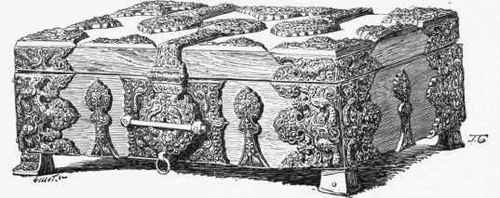
Ivory Casket, richly decorated with silver plate, chased and gilt. Arabian work of the Thirteenth Century.
(Treasury of the Cathedral of Bayeux).
Figures belonging to a still more modern epoch, have been etched on both faces of this cup and recall the "graffiti " we find on the walls of Pompeii.
Continue to:


My Books

