


Fabrics in Toulouse
Description
This section is from the book "A History Of Furniture", by Albert Jacquemart. Also available from Amazon: A History Of Furniture.
This section is from the "" book, by .
Fabrics in Toulouse
Toulouse possessed a factory, the date of the foundation of which has not come to light. But we have seen letters patent of July 20th, 1775, authorising it to take the title of royal manufactory of silken fabrics.
Lastly, at LlLLE the Sieur Cuvalier Brama obtained by letters patent of October 27th, 1776, a grant of fifty livres for each loom 111 his silk manufactory there.
After having shown the various efforts made to develop this branch of the more refined industries, it would be interesting to describe the resistance it often met with, whether on the part of the clergy appealing to the simplicity imposed on the Christian, or of the sovereigns themselves, taking alarm at the extravagant and ruinous expenditure blindly indulged in by every order of society. But the mere sketch of such a picture would lead us too far, and after all would prove but little; for it is well known that sumptuary laws have ever remained dead letters, and that authority, whether civil or religious, has always been defeated by fashion, the most powerful of masters. Still, we cannot resist the temptation of quoting at least a few extracts from the famous edict of Charles VIII., dated December 17th, 1485, offering as it does a classification of the costly materials at present under consideration.
"Charles, by the grace of God etc. . . . Whereas the common weal of our realm has been much impaired by the lavish expense and outlay incurred by many of our lieges in dresses too pompous and too sumptuous and unsuitable to their estate .. we have by perpetual edict forbidden and prohibited, and do herewith forbid and prohibit, all our subjects generally from henceforth wearing any cloth of gold or of silver as robes or linings under pain of forfeiting the said garments, and of a fine arbitrarily to be imposed save and excepted the nobles living in princely manner .. whom we permit to dress under the limitation hereunder expressed; that is to say, that knights receiving a yearly income of two thousand livres may all wear silken fabrics of whatever kind. And the esquires having also two thousand livres of yearly revenue, damask cloths and figured satin, but velvet not at all, whether crimson or figured, under the penalty here above mentioned".
Many similar edicts had preceded this, and many others followed it in the years 1549, 1563, 1607, 1610 and 1613, notwithstanding which the spread of luxury was uninterrupted and irresistible.
This brings us to the most difficult part of our undertaking, for it is now our duty to ascertain the decorative character of the materials, whose history we have just sketched. This task, we repeat, is arduous, unless it be reduced to its simplest terms by saying that the ancient fabrics of Europe are imitations of the Oriental types. And this is so far true that down to the thirteenth and fourteenth centuries the magnificent textiles brought from the East, and especially from Persia, besides those manufactured in Constantinople were the models universally followed. The influence of the East was still further increased by the conquests of Islamism in Italy and in Spain; and we have above seen that the Sicilian looms of the twelfth century were purely Arab.
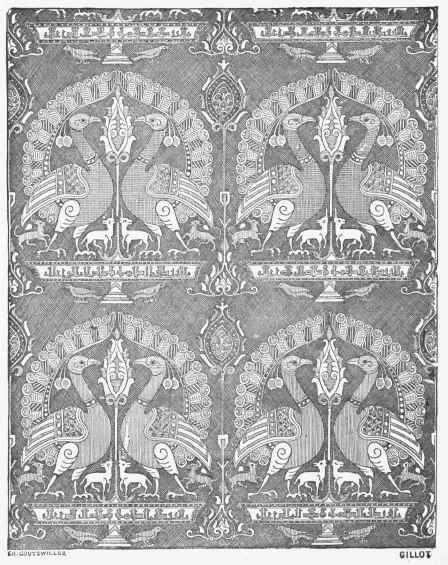
Arabian wall hanging of the Fourteenth Century.
It must therefore be always necessarily difficult to decide whether the fabrics of the Middle Ages have been imported from the East or made in Europe, either by Oriental hands or by European artisans trained in workshops of Arabic origin. This is a question which, as has been already pointed out, cannot be settled even by the presence of Arabic legends, and those materials alone can be pronounced undoubtedly European which are certified to be such by their sham or ornamented imitated Arabic inscriptions.
The subjoined seems to us an intelligible classification of the Arabo-European types met with either amongst the coverings of relics, sudaries, or ancient religious vestments. There are, first of all, the tissues with subjects representing the symbols adopted by the Sassanides, such as the combat between the lion and the bull, of the lion and the camel, of the gazelle, etc. These subjects are nearly always double, affronted, and separated by some subject from the vegetable kingdom, the palm or sacred "horn," if the type comes from Asia Minor; a bouquet composed of the iris, if specially from Persia, etc. Another equally frequent type consists in the representation of animals or birds, disposed symmetrically in arabesque medallions or compartments. These are often lions or leopards rampant, addorsed, or affronted, occasionally with the head contourne, birds of prey and parrots. In this type it is often difficult to determine where the animal ceases to be Oriental and becomes heraldic. The doubt, however, arises only in the case of works posterior to the thirteenth century, for it was not till then that the custom of armorial bearings had been adopted.
However, it will be more convenient and more useful to refer connoisseurs not to the numerous descriptions of materials preserved in the old treasuries, but to the typical specimens that may be studied in our museums. The Byzantine style of the eighth and ninth centuries is represented at Cluny by a fabric with a red ground on which is depicted a man, in all probability Samson, wrestling with a lion. The whitish flesh tints are heightened by the same orange tint which is used to colour the lion. The features of the face and a mantle fluttering in the air are black. The colours, however, are skilfully contrasted in the tissue, and a wreathed border is no less learnedly treated. This example recalls the marvels described by Anastasius, the librarian, and notably the subject of Daniel in the lion's den and the other symbolical scenes painted in the catacombs by the Christians of the first centuries.
Continue to:


My Books

