


Tapestry. Part 3
Description
This section is from the book "A History Of Furniture", by Albert Jacquemart. Also available from Amazon: A History Of Furniture.
This section is from the "" book, by .
Tapestry. Part 3
We abandon these different establishments at the moment when they are about to be united with the Gobelins; we shall resume under this head the history of our national tapestry, and of the persons who illustrated it, as well as that of collateral manufactures.
What we must examine before going farther is, the species of composition, execution, and style which may permit us to recognise the periods and origins of tapestries, as well as the way in which they were employed.
We have already said that in the middle ages furniture was constantly transported; the hangings, suspended to the walls by nails prepared beforehand, were taken down to follow their owner, and folded in the travelling chests, went to resume their respective positions elsewhere; the largest ornamented the walls of the rooms; the others covered benches and furniture, according to a fashion generally adopted during the fourteenth century. During the following century, an increase of refinement tends to multiply hangings by giving them a special destination besides the furnishing of rooms; we see curtains and bed valances make their appearance; embroidery is more particularly reserved for covering furniture and seats.
In their workmanship, the tapestries of the fourteenth century imitate the style and simplicity of the miniatures on manuscripts; no backgrounds are to be seen; a uniform coloured ground detaches the subject in which the figures are ranged with singular regularity. The tapestry of the Apocalypse, in the possession of the cathedral of Antwerp, and which was manufactured at distant periods, is demonstrative on this point: the first pieces are on red or blue grounds; in the others, these same grounds arc strewed with columbines, lion's masks, initials, and finally with branches and foliage.
Not unfrequently the heads and the extremities of the figures are simply outlined, the details being left to the work of the painter: at the Exhibition of the Corps Legislatif, a small piece of tapestry in this style was seen, which had not been completed with the paint-brush : the flesh parts left the warp of the tissue visible. This curious piece forms part of the cabinet of M. J. Fau : it represents eleven personages in civil costume.
In the fifteenth century, the whole contour is indicated by firm and visible outlines; the colours are placed between these lines, and only modelled by two or three shades mingled together by means of more or less solid hatchings.
We know how tapestry work is carried on; the weaving process is done partially, because it would be impossible to carry all the coloured threads which are employed in the making of it from one side to the other of the warp, as in ordinary figured stuffs; the number of threads necessary for each tint are raised by the workman, who in this manner executes a mosaic work of wool or of silk, formed by pieces placed in juxtaposition, although manufactured on the same warp. This may be seen, as there is a solution of continuity when the change of colour is abruptly made between two threads of the warp. It is this necessity of weaving the fabric thread by thread, of dropping and taking up again every instant, each wool or silk of the woof, then stopping to tie or cut it, which forces the workman to execute smooth fabrics on the wrong side. Thus, these carpets being usually longer than they are broad in the ancient fabrics, they had imagined, in order to facilitate the labour, the plan of arranging the warp horizontally; thenceforth the execution of shades in hatchings becomes vertical. The colours are decided; the flesh parts are sketched out by a bright pink line; pale pink is the local colour, slightly deepened on the cheeks, and shaded with a light brown. In the draperies there are three shades of blue lit up with white; red is lightened with gold; green is modelled by dark blue in the shade, and yellow in the light. The ground is first enriched by foliage and flowers; then backgrounds and perspectives make their appearance, in short, the transition from the fifteenth to the sixteenth century is effected, as it was accomplished before, by insensible shades; it is therefore often very difficult to assign the date of transitional pieces.
An idea may be formed of the hangings of the fifteenth century, by viewing the magnificent piece at the Cluny representing the Angel leading Saint Peter out of prison; this piece, stamped with the arms of the chapter of Beauvais, dates from 1444 to 1462. The tapestry brought from the chateau de Bayard, and presented by M. Achille Jubinal to the Library, is another excellent specimen, as well as the Deliverance of Dole, an historical work, dated 1477, which has just been presented to the Gobelin manufactory by M. Spitzer. Finally, at Cluny, the history of the Prodigal Son, and the series of the history of David and Bathsheba, will show the progress of primitive art towards that absolute perfection which we shall find in the works of the sixteenth century; greater ease is sought in the modelling of forms; the line of contour often disappears in the general effect, and is only strongly pronounced when it becomes necessary to impart greater vigour to the whole. These qualities may be remarked, united to a greater perfection of design, in the fine piece in the shape of a triptych, exhibited at the Corps Legislatif by Baron Davillier, and which bore the date of 1485.
As we have already said, the sixteenth century, in our opinion, attains to perfection in the art of tapestry-making; style is displayed to its highest extent; colouring is left to the intelligence of the workman; it follows the progress of the dyes, without ever seeking to confine itself to the teachings of the cartoons; it is broad and decorative, and whatever the degree of complication of the fabric, it remains what it should be, not forming a breach in the walls to create impossible perspectives.
Here we must go back a little, and endeavour to discover, side by side with the characters of periods, those of the manufactures of each great workshop, or at least to collect the few notions which exist in connection with them.
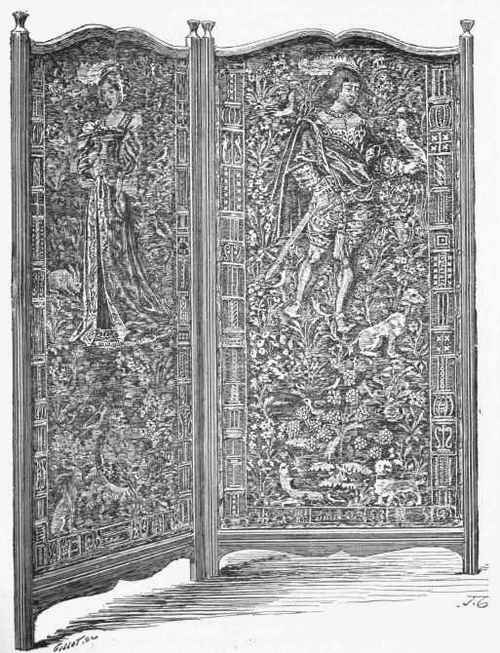
Serpen, composed of two leaves of tapestry with figures, costumes of the beginning of the Sixteenth Century. (Collection of M. Moreau).
Bruges
This town is mentioned in the edict of Charles the Fifth, and thenceforth it must have possessed manufactories; in his catalogue of the Musee de Cluny, M. du Sommerard attributes to Bruges a fine piece of tapestry of the period of Louis XII., signed "David fecit," and representing Dame Arithmetic teaching the rules of calculation to the lords and the scholars standing round her. We have not been able to examine closely this curious piece, the mark of which is a reversed B.
Antwerp
We find this name also in the famous edict of the Emperor; but we must accept with great reserve the indications which concern this town; it was the centre of Flemish commerce, and the greater number of those who traded tapestries there, were simple dealers; we scarcely know whether we ought to mention Adam de Cupere in 1504, tapestry merchant, who sells a series of the history of King " Nut," and another of the "istoire d'Hercules," to send to two generals in the service of the King of France.
Bethune
This is a manufactory of which the only mention made is an item in the accounts, extracted by M. Houdoy; this item is so important that we transcribe it: "1505, a Mathieu Legrand, tapissier a Bethune; pour II grans tappis et ung bancquier de drap sur chacune desquelles pieces sont les armes du roi des Romains et du roi notre sire et plusieurs chiens qui rongent oz".
Tourcoing
In the eighteenth century, a woman, Jeanne-Marie Lefebvre, widow of a sieur Neerinck, founded a manufactory of carpets in this town, in the Audenarde style, of which the Chamber of Commerce at Lille, and the "haut lissiers," Wernier, Pennemacker and Deltombe demanded the suppression, as being liable to encourage frauds, Tourcoing being a free town near the frontier. M. Houdoy is ignorant of what was the result of this request, but he has been so fortunate as to meet with a rather fine piece, representing a fete-champetre, and signed on the border, "Lefebvre-Tourcoing" only; by a singular circumstance, which our learned friend does not endeavour to explain, the inscription was followed by the escutcheon of the town of Lille, such as it appears on all the tapestries submitted to the inspection of the "maitrise" of that place.
Continue to:


My Books

