


Arms. Part 3
Description
This section is from the book "A History Of Furniture", by Albert Jacquemart. Also available from Amazon: A History Of Furniture.
This section is from the "" book, by .
Arms. Part 3
Nothing can be more elegant than these swords, with their light hilts, the pommels of which, truncated or piriform, are covered with wavy lines of ornamentation in silver, inlaid and chased, which are prolonged upon the delicate branches, and adorn the buttons of the cross-bars (quillons) or the swell of the branches. Often the pommel, the fusee, and even the berceau, are of chased iron, and present marvellous miniature figures, acanthus scrollwork, and foliage, such as the artists of the Renaissance knew so well how to combine. Here all the reliefs in polished iron stand out from a ground of grained gold; there cameos are sunk in the metal, and break the hardness of its tint; whilst in other examples enamel is blended with engraving, and the arm becomes a jewel.
From the time that luxury attached itself to the hilt of the arm, it was a necessary consequence that the blade should become worthy to accompany it. Spain had for long the privilege of furnishing Europe, we may rather say the whole world, with these incomparable blades. She exported them to all parts, and even the East neglected its marvellous Damascus blades, so beautiful in tint and workmanship, but unfortunately fragile, and adopted the Spanish steel. Toledo, beyond all other cities, had a well-earned fame, and the most renowned of her armourers often signed with their names, and always marked with their ciphers, the weapons which came from their hands

Italian Helmet of iron repousse, chased and ornamented with damascenings of gold. (Sixteenth Century.).
The curious will without doubt be pleased to see here a list of the most famous workmen of Spain, and also the marks (poincons) with which they stamped their works.
Marks (Poincons) Of The Chief Sword-Cutlers

Adrien de Lafra, Toledo and St. Clement (mark 14).
Alonzo de Caba, Toledo (5).
Alonzo Perez (3).
Alonzo de los Kios, wrought at Toledo and Cardora (4).
Alonzo de Sahagun, the younger (2).
Alonzo de Sahagun. sword-cutler, Spaniard, of the sixteenth century, called the elder, was living in 1570 (1).
Andres Garcia, Toledo (9).
Andres Herraes, Toledo and Cuenca (7).
Andres Martinez, son of Zabula, of Toledo (6).
Andres Munesten, Toledo and Calatyud (8).
Anna Damine, in Volenzia, Swiss two-handed sword, fifteenth century
Antonio de Baena, Toledo (10).
Anton Guttierrez, Toledo (11 and 12)
Anton Ruy, Toledo and Madrid (13).
A. Thomas Gaya, sword cutler, Spaniard, sixteenth century.
Avala (Tomaso). armourer, of Toledo. - TOMASO AVALA-EN TOLEDO.
Bartholome de Nieva, Toledo (15).
Basil Bastraniato, in Toledo, anno 1514, sword of Henri IV.
Biscoli, sword, Italian armourer, Louis XII.
C...Alcado, Toledo, Cuella and Badajos (16).
Camo, sword, Spanish armourer, seventeenth century.
"Chataldo te fecit," upon the blade of the sword of Francis I., a blade of the fifteenth century.
"Clemens Horum me fecit," Solingen, two-handed sword.
"Clement Horn me fecit," Solingen, sword, sixteenth century.
Da Pedro, Jopo Antoia. sword, Spanish armourer, sixteenth century.
Domingo de Aquirre, son of Hortuno, Toledo (22).
Domingo Corrientez, Toledo and Madrid (24).
Domingo de Lama, Toledo (23).
Domingo Maestre, the elder, Toledo (18).
Domingo Maestre, the younger, Toledo (19).
Domingo...de Orosco, Toledo (17).
Domingo Rodriguez. Toledo (20').
Domingo Sanchez Clamade, Toledo (21).
Favian...de Zafia, Toledo (25).
Federico Piccinino, sword, sixteenth century.
Francisco de Alcoces, Toledo and Madrid (30).
Francisco Cordoi, Toledo (32). Francisco Gomez, Toledo (28). Francisco Lurdi, Toledo (31). Francisco Perrez, Toledo (33).
Francisco... Ruiz, the elder, Toledo (26).
Francisco Ruiz, the younger, brother of Antonio, Toledo (27). Francisco de Zamora, Toledo and Seville (29). Gabriel Martinet, sonofZabula Toledo (36). Gil de Alman, Toledo (37). Giraldo . . . Reliz, Toledo (34). Gonzalo Simon. Toledo (35). Hortuno...de Aquirre, the elder, Toledo
(38). Jen Hartcop, twice repeated, sword, in the Sechan collection. "Johannes me fecit," sword, Italian armourer, sixteenth century. Johann Broch del rei David, sword, Spanish armourer, sixteenth century. Johannes Hopp, sword of Justice, sixteenth century. Johannes de la Orta, sword, sixteenth century. Johannes Wundd, and mark of a greyhound, sword, Flemish armourer, seventeenth century. Joseph Gomez, son of Francisco Gomez,
Toledo (62). Josepe de la Hera, the elder, Toledo (63). Juanez de Tolledo (54). Juanez Uriza, Toledo (58). Julian Garcia, Toledo and Cuenca(60). Julian del Key, Toledo and Saragossa (59). Julian de Zamora, Toledo (61). Luis de Ayala, son of Thomas de Ayala,
Toledo (71). Luis de Nieva, Toledo and Calatayud (75). Luis .. de Nivez, Toledo (70). Luis de Sahagun, son of Alonzo the elder,
Toledo (73) Luiz de Sahagun, another son of Alonzo the elder (74). Luis de Velmonte son of Pedro...de Velmonte, Toledo (72). Lupus Aguado, son of Juanes Mutelo, Toledo and Sainte-Clement (76). Malvanta, in Toleta, sword, from the Sechan collection Marson, upon a sword marked with the figure of an animal.
Miguel... Cantero. Toledo (77).
Miguel Sanchez, son of Domingo. Toledo (78). Miguel Suarez, Toledo and Lisbon (79).
Nicolas Hortuno de Aquirre, grandson of Hortuno, Toledo (80).
Petro Caimo I seo Delio, sword, Spanish armourer, sixteenth century.
Petro de Arechiga, Toledo (82).
Petro de Lazama, Toledo and Seville (84).
Ivanogil, Spanish sword, Italian armourer, sixteenth century.
Josepe de la Hera, the younger, Toledo (64).
Josepe de la Hera, the grandson. Toledo (65).
Josepe de la Hera, the great-grandson, Toledo (66).
Josepe de la Hera, son of Silvcstre, Toledo (67).
Juan de Alman, Toledo (43).
Juan de Leizade, Toledo and Seville (40).
Juan...Martin, Toledo (39).
Juan Martinez, the elder, Toledo (41).
Juan Martinez, the younger, Toledo and Seville (42).
Juan Martinez, Menchaca, Toledo and Lisbon (47).
Juan Martus de Garata Zabula, the elder, Toledo (46).
Juan de Meladocia, Toledo (51).
Juan Moreno, Toledo (49).
Juan Ros, Toledo (48).
Juan Ruiz, Toledo (45).
Juan de Salcedo, Toledo and Valladolid (50).
Juan de Toro, son of Pierre Toro, Toledo (441.
Juan de Vergos, Toledo (52).
Juanez, the elder, Toledo (57).
Juanez de Alguiniva, Toledo (55).
Juanez...de la Horta, Toledo, 1545 (53).
Juanez Muleto, Toledo (56).
Petro de Lazaretta, Toledo and Bilbao (85).
Petro Lopez, Toledo and Orgoz (83).
Petro de Orozco, Toledo (86).
Petro de Toro, Toledo (81).
Petro de Vilmonte, Toledo (87).
Petrus Ancinus regiensis 1661, Reggio.
Philippe de Salles, sword, sixteenth century.
Rogne Hernandez, Toledo (88).
Sahagom, sword, Spanish armourer, seventeenth century.
Sebastian Hernandez, the elder, was living in 1637, Toledo (89).
Sebastian Hernandez, the younger, Toledo and Seville (90).
Silvestre Nieto, Toledo (91).
Silvestre Nieto, son, Toledo (92).
Thomas Ayala, was living in 1625, Toledo (93).
Thomas Haiala, sword, Spanish armourer, seventeenth century.
Thomas Layala, sword, Spanish armourer, sixteenth century.
Vernier (Pierre), "forgeur d'epees,' lived at the Louvre in 1608.
Vial, sword, Spanish armourer, seventeenth century (end of).
Ygnacio Fernandez, the elder, Toledo (68'.
Ygnacio Fernandez, the younger, Toledo (69).
' Johannes Keindt me fecit, Solingen," sword, sixteenth century.
Zamorano el Toledano (94).
E B. Stock of an arquebus, with fine inlaid designs, Saint-Seine collection.
Frantz Heintz in Sternberg, seventeenth century, wheel-carbine, Sechan collection (I.).
Sword of the reign of Louis XIV. (II.).
Sword, chased, of the sixteenth century, Saint-Seine collection (III).
Iron portion, superbly chased, of wheel arquebus, the stock richly inlaid, and bearing the signature E B, Saint-Seine collection (IV.).
Rapier, with leaves and foliage, Saint-Seine collection (V.).
Wheel-lock pistols, dated 1577, Sechan collection (VI.).
Sword, chased upon a gold ground, sixteenth century, Saint-Seine collection (VII.).
Emulation, perhaps a sense of shame at thus paying an enforced tribute to the ability of foreign artisans, induced the other civilised nations to establish a rival industry to that of Spain in their own countries. It is not to be doubted that Italy was among the first, if we may ascribe to her the fifteenth century blade fitted to the hilt of the sword of Francis I., and signed "Chataldo te fecit;" while the names of Biscoli, Johannes, Federico Picci-nino, and Petrus Ancinus of Regio, bear witness to the advance of art in that country. Germany, very advanced in the manufacture of arms, furnishes a sword of justice signed by Johannes Hopp; Clement Horn, and Clemens Horum, no doubt one and the same, and Johannes Keindt of Solingen, supply us with examples of this famous manufactory; and, lastly, Johannes Wundt, a native of Flanders, signed, and marked with a grey-hound, a sword, the work of his own hands. As to Philippe de Salles, whose name we find upon a blade belonging to the middle of the sixteenth century, he was clearly a Frenchman, and had rivals at home, inasmuch as in 1608 Pierre Vernier, a sword-maker had his lodging in the Louvre, as had also Jean Petit, sword-cutler, gilder, and damascener.
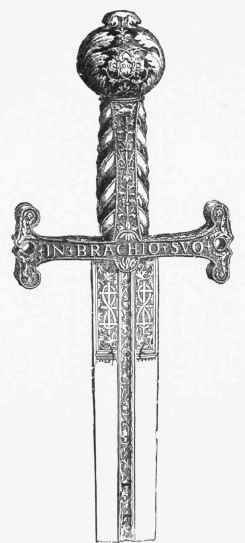
Sword of Francis I., with hilt of gold chased and enamelled. (Museum of the Louvre.).
Our readers need feel no surprise if we pass lightly over the daggers and poignards, in which the various transitions, undergone by the swords, are repeated, and of which the hilts, often elaborately wrought, have an equal claim to take their place in a collection of arms. We have yet to speak of hafted weapons before we arrive at fire-arms in their sequence. Lances are almost out of place, except in an armoury; it is not until we come to the falchions, boar-spears (epicux), partisans, and halberds, that we meet with picturesque forms and remarkable ornamentation; then we find the iron curiously cut out, and covered with elaborate engravings, wherein were often figured the gilded blasons of the prince, to whom the companies belonged. The partisan differed from the halberd, inasmuch as it had only lateral projections at the base of the blade; the axes of the halberds, which in the more ancient specimens have a straight edge, were sometimes made in the form of a hollow crescent, and sometimes had a convex outer or cutting edge.
It was not long ere war caused men to seek for some means of striking their enemies from a distance, and so prepare the way for hand to hand encounter. The invention of the bow, a well-aimed arrow from which could strike from afar, supplied this requirement; but the range still remained too limited, and the arrow did not always reach its mark; to it succeeded the cross-bow, which was a bow of great strength, fixed upon a frame or stock of wood, having a hollow groove to guide the bolt: next we have the arbalest ("a pied de biche ") with screw and winch-handle used in war, and arbalests discharging stones and bolts, more especially intended for the chase. These several kinds, which we cannot describe in detail, became, in the sixteenth century, the subjects of curious artistic embellishments; the wood of the stock was covered with incrustations in ivory, or in brass, finely cut and engraved, and the iron of the bow was chased with extreme delicacy. One may instance the stone-bow (arbalete a jalet) of Catherine de' Medicis, the stock of which, of ebony sculptured with dolphins, and charged with the fleur-de-lys of France, has mountings of burnished steel finely chased and damascened in gold, with the monogram of the celebrated Florentine. From the cross-bow to the arquebus was but a step in art, although, viewed from a military point, an entire revolution. As this revolution is nearly coincident with the beginning of the sixteenth century, it is clear that our view is not by any means exaggerated; the same two classes of artisans wrought upon both, the armourer to forge the barrels and lock-mountings, the carver in wood to shape and ornament the stock. We need not describe the various sorts of arquebuses with wheel-locks, the earlier ones on the external principle, those of a later date with works concealed beneath, and in the body of the lock-plate. It was about the year 1630 that the cock and hammer replaced the wheel, another most important change, yet one which had not the slightest influence upon the ornamentation of arms, or their decorative aspect.

Pistols, of the Renaissance, in carved ivory, the barrels and looks in chased iron upon a granulated gold ground.
(Collection of M. Spitier).
The earliest armourers renowned for their arquebuses were Simon Marenarte and Pedro Maese, whom Charles V. brought to Madrid to establish there a manufactory, which, so late as 1777, turned out a beautiful weapon signed by Fran0 Ant0 Guarzia. Maistre Gaspard, a Milanese, was also held in high esteem in the sixteenth century, as Brantome declares him to be "the best forger of guns and master-workman who will ever exist." Nor was France far behind, and we find upon a wheel-lock carbine of the seventeenth century the name of Habart, of Nancy. As to Germany, she has given us Frantz Heintz, of Sternberg, and Johann Georg Dax, of Munich.
Pistols, which were nothing but small arquebuses, had also their artists: there are barrels signed by Giemutti, Antonio Francino, Gio-Battista Fran-cino, F. Bigoni of Brescia. Giovane Borgognone of the same town, made the ornate locks for pistols, the barrels of which issued from the celebrated workshop of Lazarino Cominazo. La Fontayne, of Mouergues, put his name, in 1645, upon some fine French pistols, and we know, moreover, that between 1590 and 1603, there was, at Blamont (Meurthe) a manufactory of pistols which was held in great repute.
The inventors of the "tauchie," or incrustation upon wood, signed their names less frequently. However, we meet with a wheel-carbine ornamented by S. Fachenauer, and pistols ascribed to Gio Marno; Barto Bonfadino has also left his name upon a wheel-lock pistol.
Continue to:


My Books

