


Arms in The East
Description
This section is from the book "A History Of Furniture", by Albert Jacquemart. Also available from Amazon: A History Of Furniture.
This section is from the "" book, by .
Arms in The East
The Orientals, so far in advance of us in the invention of gunpowder, since the Chinese had discovered it 400 years B.C., were nevertheless very far behind it in the manufacture of defensive arms. Persia, India, and Circassia, have retained, almost down to our own times, those coats of chain-mail in which the men-at-arms of the thirteenth century were clad. It is on a few suits only that we see those four rectangular plates called mirrors, and intended to afford special protection to the chest, back, and sides. These plates were very frequently embellished with incrustations of gold and silver, and with religious inscriptions invoking a moral defence against the blows of the enemy. The suit was completed by a round shield, of rhinoceros' hide, or of iron, highly ornamented, which covered the left side of the body, and by brassards with gauntlets of mail, the coude, or elbow-piece, of which protected the right arm while wielding offensive weapons. Nothing can be more elegant than these brassards, mostly damascened, often in reliefs, in imitation of movable plates, and always enriched with borders, medallions, and legends, in gold inlaid in the metal.
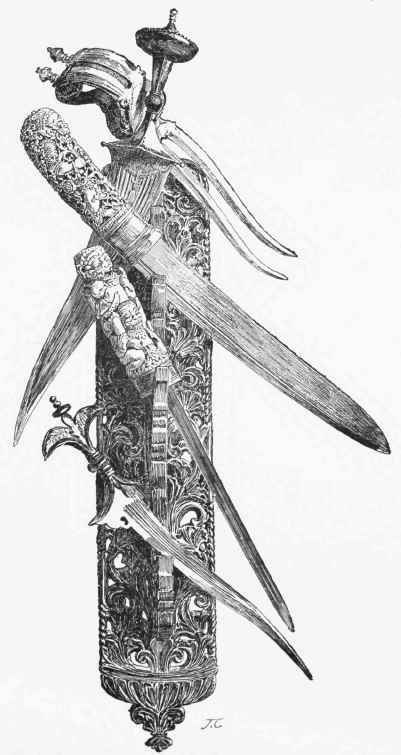
Rack, of antique Birman Arms, with hilts of carved ivory, or of damascened work. (Collection of M. J. Jacquemart.).
The head-pieces correspond in style with the rest of the costume; they have generally a spherical top surmounted by a quadrangular spike, with a movable nasal floriated at both extremities, and provided with one or two plume holders, a camail attached to the skull-cap, of chain-mail, which hung down in long folds, completed the defence of the neck. Frequently of links of exceeding fineness, the camail was usually wrought with gilded rings into a lozenge, or striped pattern.
The Circassian and Indian head-pieces, which, by the way, strongly resemble each other, are almost always damascened with gold, and occasionally have engraved medallions with inscriptions in relief; whereas the Persian helmet is materially different; the top is conical, and surmounted by a sort of movable ring, which takes the place of the spike in the other styles. This head-piece, strengthened at its circumference and on the summit by the addition of applique open work, and relieved by gilded ornaments, and medallions inlaid with legends in niello, has beauty and grandeur as a whole, and is incomparably elegant in detail.
This is the place, if not to describe, at least to mention those armours of the far East, which also are rapidly disappearing. The Chinese have no armour of any of the styles yet instanced by us: their mail is a species of brigandine, the metallic plates of which are concealed beneath an elegant outer covering of woollen stuff. From this the Japanese hardly differs at all; in its usual form, it, too, is a sort of brigandine of plates of metal over-lapping each other, and held in their places by cords of silk. The head-piece is of metal, frequently lacquered and ornamented with a large neck-guard, or camail, of movable scales, and a species of oreillette almost invariably with heraldic blazons, and also a front ornament of a crescent shape, or in imitation of the horns of the ox: the visor, which varies in size, falls over a grinning mask of blackened copper, which protects the lower part of the head. In some ancient suits, a real corselet of plate iron, damascened, is substituted for the pectoral and dorsal plates, and the round-topped helmet, with its visored front, would seem to have been copied from the basinets of the fourteenth century. The "armes blanches" of these Eastern nations are among the most precious ornaments of a panoply: their elegant hilts, in some instances of the carved tooth of the sea-horse, or of ivory, more generally cut cut of gold or silver, or such hard substances as jade, agate, or rock-crystal, are further enhanced by the application of precious stones. But it is not in this alone that their merit lies, the blades of Damascus have a European reputation; and, in spite of the fame which those of Toledo have enjoyed even in the East, some examples of the Damascus swords have become extremely rare, and at this day fetch even there fabulous prices never approached in France. One celebrated maker, Assad-Allah of Ispahan, who lived in the time of Abbas the Great, has given his name to the most beautiful blades, and in the East, to this day, men speak of an Assad-Allah as do we of an Andrea Ferrara or a Clamade. We must, however, add that this reputation is even a danger for the collector, as many arms have received the name of Assad-Allah in order to enhance their price. The genuine blades may be distinguished by their exceedingly fine grain, and by the excellence of their temper; they are known by the name of the Old Indian steel, the secret of the manufacture of which has been totally lost.
The most famous sword-cutlers affixed their names or marks, and we have seen this inscription: "Abbas Sarlahnaber has forged the Lion of God: there is no Prophet but Ali: there is no sword but Joulfiker." It is in Persia chiefly that the renown of the famous blades of Khorassan still survives; the black Damascus of Constantinople are still in great request; in a word, there are varieties, even in the damascening itself, due to the style of manufacture, as, for instance, the bilious damascene remarkable for its yellow tinge. In the grey or black damascene, distinction must also be drawn between the rough variety, that in scales, and those in which the working presents singular peculiarities, such as open-work carving or blank spaces studded either with small rubies or damascened balls running between the grooves.
The Persian and Turkish scimitars are all of curved form, and the hilts are somewhat plain; their sole merit is in the blades. India, on the other hand, presents numerous examples of straight weapons, species of swords or sabres, widening towards the point, denominated Khounda. The Indian hilts can be almost invariably known by their small dimensions, and by a bowl-shaped roundel, which serves for the pommel; occasionally this rounded top is prolonged into a small slightly curved spike or point.
Now and then Indian swords are met with, in which the round hilt completely covers the hand, and is prolonged by a brassard; and also some the blades whereof are flamboyant, and have serrated edges.
It is needless to remark that the daggers are no less rich than the scimitars; frequently damascened on the blades, they have costly hilts of the highest elegance. Jade, or crystal relieved by precious stones set in gold are the most common materials, and, what is very remarkable, this richness and taste appear to extend to all nations of Indian origin, to the Burmese Empire, the Malayan Peninsula, the Kingdom of Siam, and even to Java. All the latter class of productions may be distinguished by the presence of monstrous figures, quite foreign to the styles of ornament in use among the Hindoos properly so called.
In this department, especially among the daggers, and beginning with the Khouttars, there is quite a valuable and interesting collection to be made, the Krises and the Malay knives, with their marvellous chasings in gold and silver, complete the series.
We would speak of the maces with ribbed wings cut out in open work, the shafts damascened and studded with turquoises; of the battle-axes with cutting edge, bordered by inscriptions, of iron inlaid with gold, the shafts of which were sometimes transformed into a primitive pistol, with matchlock; and also of those so-called hafted arms (armes d'hast), lances, etc, the staff either painted in lacquer work with the richest arabesques, or entirely of chased iron, the blades chased with fine arabesques and set off by rubies.
But we must come to missiles, and pause for a moment over the bows, primitive instruments to be sure, but which have yet continued in use in Eastern countries down to modern times; the huge bows of India, of wood painted with fine polychromatic embellishments, and those of China with decorations in lacquer work, are not the only curious articles which merit a place in our collections; we must also include the rare bow-cases, and the quivers of stuffs embroidered in gold and silver, or of leather with mountings of metal chased and engraved.
Before entering upon the consideration of their fire-arms, we should like to know exactly what historians designate, among the Chinese, and long before the Christian era, as tubes of fire, ho foung, and globes containing the celestial fire, Tien ho kieou. If these are not the gun and the shell, they resemble them strangely. And yet, during the last 4,000 years the "Empire of the Middle" has progressed so slowly that we know how infinitely inferior their arms are to our own.
Of all the Eastern peoples the Persians were the most anxious to rival in arms the nations of the West; their skill in damascening enabled them to turn out superb gun-barrels, often rifled in grooves inside, and provided with movable rests and a sight to direct the aim; and yet, strange to say, they fired without bringing the gun to the shoulder, and their fire-arms without a butt-end must have projected beyond the shoulder. Moreover, the locks remained unalterably primitive, and never progressed beyond screw plate or miguelet, the tumbler not being protected, so that accidents must have been of frequent occurrence. But from an artistic point of view nothing could be more exquisite: damascenings and inscriptions covered the barrels and locks, mountings in nielloed silver showed out on the grey of the damascene work, or the leather, black or green, with which the stock was embellished, and where the mounting ceased the wooden stock itself was relieved with fine and elaborate mosaics, of metal pique, wood, or ivory. Oriental firearms therefore are not unworthy of vying in trophies with the arquebuses and carbines of the Western Renaissance.
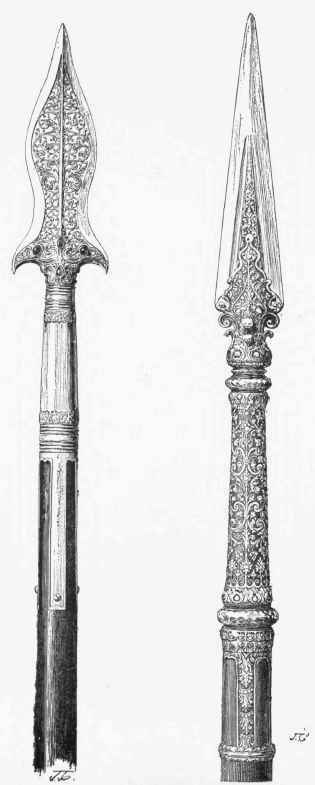
1. Lance of damascened work, chased and set with rubies. 2. Lance of damascened work, chased, and overlaid with silver. Hindoo work of high antiquity. (Collection of M. J. Jacquemart).
Continue to:


My Books

