


Chapter IV. Wood
Description
This section is from the book "A History Of Furniture", by Albert Jacquemart. Also available from Amazon: A History Of Furniture.
This section is from the "" book, by .
Chapter IV. Wood
In the daring task undertaken by us to show Art-lovers the paths open to their research, and the chief points whither history beckons them to safe havens, there is assuredly nothing more arduous than a survey of the monuments executed in wood. Shall we go back to the rudimentary statues, mere trunks of trees, scarcely rough hewn and daubed with red - the first gods of the Greeks? Or shall we pass over such recondite themes, which for many would seem but pedantry, and come to those marvellous statues, the work of the early Egyptians, preserved for well-nigh forty-nine centuries, as evidence of the persistence of human genius? But we need not speak of such rare and famous works either known to connoisseurs, or which they can inspect in the Boulak Museum, or in the galleries of the Louvre, but which they can never hope to acquire.
Even the statues of wood, spoken of by Pliny, had already become subjects of conjecture in his time. They were described from traditional reports, and the very material in they were carved had become a matter of controversy, some holding it to be cypress, others ebony or the vine. Leaving, therefore, these antiques, some few fragments of which have barely reached our days, and omitting the intervening centuries, let us come to mediaeval times, which not only made a systematic use of wood, but, moreover, subjected it to fresh forms, thus revealing a new phase of Art.
Here, indeed, we do not find, as in ivory, successive stages well defined by the modifying influence of advancing civilisations. The idea appears of a sudden, as if conjured up by some special want, and it continues to fructify under the conditions that gave it birth. The sumptuous conceptions of the Eastern Empire would have adapted themselves but indifferently to the simplicity of wood, even when set off with painting and gold. Nothing less would have suited them than repousse gold, or, at the very least, gilded and enamelled bronze. The more simple minded West, with its mysterious monuments, its timid faith and mystic aspirations, could alone have invented that charming iconography, the earliest specimens of which are to be seen in the carvings of the porticos and the capitals of our mediaeval cathedrals. But the masons, both builders and statuaries, were a nomad race, migrating to great distances to supply the demands of mediaeval enthusiasm. The wood carvings of the retables and those of the interior decoration of the churches forming the details and the furniture, so to say, of religious worship, were, on the other hand, entrusted to the genius and zeal of the local schools of Art, and it consequently becomes more interesting to study the works produced by them, than the sculpture on stone.
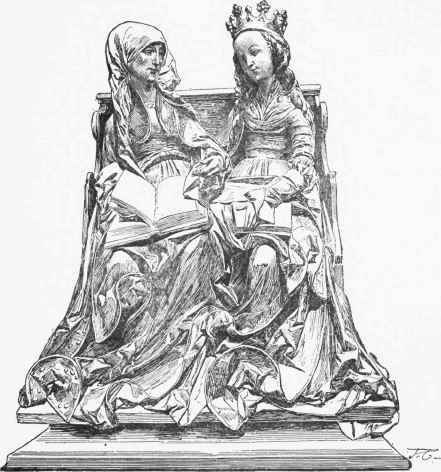
The education of the Virgin ; a group in wood painted and gilded ; French work of the fifteenth century.
(Fould Collection).
We need not therefore feel surprised at the rareness of very old specimens in wood. At Cluny we have a Christ of natural size, and draped in long robes, according to the custom of the eighth century. Its somewhat Byzantine style is explained by its date - the twelfth century - and it comes from Auvergne, where the monuments of the Romanesque period are so numerous and so remarkable. For the following century we find, also at Cluny, the statue of St. Louis in yew, formerly forming part of the retable of the Sainte-Chapelle. Here we have a proof of what was stated higher up. There is no necessary connection between this piece and the statues of the twelve apostles executed under the orders of Pierre de Montereau, the perfection and the style of which we have been enabled to judge of from the beautiful head of St. Mark exhibited by M. Edmond Bonnaffe. The Cluny statuette is evidently Parisian, harmonising with the ideas current at the time. The head, of somewhat large proportions, delicately worked out and carefully painted, indicates certain realistic tendencies, for it is doubtless a portrait, the simple and kindly expression of which may very well correspond with the saintly character of the King. The draperies are also painted, and the mantle, seme with large fleurs-de-lis, envelopes the body, inclined a little to one side and narrow at the shoulders, in a word showing the curved and long lines familiar to the artists of this period, who worked both in wood and ivory.
In the fourteenth century the monuments crowd upon us, all affecting the so-called Gothic type, characterised especially by its artless delicacy. At Cluny we have the group of the Virgin from the Soltykoff collection, the fragment of the retable of the Abbey of Cluny, all that intricate and patient sculpture enriched with colour which becomes so common in the next century. It is here above all that it would be so interesting to possess accurate information as to the places where such works were produced, in order to study the various styles, we had almost said the more or less educated hands, characteristic of each locality. One would gladly know the nature of the influence exercised on southern art by King Rene, or that of the Dukes of Lorraine and Burgundy, so much more potent as it was, on the centre and the east of France. A few land-marks have already been ascertained in this vast region, but far from enough to enable us to build up any complete theory. The most reasonable conjectures are still constantly disturbed by numerous exceptional phenomena.
Continue to:


My Books

