


Wood. Part 2
Description
This section is from the book "A History Of Furniture", by Albert Jacquemart. Also available from Amazon: A History Of Furniture.
This section is from the "" book, by .
Wood. Part 2
The art of wood-carving has left written records in France going back to a tolerably remote period. In 1379, the inventory of the Treasury of Charles V. mentions Girard d'Orleans as having made for the King, " ung tableaux de boys de quatre pieces." In 1391, Jacques de Baerze carves two retables; in 1422, Claes de Bruyn executes a statue of the Virgin, while in 1443, there flourished two Flemings, Henry and William. Flemings? It will be asked. Then the claims of France may be greatly enlarged. Of this there can, indeed, be no doubt, and this is itself one of the most serious difficulties in the history of the Arts. When the Dukes of Burgundy ordered works, some for Dijon, others for Brussels, how is it possible to separate those by whom they were executed, into two classes - the Flemings and the French? Was not the school essentially one, swayed by a uniform style, and subjected to the discipline of one master-thought? This is precisely the reason why it will be possible one day, by dint of local research and comparisons, to discover the national characteristics spoken of at the outset. Such characteristics were based much more on the quickening influences of work, than on personal qualities, for the full development of which there was still wanting a freedom of individual action, at that period rendered impossible by the rules of the guilds.
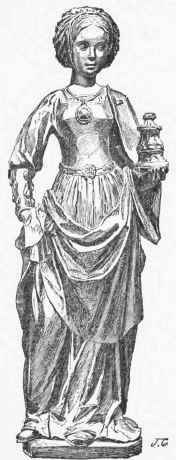
Figure curved in wood, Pandora or Mary Magdalene; costume of end of fifteenth century: French work.
(De Meynard Collection).
Let us endeavour to explain ourselves by a few illustrations. Here is a little figure of the fifteenth century, inspired, as we think, by the unstudied grace of French art in all its primitive freshness. It represents a young woman in an elegant and simple costume, in her left hand holding a covered vase. Some take her for Pandora with the fatal box, such as the mediaeval art delighted to associate with religious conceptions. Others again recognise in her one of the holy women on her way to the sepulchre, to embalm the body of the Saviour, already risen from the dead. But whatever view be adopted, here is what all will agree in observing - a natural and modest attitude, draperies well disposed without study, head somewhat heavy, features delicate without affectation. All these are the essentially national traits that have been long preserved almost unaltered in the North of France.
In this other magnificent painted and gilded group belonging to the Fould collection, and representing the Education of the Virgin, everything is different, although the work is of the same epoch. The long robes are of sumptuous materials, such as might have been worn at a brilliant Court, and the Virgin is in fact crowned like a queen. In her elongated features and thin arched nose, her mother, St. Anne, shows a type already noticed in an ivory statuette of St. George, and which would seem to have been peculiar to the race of the Burgundian dynasty. The artist must have accordingly taken his types and costumes from his patrons themselves, to his personal inspirations adding the results acquired by familiarity with the masterpieces of every description that must have been found at the Court of one of the most enlightened princes of the period. Thus the disposition of the draperies, with their wide and broken folds turned back towards the skirt, implies a study of the paintings of John van Eyck, painter, and valet de chambre of Philip the Good, or else of Martin Schongauer's engravings and compositions. These traits, which became common to the whole Burgundian school, are conspicuous also in the magnificent retable on which is figured the Purification of the Virgin.
It would be desirable to be able to compare these works with those of the Germans, which ought to show a close analogy with them. So early as 1431, Lucas Moser executed some sculptures at Tiefenbronn that have since become famous. In the same place, Schiilheim distinguished himself by a Descent from the Cross, while the Chapel of the Holy Sepulchre at Bamberg preserves the splendid coloured retable, the work of Adam Kraft, who died at the opening of the sixteenth century. Now the most striking character of these compositions is a thorough realism, a relative meagreness and less searching study, than in the Burgundo-Flemish sculptures. There may be seen at Cluny a St. Catherine and a Mary Magdalene of very fine execution, and especially a large quantity of coloured bas-reliefs, fragments of retables, all showing the characteristics we have just pointed out.
The transition from the fifteenth to the sixteenth century is scarcely to be detected in the greater part of the French and German works. The costumes will often already announce the Renaissance, while the details, the surroundings, the backgrounds are still in the Pointed style. Nothing shows this contrast more forcibly than the retable of Champdeuil now in Cluny. Here the draperies display eccentricities of fashion, that might seem to have been inspired by the "Triumph of Maximilian." The features are marked by an exaggeration verging on caricature, such as is found, as a rule, only in an art that has grown old; and yet the whole still retains the appearance of a production of the close of the fifteenth century! At the same time one may ask by what accident did this obviously German work find its way to a church of the Seine and Marne, where it was certainly executed, the paintings of the closing shutters being in the French style, and bearing the legend several times repeated : " A fait Lucas Lois peintre du donateur Demorant. . ." (made by Lucas Lois, painter of the donor Demorant) . . . ? This uncertainty of style is found in a large number of other sculptures even undoubtedly German. We can give no better instance than the little figure of the fifteenth century, adorned and decorated with floriated work, according to the practice of the Renaissance. Its somewhat strained grace, and the excessive care lavished on the details would seem to betray that exaggerated refinement which soon becomes the distinctive mark of the Nuremberg school. So also this German figure, in its rich theatrical costume, and many other works carved in wood, partake of the Gothic and the Renaissance, and we must wait for the middle of the sixteenth century to see the thorough development of the grand style, itself destined soon to degenerate through the very excess of studied elegance.
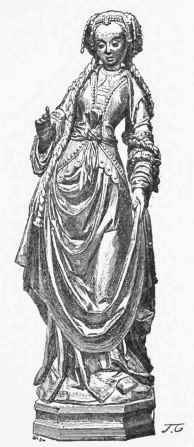
Statuette carved in wood; costume of the end of fifteenth century. German work. (J. Fau's Collection.).
In this movement, France had preserved her simple, artless attractions and her racy spirit of raillery. What a caustic touch Le Gentil of Troyes has contrived to give to the sullen, thick-lipped features of the Canon Guy Mergcy! Here his witty humour, doubtless, saw a chance of indulging some long-cherished feeling of revenge, seeing that he carved a masterpiece of sculpture out of a block of wood intended to serve as a salt-box. This remarkable work was executed about the year 1545, though from its head-dress one might suppose that it dated from the end of the fifteenth century.
Continue to:


My Books

