


Wood. Part 3
Description
This section is from the book "A History Of Furniture", by Albert Jacquemart. Also available from Amazon: A History Of Furniture.
This section is from the "" book, by .
Wood. Part 3
As we are speaking of France and of the masterpieces of wood carvings, we must not overlook Germain Pilon, prince of sculptors in wood. While admiring the four cardinal virtues intended by him as supports for the relics of St. Genevieve, we feel how indifferent genius is to the material it works in. Here the wood is made to speak as eloquently and becomes as finished in appearance as marble itself.
At the same time, we readily admit that wood must be much more suitable for statuettes than for monumental works, a proof of which is afforded by the groups and bas-reliefs of the former Sauvageot collection, notably the Pallas, the group of the three doctors and the female bather, by Jean de Bologne. Here the pear-tree wood adapts itself to all the delicate touches of the modelling, and certain carvings will even bear comparison with the Florentine bronzes.
Before approaching the modern period, let us state why we have here departed from our usual plan, so far as not to quote in chronological order the artists whose works should ever commend themselves to the collector. The fact is, here the difficulty verges on the impossible. In 1379, the inventory of the treasures of Charles V., mentions Girard d'Orleans as having made for the king "ung tableaux de boys de quatre pieces." But how many masterpieces must have been created between this date and that of 1584, when the archives of Lille mention Gilles Capitaine, carver in wood!
Let us remember that the monkish artists in France worked at that time without the stimulus of personal fame, never aiming at becoming known outside the cloister. Hence, here, as in the case of the alabasters of Lugny, it is in the general list of sculptors of images that must be sought the somewhat rare names of the forerunners of French art.
It is the same for Italy, and in the choice specimens that adorn the public and private collections. There is a total dearth of names, and a comparison of style with the bronze or marble works can alone enable us to venture here and there on determining a school or a particular work. Nevertheless, the "Piazza Universale" quotes as excelling, especially in wood sculpture, the names of Gasparo Moranzone, Donatellc, the Cannozzi, Paolo and Antonio Mantoani, Bernardino Ferrante, F. Scbastiano da Rovigo, F. Giovanni da Verona, lay brother of Mount Oliveto, Mariano Francesco, who had worked on the choir of Sta. Giustina at Padua, and entirely decorated that of the regular Lateran Canons at Sta. Maria in Porto at Ravenna.
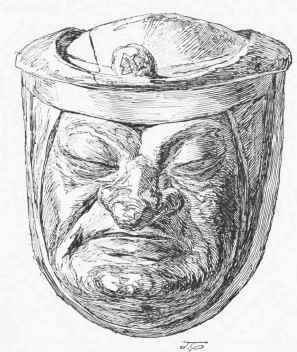
The Canon Guy Mergey, carved wood saltcellar by I.e Gentil of Troves. Marquis de I.aborde's Collection.).
In Germany also wood carving was held in high esteem, and here we may quote a considerable number of names rendered famous by works executed on the public monuments. Hence, it may be presumed, that the same artists, after having carved the Descents of the Cross, the Annunciations and retables with their manifold scenes, sought employment on decorative work of an inferior order, and that the authors of the statuettes or medallions collected by connoisseurs, must be looked for in the subjoined list.
XlVth Century. | - | Bartolomeo di Paolo. |
- | 1391. | Jacques de Baerze. |
XVth Century. | 1409. | Francesco di Domenico di Valdambrino. |
- | 1422. | Claes de Bruyn. |
- | 1431. | Lucas Moser. |
- | 1468. | Schiilheim. |
- | 1498. | Du Hancy. |
XVIth Century. | + 1507. | Adam Kraft. |
- | 1514. | Jehan Pothyn. |
- | + 1519 | Wohlgemuth. |
- | 1521. | Hans Bruggeman. |
- | 1521. | Daniel Mouch. |
- | + 1529. | Peter Vischer. |
- | + 1535. | Ludwig Krug. |
- | 1541. | Nicholas Quiesnel. |
- | + 1542. | Veit Stoss. |
- | + 1546 | Peter Flotner. |
- | + 1546. | Johan Teschler. |
- | + 1550. | Hans Schaufflein. |
- | + 1564. | Jacob Hoffmann. |
+ 1586. | Wentzel Jamnitzer. | |
- | Antonio Mantoani. | |
_ | Andrea Brustolon. | |
- | The Brothers Cannozzi. | |
- | Donatello. | |
- | Bernardino Ferrante. | |
- | Fr. Giovanni di Verona. | |
- | The Brothers Jacquot. | |
- | John (German School). | |
- | Mariano Francese. | |
- | Mariano Francesco. | |
- | Francesco Moranzone. | |
- | Gasparo Moranzone. | |
- | Paolo Mantoani. | |
- | Fr. Sebastiano da Rovigo. | |
- | Richard Taurin, of Rouen. | |
- | Francesco del Tonghio and his son Giacomo. | |
XVIIth Century. | + 1630. | Leo Pronner. |
- | 1659. | Cesar Bagard, of Nancy. |
- | ., | Bayard, of Mirecourt. |
XVIIIth Century. | 1704. | Leo Baur. |
- | 1727. | Antonio Corradini. |
- | 1728. | Otone di Manzano. |
- | 1776 | Rousseau de la Rottiere. |
- | " | Marc. |
In the seventeenth century wood carving becomes less common. The few specimens still to be met with by the hand of Francois Flamand and some other celebrities, rather form exceptions to their general habit of preferring ivory for their statuettes, groups and favourite bas-reliefs.
Before concluding this necessarily somewhat rapid sketch, we may also mention the remarkable works of the sculptor Bagard - the Saviour, group of Holy Women or the Guardian Angel admired at the retrospective exhibition of Nancy, his native city.
Continue to:


My Books

