


Wood in The East
Description
This section is from the book "A History Of Furniture", by Albert Jacquemart. Also available from Amazon: A History Of Furniture.
This section is from the "" book, by .
Wood in The East
Still more universally than in the West, wood has been employed in Asia for decorating temples and houses. The very finest specimens of Indian art are to be found in those fretted or open work enclosures of the ancient pagodas, and the richly carved gates of their palaces. We may refer to the enclosures in sandal-wood of the pagoda at Perur, the famous gates of Somnath, and the wood carvings that adorned the interior of the old palace of Dummul in the southern Mahratta country.
The collection formed by the care of the French Minister of Marine includes a somewhat remarkable contingent of old Indian wood carvings, with representations of the strange divinities of their complicated theogony. Objects such as these are doubtless rather too disfigured by age, if not too barbarous, to be admitted into the elegant dwellings of men of taste. There are, however, some more recent statuettes in wood painted and gilded, alike interesting for art and for history, while supplying fresh and valuable landmarks in the great highway traversed by the human intellect.
We may also mention some charming objects, such as boxes, screens, fans, etc, in which the delicately carved sandal, notwithstanding a perhaps somewhat excessive exuberance of detail, still betrays the ever marvellous taste of this people. From this epoch dates the introduction into their carvings of grotesque subjects and fabulous animals - the yali, the garuda, fanciful mingling of lion and dragon, or of the human figure with the bird, or else the tapir of the Malay Peninsula, and art loses the simplicity and grandeur of the Buddhist period.

Iarge fan in two branches, carved in sandalwood; old Indian work. (M. J. Jacqnemart's Collection.).
The extreme east is more available for our purposes, and in the civilised art of these regions, there may be found many conceptions worthy of the serious study of connoisseurs. We shall not speak of those fantastic man-dragores, the inheritance of superstition, which, with the help of a little ingenuity, has detected in them the figure of the dragon, of the tiger, and even of man himself. But let us pause before the figures, boldly carved in close-grained woods or in the roots of the bamboo, in order to realise their grand features; and at times, the minute perfection of their workmanship. As a rule, the statues of hard wood are characterised by a bold design, broadly conceived, and draped with singular taste. Representations of warriors, sages, and certain graceful figures of Kuan-in are genuine pieces of sculpture. A bamboo-root has often been fashioned into little pantheons, in which the statuettes of the immortals seem to move about, or repose upon a sort of sacred mount, overgrown with evergreen trees of the pine order. Turning to account the accidents of a knot, or the outlines of the rind or husk of a fruit, the artist will occasionally carve perhaps whole groups sheltered under the rugged projections of a rock, or else a number of boatmen navigating a boat.
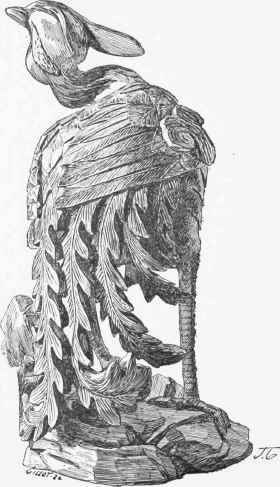
Fong-hoaug curved out of a bamboo root ; antique Chinese work.
No less remarkable than China is Japan for its wood-carvings. From the sides of a bamboo cane, they will conjure up hilly and wooded landscapes, enlivened by wayfarers moving about among the trees. Their figures, their groups, and masks fashioned into charms or trinkets for the girdle, are unrivalled except by objects of the same description in ivory. Here, also, the finished workmanship, combined with a vein of caricature, distinguishes the Japanese works from those of China. Amongst the productions of Niphcn, we must make special mention of certain birds and animals, often very animated, which are set up in Japan at the threshold of the temples, or the entrance of the houses, but, which in Europe, may very well stand in an ante-chamber, or at the entrance to a gallery in company with the large painted effigies of the god of war or of Fo-Tci, god of contentment.
The reader will not be surprised if we do not speak of the Mahommedan, and especially the Arabic carvings. Iconoclasts by virtue of their religious tenets, they have devoted all their artistic genius to the composition of ornamental work; but the gap they leave in this branch of art history is largely compensated by the importance of their furniture work and architectural ornamentation elsewhere described by us.
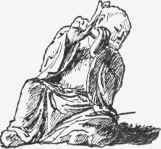
Chinese figure carved in hambon.
Continue to:


My Books

