


Ivory in The East. Part 3
Description
This section is from the book "A History Of Furniture", by Albert Jacquemart. Also available from Amazon: A History Of Furniture.
This section is from the "" book, by .
Ivory in The East. Part 3
These little trinkets or charms, known as Japanese buttons, are the only ornaments with which the upper classes relieved their severe costume - while there still existed a national costume. Each of these little groups with their studied expressions and dress, at times profusely ornamented, is an original composition, a chapter on history or manners, a caustic satire aiming its darts at the social vices, and often at religion itself. Here a Sintoist doubtless wishing to jeer at the Tao-sse, has represented Cheu-lao, making the most comical grimace beneath his prominent skull, which is turning into a cucumber; here again is the same god typified by a cuttlefish fixed upon a rock. Elsewhere, groups of devotees joined in the most grotesque attitudes, and making the most hideous faces; but, on the other hand, there is no lack of more graceful types. Here are young women in elegant head-dresses and richly attired, one of them suckling a child. On examining her little head bent over her nursling, we are astonished at the skill of the artist, in representing on such a minute scale the tender care of a mother, and the total abstraction from everything except the child of her affections. Nor is this an exception or a mere compliment. By the lady's side is the housewife, making her toilet over a tub - a charming figure. Here again, is another washing her linen, in company with gossips of various ages and expressions, some cooking, some working. But where Callot himself is eclipsed, is in the series of mendicants. Nothing can be imagined more curious or more picturesque than these real or sham cripples - men borne on the backs of animals, or themselves carrying monkeys, repulsive in grotesque associations. Wrangling and fighting, nothing is wanting to satisfy us that the "Cour des miracles" is no western invention.
We need not refer to the thousand scenes of domestic life, of travels, movings, and many others in which decorum is not always sufficiently preserved. But we must also say a word on the representations of animals, no less correct and amusing than the others in their infinite humour and variety. Here we have a lavish display of the most fanciful and comical conceptions - frogs dancing a wild sarabande on an old straw slipper, rats clustered together, showing on all sides their lively faces, a mouse that has taken possession of a fruit, and ensconced itself in it like the rat of the fable in its cheese. Here is a chestnut pierced by the gnawings of a worm, that has traced out, hollowed in the ivory, a narrow passage, emerging at last through a hole in the brown rind, and crawling to the surface, where it seems as if still creeping, so life-like is the imitation. Here again is an egg, an irregular fracture in its broken shell giving a peep inside; as far as the eye can reach, it detects the microscopic figures of a Buddhist and pantheon, each divinity of which may be recognised by his features, as well as his distinctive attributes.
After studying these ingenious objects, equally distinguished by their science and inspiration, we remain convinced of the enormous difference between the Chinese and the Japanese from the artistic point of view. The former, at once painstaking and skilful, reproduce, with undeviating fidelity, the types handed down by the national workshops from time out of mind. The latter, trained to the study of nature, and left to the inspirations of their own genius, infuse into their works that instinctive humour and pungent fancy, which a philosophic mind may delight to embody in grotesque scenes, in order, through them, to aim the shafts of satire against the manners of the times. The Japanese trinkets thus present some analogy to the English "Punch," or the French "Charivari".
But in our admiration for the almost French spirit of the Japanese sculptors, we must not overlook the Arabian works, the perfection and taste of which are above all praise. Here we have no longer to look for graceful scenes or sacred representations. All animated nature is forbidden to the artist, whose ingenuity is fain to restrict itself to the various combinations of the straight and curved line, and to a more or less idealised copy of the vegetable kingdom. Yet one is lost in amazement before the marvellous conceptions inspired by a field apparently so simple and limited. Endless meanders and graceful foliage are mingled in seemingly inextricable confusion, the prolific exuberance of a practically inexhaustible genius. Hence no attempt can be made to describe these combinations, an idea of which can be formed from the actual design alone.
We shall here refer to two of those cylindrical caskets with their slightly convex lids surmounted by a button, in which beauty of execution is combined with historic interest. The first, described in the " Nouveau Cabinet de l'Amateur," contained, in its purely Arabian style of perforated ornamentation, a dedicatory inscription to Hachem Mostanser Billah, Commander of the Faithful. This Hachem II., Ommiade Caliph of Cordova, son and successor of Abderam III., and who reigned from 961 to 976, is famous in the annals of letters as founder of the Cordova Library and Academy. The second casket, shown at the Oriental Exhibition of the "Union Centrale des Beaux-arts," also bore, round its lid, a legend in Cufic characters, vaunting its worth as equal to that of precious stones, and declaring it worthy of containing musk, camphor and amber. Also inscribed with the name of its maker, Kalaf, this monument would seem to have been executed about the year 1060, under the reign of Abderramen, Moorish sovereign in the North of Africa. Here the style entirely resembles that of the Alhambra.
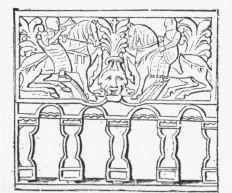
Norwegian seat.
Continue to:


My Books

