


Lacquered Furniture of The East
Description
This section is from the book "A History Of Furniture", by Albert Jacquemart. Also available from Amazon: A History Of Furniture.
This section is from the "" book, by .
Lacquered Furniture of The East
It is not our intention to examine here the marvellous lacquers of every description which have come to us from the East; we shall return to them later on, and speak at present of the special object of this chapter, lacquered furniture.
The whole of the extreme East, China, Japan, Annam, Persia, and India made use of gum lac for the decoration of furniture, and employed it with a taste which cannot be too greatly admired.
What we most frequently meet with are cabinets with double doors, concealing numerous drawers; others with etageres (sets of shelves standing on supports), the unequal compartments of which are arranged in the most charmingly fantastic manner, seats, stools, tables, gueridons, folding-screens, and fire-screens of various dimensions. Generally speaking, these articles of furniture are in black lacquer, decorated with gold reliefs; but some rather frequently met with are more or less of a bright red colour, in which the ornaments are chased, and form a relief on a guilloche ground. Amongst these chased lacquers there are two origins to be distinguished : China furnishes us with those of a vermilion red colour with very delicate details which come from the north, and are called in trade Pekin lacquers, although in the country they are designated as Ti-tcheou lacquers. Those of which the pale tint most resembles sealing-wax are the most recent; the more this tint darkens, the older is the furniture. In many etageres, the framework and the panels are red, and chased, and the lower shelves are in black lacquer and gold. Japan is the country where these lacquers were first invented, and some are to be met with of very ancient date; their general characteristic is a larger and bolder style of sculpture; the red is dark, and all the projecting surfaces are brilliant and glossy; in the etageres the shelves have usually black grounds, with coloured decorations without relief, that is, polished lacquer, generally composed of bouquets or birds. Some carved Japanese furniture is black or dark brown. It is in Japan, too, that the Chinese workmen who are specially employed in the Ti-tcheou lacquer, acquire their perfection.
The Japanese black and gold lacquers may be recognised by the beauty of their ground, which is always bright, intense and brilliant, and by the perfection of the ornaments; they not unfrequently exhibit armorial bearings; this is especially the case with the fessembaks, large travelling trunks, which serve the same purpose in those countries as our chests (bahuts) in the middle ages.
Some articles of furniture are relieved by burgau, that is, incrustations in mother-of-pearl; one particular species has a ground of pebble-work, or is seme with irregular and almost contiguous pieces of mother-of-pearl; they belong to a Japanese centre, which we have hitherto been unable to determine. A similar work, however, has been executed in Annam and at Siam, where the burgau lacquers are perhaps more frequent than others.
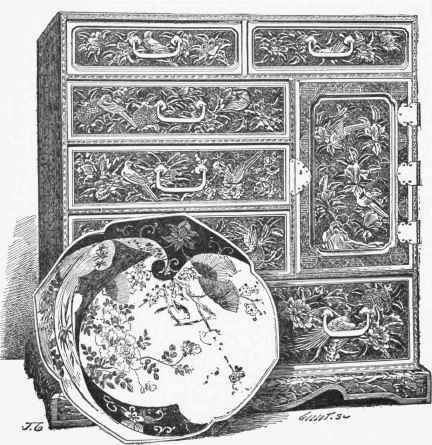
Cabinet of red chased lacquer of Japan. (Collection of M. P. Gasnault). Japanese porcelain dish with chrysanthemo-pceonian decoration. (Collection of M. J. Jacquemart).
Some very fine lacquers incrusted with mother-of-pearl are also made in Persia and India; unfortunately the quality of the varnish is not irreproachable, and the articles which reach us are all more or less deteriorated. The curious chest, ornamented with inscriptions, which was seen at the Sechan sale, and a no less curious table lined with coloured lacquer, which belonged to M. Jules Boilly, will not be forgotten; their workmanship was irreproachable, but the chatoyant mosaics were detached from the shell coating which should have held them.
To what country may belong an interesting species designated under the name of Coromandel lacquer, it is impossible for us to say. The designs are indicated by projecting cells reserved in the wood, almost the same as in a champleve enamel, and the different colours are placed in the cavities without thickness, and thus stand out better against the black ground. The subjects represented are almost always Chinese; the legends and inscriptions are in Chinese characters of the kiai or regular description, and the emblems also are those of the Celestial Empire, dragons, fong-hoang, cranes, etc. The largest pieces are armoires, which seem to have been made for Europe about the seventeenth century, large folding-screens, cabinets, and nests of drawers, doubtless intended to furnish bureaux. It is inexplicable how the origin of these articles of furniture could remain unknown. What is almost certain is that the coast of Coromandel has never manufactured anything similar. One of the finest armoires known is that preserved in the cabinet of medals; some magnificent screens are in the possession of M. Decaisne, member of the Institut.
Continue to:


My Books

