


Sec. 9. - Furniture Lacquered Or Varnished
Description
This section is from the book "A History Of Furniture", by Albert Jacquemart. Also available from Amazon: A History Of Furniture.
This section is from the "" book, by .
Sec. 9. - Furniture Lacquered Or Varnished
A distinction must be established here between European furniture, properly so called, that manufactured in Europe with Oriental elements, and furniture of Oriental origin.
At the time when China and Japan began to send us their precious lacquers, a movement took place amongst connoisseurs; some began forming special collections, others contented themselves with choosing the finest pieces to exhibit them 111 their sumptuous saloons together with the porcelain and the "magots" then so much in vogue; others went even farther, and would have desired that then their furniture should be incrusted with japanned plaques, with subjects or landscapes, in gold relief. The number of Oriental cabinets which our cabinet-makers must have destroyed in order to satisfy this fashion is incalculable. From the period of Louis XIV. we find pieces associated with Boule marquetry; under Eouis XV. the vogue continues, attaining its height during the reign of I.ouis XVI.
Our artists were too intelligent not to yield to the movement and take advantage of it; they had at first contented themselves with breaking up the etageres, boxes, and folding screens to use them for their purpose; but the supply of these manufactured objects being insufficient for the demand, they imagined the plan of sending their woods in a prepared state to the Oriental workshops, where they were lacquered, and on their return the pieces had only to be mounted.
This constraint, the delay it caused in the execution of the work, the immense augmentation in the return price, all concurred in inducing cabinetmakers to seek some means of replacing the Oriental gum lac by an analogous composition of the same effect. Ingenious men set to work, and if their success was not complete, they at least succeeded in making their names famous and endowing Europe with a new produce. The first of these, inventors was Huygens, a Dutchman, who must have followed his model rather closely, for if the name of the man has reached us associated with a certain renown, his works are unknown, a fact which proves that they are lost among the mass of second-rate lacquer work which is rejected at the present day. The second and most celebrated was Martin, or rather the Martins, for it was a family, about which M. Louis Courajod has collected the most curious details. Before 1748, the fame of the Martins was established, and their workshop had been honoured by the title of "Royal Manufactory." They had three manufactories: one in the faubourg Saint Martin, another in the faubourg Saint Denis, the last in the rue Saint Magloire. A decree of Council on the 19th February, 1744, had enabled the sieur Simon-Etienne Martin the younger, "exclusively of all others," to manufacture during twenty years all sort of works in reliefs, and in the style of Japan and China. This decree evidently relates to imitations only, and it is certain that the Martins executed some which were very remarkable; we have seen boxes and caskets in which one would hesitate to recognise an European work, if certain details in the costume of the figures, and certain trees in the landscapes, especially the palm trees, did not betray this particular invention of an imaginary East which was in vogue during the whole of the eighteenth century, in spite of the descriptions of travellers, and the figures sent over to us by the Orientals themselves.
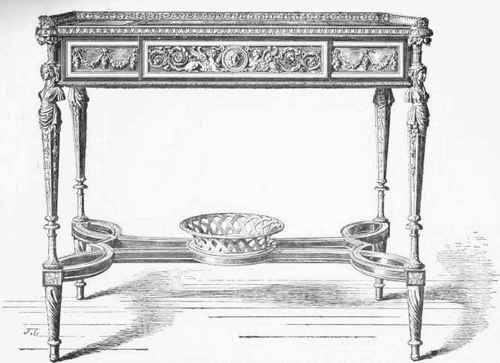
Small table given by Marie Antoinette to Madame de Polignae, the top of Japan Jacquer, mounted in chased and gilded bronze End of the Louis XVI. period. (.Museum of the Louvre).
M. Courajod tells us that Madame de Pompadour prized the vernis Martin, and introduced it into her own surroundings; he adds: "The Dauphin seems especially to have appreciated the vernis Martin work, and the pleasing effect that may be obtained from it in the decoration of houses. One of the Martins, Robert, I think, was employed from 1749 to 1756 in his apartments at Versailles in extensive works. In 1749 he receives 6,459 livres, 5 sols, 2 deniers for works executed by him in the cabinet of the Dauphin. In 1756 he again works, and his lacquers are paid at more than 9,000 livres. The 28th January of the same year, the king ordered him to paint the cabinet of Madame Victoire".
Let us pause a moment to inquire what can be meant by this passage. It is quite certain, for the terms of the decree of 1744 confirm it, that the Martins began by imitating the Japanese works in relief, that is to say, the black lacquer ornamented with gold. But being in possession of a certain process, and placed from their success at the head of a high connection, they extended their plan of work, and thought of inventing a varnish which should be French in its style, and superior in richness to-that of the Orientals. It is doubtless this which they used at Versailles in the apartments of the Dauphin, and of the daughter of Louis XV Voltaire's verses, in his "Premier Discours de l'lnegalite des Conditions": -
Et tandis que Damis, courant de belle en belle Sous des lambris dores et vernis par Martin. can only allude to the French style of varnish. It is against this, too, that Mirabeau inveighs in " l'Ami des homines," when he says : .." Qu'appelle-t-on dans ce cas mieux vivre? Ce n'est pas epargner plus aisement de quoi changer tous les six mois de tabatieres email lees, avoir des voitures vermes par les Martin? . . . L'homme dont les meubles et les bijoux sont guilloches, doit l'etre aussi par le corps et par l'esprit. L'homme aux vernis gris de lin et couleur de rose porte so livree en sa robe de chambre, en sa facon de se mettre, etc. . . ".
If we endeavour to divide the Martins' work into two distinct parts, we find that the first, comprising Oriental imitations, is extremely restricted and without any positive boundary line; we shall presently explain from what cause. The second, on the contrary, will prove considerable, as it will comprehend in addition to furniture properly so-called, carriages and sedan chairs, folding-screens, hand-screens, and those gilded wainscotings mentioned by Voltaire; the innumerable series of lesser articles, boxes, snuff-boxes, pocket-books, memorandum books, etuis, bonbonnieres, which at the present day are the ornaments of richly furnished etageres. Varnish of this description has a limpid transparency which admits of its being applied to figure painting; it is unfortunately liable to crack in the open air; two magnificent angle cupboards (encoignures) belonging to Baron Gustave de Rothschild exhibit this defect, the only one it can be taxed with. In the midst of their gold groundwork mythological subjects are seen delicately painted after Boucher's manner, and framed in rocaille bouquets of the purest Louis XV. style. In the smaller objects executed in the same varnish, analogous subjects are seen, and compositions painted after Lebrun, Teniers, and other Flemish artists.
As for black lacquers, the most perfect, we repeat, may have come from the workshops of the Martins; but how many others, without mentioning those of Huygens, may not be mingled with them? The very success of the process naturally created a competition with the Martins; there was the chance of making a fortune by following them at a distance and selling at a cheaper rate; enterprise therefore began to increase, and we have mentioned elsewhere that of the widow Gosse, and of Francois Samousseau, her son-in-law, who obtained, by a decree of Council of the 6th June, 1767, that is, at the expiration of the Martins' privilege, an authorisation to establish a "royal manufactory" of varnish according to the Chinese method, to apply it on all sorts of metals, on wood, leather, pasteboard, paper, baked or raw earthenware, faience, and porcelain, with gilding and other colours. Where are these works? Who has met with them? No one that we know of, for they are lost in the immense whole of secondary articles neglected by connoisseurs. Fine works alone have the right to outlive their day.
Continue to:


My Books

