


Pique in The East
Description
This section is from the book "A History Of Furniture", by Albert Jacquemart. Also available from Amazon: A History Of Furniture.
This section is from the "" book, by .
Pique in The East
It was from the East, as we before remarked, that the inlaid work called pique became introduced among us; it is to be found of very ancient date, and it has remained in favour up to the present day, in graceful little works which are in everyone's hands. These microscopic wonders are too well known for us to pause and describe them; we will only observe that in the modern work the method is often reversed from that of the ancient; ivory forms the ground; coloured woods, metals, and mother of pearl the designs; many modern piques have sandal and cedar wood for their grounds.
Persia and India are the birthplaces of this style of mosaic work. From Persia came the caskets that were first imitated at Venice; many of the arms manufactured there are entirely covered with this patient labour, which is also seen on looking-glasses, inkstands, and numberless other small articles; occasionally pique accompanies the varnished paintings, a species of lac-varnish peculiar to Persia. The works of India are very similar to those of Persia, and not less delicate; one style, which is evidently contemporaneous with the intercourse between India and Portugal, is seen in large cabinets, frequently supported by ivory caryatides of extraordinary size and barbarous appearance, terminating in acanthus leaves. The ornamental designs of the incrustations are very simple; the details with which they are loaded form their sole richness: thus, intersected circles forming a network are frequent, and constitute the general mass of the decoration. The colour of the ground is a warm tint of a bright yellow ochre, owing doubtless to a soft and extremely resinous wood, resembling sandal - this colour can be compared to nothing better than cinnamon; ivory and ebony strongly relieve each other, and the whole is bright and pleasing to the eye.
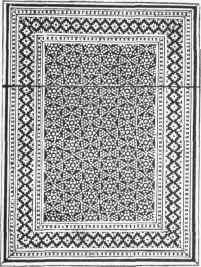
Card-case, Indian pique.
As a transition between pique properly so called, and marquetry, some Arabian and Turkish works follow, of charming effect, and which Mussulmen introduced into all the countries subdued by them; they are that sort of mosaic-work in wood, ivory, mother-of-pearl, and shell, which form the elegant furniture of those countries without furniture. Nothing can be prettier than these boxes, some opening from the top like our own chests (bahuts), others provided with a large drawer, used to contain the rich dresses and ornaments; some of them are surrounded on three of their sides with an open-work gallery imitating the shape of a throne or " masnad;" others again have their top of a convex shape. We are familiar with the small polygonal tables, of the height of a stool, the outer rim of which is carved in horseshoe arches; nothing can be more varied than their decoration, in which, amidst flowered foliage and festooned or subdivided indentations, are seen emblematic figures such as interlaced triangles, or Solomon's seal, the pentagon, the stars and crescent. We also find kaou-klouk or turban bearers, species of carved and inlaid shelves, which are suspended to the wall, and sometimes exhibit in the midst of their rich ornamentation a small mirror, enabling the believer on taking back his head-dress, to arrange it with all due order and gravity. We also frequently meet with sliding mirrors (a cremaillere) enclosed by ornamented folding shutters, and surmounted by a sort of heading carved in an open pattern, and again with hand mirrors in the shape of a palm the backs of which are covered with richly worked palmettes, and bouquets of the most charming design.
The rarest piece we ever met with was a portable chapel enclosed in a magnificent frame. The centre was in the form of a portico supported by two columns, a real "mihrab," and singularly ornamented, in front of which projected a half-circle shelf surrounded by a balustrade, and doubtless intended to contain the symbolic lamp. This piece, from the distribution of its ornamental masses, and the taste of its details, certainly characterised one of the finest periods of Mussulman art.
We shall not pause to speak of the desks and other minor articles which are easily met with; we will content ourselves with remarking the brilliant tone which oriental incrustation throws amongst an elegant set of furniture where carved woods with their severe style and form predominate.
Continue to:


My Books

