


Marble - Stone - Alabaster. Part 2
Description
This section is from the book "A History Of Furniture", by Albert Jacquemart. Also available from Amazon: A History Of Furniture.
This section is from the "" book, by .
Marble - Stone - Alabaster. Part 2
But Italy, carried away by the movement of the times, had already opened the way. Painting and sculpture had gone hand in hand on the path of progress. Donato or Donatello sculptured in soft relief on marble those delicate and inspired madonnas, whose divine expression was so happily blended with physical beauty. His brother Simone was seeking the same style in which Mino da Fiesole and Desiderio da Settignano were to make themselves illustrious. In the Louvre museum may be seen a lovely Madonna by Mino, and not far off the charming bust of Beatrice of Este, by Desiderio. Here are united all the soft graces of youth with the refinement of social rank, already revealing a new art entering on that fresh study of form quickened by the inward feelings of the soul, and appealing much more directly to the mind than to the senses.
Such is in fact the pre-occupation of the masters of the Renaissance, the aim to elevate beauty without ceasing to give expression to the divine spark, the trace of which mediaeval art had been able to find only through its ascetic gloom and the visible stigmata of the most severe penance.
This character of the Renaissance has not been sufficiently pointed out, it being generally considered only in its complete development in the sixteenth century, and which is reproached with a sort of return to paganism, that is, to the absolute worship of form. But on the contrary, by studying the masters of the fifteenth century, from Donatello to Antonio Rossellino, true pioneers of the movement in Italy, their essential merit will be found to consist in their efforts to associate the spiritual with physical beauty. Hence it is that all this marvellous sculpture prepares the way for the paintings of Leonardo da Vinci and of Raffaelle, revealing a new aspect in art.
But even Italian Renaissance must not cause us to overlook the other artistic works of the fifteenth century, and we would point out above all the grand alabaster retable of the Cathedral of Tarragona, sculptured about the year 1420 by Guillen de la Mota and Pedro Juan. The Musee de Cluny will also offer to the student diverse types of the same epoch, either in stone, marble, or alabaster.
As has been done for the fourteenth, we may here subjoin a chronological table of the principal sculptors of the fifteenth century. Italy gives us the following names: -
Lorenzo Ghiberti, born in Florence, 1378, † 1455. Donato or Donatello, born in Florence, 1383, † 1466. Antonio Filarete, born about 1400. Jacopo della Quercia, born about 1400. Luca della Robbia, born about 1400, † 1482. tonio Rossellino, born 1427, † 1490. mone, brother of Donatello, born about 1431. Andrea Verrocchio born 1432, † 1488.
Desiderio da Settignano, born 1445,† 1485. Mino da Fiesole, born 1446,† 1486.
In the other countries of the West we can find only the names of : -
Gilles Paul, of Lille, sculptor of uncertain date. Jehan Braspot. "tailleur d'images" at Lille, 1448. Claix and William Fors, "tailleurs d'images," 1461. Jacques Hacq, "entailleur d'images," 1481.
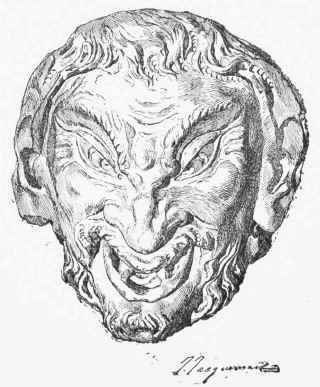
Alask of a faun in marble, by Michael Angela Florence.
This brings us to the full glory of the Renaissance, and to the threshold of the sixteenth century. The giant of this age has appeared, and in presence of his vigorous fire and overwhelming power, all is silent. Henceforth Italy is his, and what man, what genius more worthy than Michael Angelo Buonarotti to rule over an epoch. Endowed with every science, matured by reflection, a kind of anchorite in labour, alone with marble er with earth, he stamps them with the seal of his will, and compels them to submit to his thought.
It is unnecessary to refer the student to the splendid figures of captives now in the Louvre, figures originally intended like the Moses to form part of the monument of Julius 11. The life-breathing works of this sculptor are known to the whole world; and it will be enough to remark, that when art reaches such perfection, it has only to decline. Such was in effect the history of sculpture after Michael Angelo. We all know Baccio Bandinelli, who aspired to imitate him, and who by his mannerism brings about the decline. Other great artists doubtless still continued to flourish in Italy during the course of the sixteenth century, and the works of Sansovino and Alessandro Algardi display a charming grace. But the interval is infinite between them and the sublime heights where soars the genius of the master.
Amongst the sculptors of the sixteenth century may be mentioned :
Paolo Romano, whose Robert Malatesta tonus a sort of transition between the two Italian schools Gian Francesco Rustici. of Florence, born 1470, † 1550, Michael Augelo Buonarotti, born 1471. † 1564. Baccio Bandinelli, born 14.S7, † 1559. Lorenzo da Mugiano, flourishing in 1508. Pierino da Vinci, nephew of Leonardo, born 1520, † 1554. Daniele Ricciarelli, called di Volterra, born 1509, † 1566. Properzia Rossi. † 1530. Ponzio Jacquio, born 1535, † 1571 . Pietro-Paolo Olivieri, born 1551, † 1599.
Although much later than Italy, France also had its Renaissance. Was it, as some writers have maintained, in yielding to the passion entertained by Francis 1. for Italian artists and their works, that this evolution was accomplished. Far from that. Not that there is any need to suppose French artists animated by an unworthy feeling of jealousy towards those strangers invited from afar, and laden with honours and wealth. France has its own national genius, by which it is ever safely directed. She locked on while the Italians were at work, relying on the influence her honours and her genius were sure to exercise over them, and so it happened that those teachers who had been invited to transform French genius, were transformed themselves, and their works had become French.
Continue to:


My Books

