


Marble - Stone - Alabaster. Part 3
Description
This section is from the book "A History Of Furniture", by Albert Jacquemart. Also available from Amazon: A History Of Furniture.
This section is from the "" book, by .
Marble - Stone - Alabaster. Part 3
The French sculptors entered slowly, and step by step, on the new path, so that it is not till the middle of the sixteenth century, and precisely at the epoch of decline in Italy, that the man who in France characterises the Renaissance, Jean Goujon made his appearance. There is no occasion to dwell upon the merits of this statuary, and who, so to say, writes in marble and in never-dying lines, the distinctive features of French beauty. He doubtless studied classic art, but without borrowing from it; and his Dianas, his nymphs, are ladies of the Court with all their patrician grace, and delicacy. And what need had he to search elsewhere for models more elegant, more capable of captivating his contemporaries ?
It is also a fact which must be thoroughly realised. Every people has its special characteristics, and France excels in that intelligent grasp of the national type which has ever converted her portraits into models. This type she has breathed into her marbles with such surprising instinct, that we can never hesitate to fix the date of a mythological figure, whether produced in the sixteenth or,in the seventeenth century; the ethnical character of the work bears this date clearly stamped upon it.

Alabaster Statuette of Otho Henry, German work of the sixteenth century. (Louvre.I).
French Renaissance has been illustrated by: -
Michel-Colombe, born 1430, † 1511.
Gilekin Reuzere, of Lille, flourishing in 1508.
Jean Bernard and Jean Marchand, "tailleurs d'images," 1509.
Jean Cousin, born 1500,† 1589.
Richier, sculptor, of Lorraine, born 1525,† 1544
Jean Goujon, flourishing between 1541 and 1562.
Fremyn Roussel, 1540-1566.
Pierre Bontemps, about 1552.
Germain Pilon, born 1535,† 1590.
Abraham Hideux, "tailleur d'images," about 1596.
Barth6lemy Prieur,† 1611.
No mention has hitherto been made of a peculiarly interesting school of artists, issue of the Renaissance in Germany - those wonderful carvers of the compact limestone above described under the names of alabaster and Pap-penheim stone. If the monograms can be trusted that are inscribed on some of these works, this branch of art would have been ushered in by the most illustrious of German artists. Thus the signature of Albert Durer may be seen on the statuette of Otho Henry the Magnanimous, Count Palatine of the Rhine, one of the gems of the former Sauvageot collection. It was his disciple Aldegrever, also, who reproduced in lithographic stone the scenes engraved by him under the title of "The Wedding Dancers." Here the pretty Augsburg maiden and the Bavarian Prince are rendered with all imaginable delicacy. The features have a charming expression, and no details of the graceful draperies have been neglected by the chisel. In the Debruge Dumenil collection we have seen another delightful work, signed by George Schwelgger. We need not refer to the numerous medallions produced in Pappenheim stone by the two schools of statuary established at Augsburg and Nuremberg. It will suffice to say that their style and perfect execution make them worthy of a place in the exhibitions by the side of the bronze medallions of the Italian Renaissance. It was also a German artist, Emeric Schillinck, that executed the monument in black marble incrusted with alabaster bas reliefs, raised during his lifetime by the precentor of Lantsteyn. The fragments of this monument that have been collected at the Louvre, and are dated 1561, show the merit of the sculptor.
One word in conclusion, to complete our remarks on alabaster. The French artists, notably Germain Pilon, have employed it for busts, the accessories of which are often of a different material. The same sculptor also carved in alabaster some bas-reliefs, representing Christ on the Mount of Olives, Melchisedech and St. Paul.
Nor should we overlook a little group of names that have had a real influence over French art in the seventeenth century. At their head stands Jean de Bologne, born at Douay in 1529, and who died at Florence in 1608.
His pupils Pierre Tacca, and especially Pierre de Franqueville, born at Cambray in 1548, and who returned to France in 1601 in order to enter the service of Henry IV., gave an impulse to the sculptor's art, the effects of which are perceptible in the works of the greater part of the artists of this century, whose names are here subjoined : -
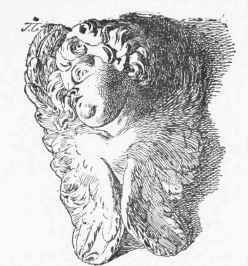
Winged angel in marble, by Puget; seventeenth century. (M. H. Barbet de Jouy's Collection).
Guillaume Berthelot, statuary of Mary dei Medici,† 1648.
Simon Guillain, born 1581,† 164S.
Jacques Sarrazin, 1588-1660.
Francois Duquesnoy, called the Fleming, II Fiammingo, 1594-1644.
Philip de Buyter, pupil of Sarrazin, 1595-1688.
Louis or Gilles Guerin, pupil of Sarrazin. 1606-1678
Francois Anguier, pupil of Guillain, 1604-1669.
Michel Anguier, pupil of Guillain, 1612-1686.
Louis Lerambert, pupil of Sarrazin, 1614-1670.
Gaspard Marsy, 1624-1681.
Balthazar Marsy 1628-1674.
Etienne Lehongre, 1628-1690.
Jacques Buiret, 1630-1699.
To attempt a description of the still noteworthy works of all these artists would swell the proportions of this volume to an unreasonable extent, besides which, their various types may be seen in the public museums in sufficient numbers to convey an idea of their peculiar style and genius. Pliancy and a certain easy grace characterise this school, whose busts have that grand air and that broad and somewhat theatrical treatment which, through Louis XIV. became the salient feature of the century.
We might here point out the remarkable change introduced into art towards the close of Louis the Fourteenth's reign, and dwell especially on the coquettish grace and unstudied felicities of the sculpture of the eighteenth century. But in order to speak of the contrast more comprehensively, it will be more, convenient to reserve it for the chapter on terra-cottas, in which it found its most triumphant expression.
Continue to:


My Books

