


Ivories. Part 2
Description
This section is from the book "A History Of Furniture", by Albert Jacquemart. Also available from Amazon: A History Of Furniture.
This section is from the "" book, by .
Ivories. Part 2
The art of the tenth century, is represented by the authentic Byzantine bas-relief showing Christ crowning the Emperor Otho II. and his wife Theophania. At the feet of the emperor is a figure crouching in the most abject attitude and covered with a mantle seme with stars. This is the artist John Ch . . . ., author of the work, as it can scarcely be supposed to represent a donor. This ivory seems to have been carved for the marriage of Otho, Emperor of the West, with the daughter of Romanus II., Emperor of the East. It is interesting to compare this purely Byzantine piece with another plaque of Italian origin, representing Christ on the Cross between Mary and St. John, with details of Byzantine emblems, and figures of saints in the circular arcades and in medallions. The cover of an Evangeliary shows, with its ivory carvings, the filigree frames, enriched with gems, common at this period.
As a transition between the tenth and eleventh centuries, we may refer to the two plates also at Cluny, carved on both sides, one representing Christian subjects taken from the life of the Saviour, the other some mythological emblems of more recent date, and all the more interesting, that its style of ornamentation seems to indicate oriental influence.
For the eleventh century itself, we have a work of certain date in the glass cases of the Cabinet of Medals. This also represents Christ crowning the Emperor Romanus IV. and Eudoxia, who ascended the throne of the East in 1067. This ivory tablet doubtless formed part of a "Hagiothyrides," or triptych, used as a cover for an Evangeliary, preserved in the metropolitan church of St. John at Besancon. Not far off, is another complete binding, that is still provided with its two leaves or shutters. Here the principal subject is Christ on the Cross between the Virgin and St. John, and Constantine the Great, with his mother, St. Helena, praying at his feet. On the leaves, medallions, occupied by five saints, are framed in an ornamental border.
It would be hopeless to attempt a description of the many pieces existing in the French collections, and by imperceptible gradations illustrating the transition from the classic Art in its decline to that created under the inspiration of the ideas of the West. Here the question of locality clearly eclipses all others, and while the Byzantine school long upheld its teachings in all that regarded religious subjects, the moment that Art was called upon to give plastic embodiment to the creations of the poets, or to the scenes of mediaeval metrical romances, the image-carvers who worked in ivory interpreted such scenes through the ideas and manners of the times.
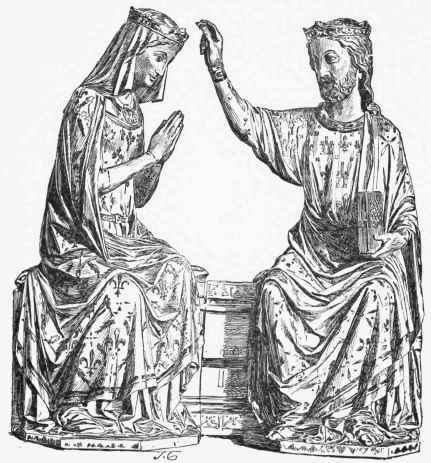
Coronation of the Virgin; group in ivory, relieved with colours and gold: thirteenth century. (Louvre.).
Interesting, on this account, is the ivory casket at Cluny representing a sort of chapel, and amidst religious subjects containing some figures apparently relating to the life of St. Remy and the baptism of Clovis. After studying this piece from Rheims, the observer may notice, as illustrating the following century, the reliquary of St. Yvet, long preserved in the Abbey of Braisne-en-Soissonnais, and the numerous statuettes of which are executed in a remarkable style.
But in the thirteenth century, secular monuments become more frequent. Here is, in the first place, the mirror case on which are represented Queen Blanche and St. Louis. In spite of serious multilations, this relic of the ancient treasury of St. Denis retains all its interest and shows a close connection with the style of contemporary seals. But it will be better still to examine the famous group in the Louvre acquired at the Soltykoff sale, and which, as some suppose, under the religious form of the Coronation of the Virgin, gives us the portraits of Philip III. the Bold, son of St. Louis, and of Mary, daughter of Henry III. the Debonnair, Duke of Lorraine and Brabant. M. Alfred Darcel, who has described this fine group, hesitates to recognise in it an iconographic value apparently so daring. He with difficulty admits the heraldic devices of the King and the Queen on the sacred vestments. Questions touching the manners of former times are always somewhat difficult to determine. But M. Darcel's remark induces us to form a conclusion different from his. It would indeed have been a sort of desecration to array the Saviour and his Mother in a sort of human livery, even though it be that of the greatest on earth. But to represent the king and queen of France under a form consecrated by the Church, would have meant nothing more than placing them under the immediate protection of those whose outward appearance they were made to assume. The costumes of the group under consideration are not in the usual style of religious representations, but are those worn in France at the time of the marriage of Philip the Bold. Hence the tunic seme with the emblems of France and Castille must be that of the King, just as the cotte-hardie embroidered in lilies and barbels is that of Mary of Lorraine and Bar. A perfect and wonderful type of French sculpture in 1274, this group must have been all the more maturely composed, in consequence of its high destination. Hence we do not think it at all impossible that it consecrated a marriage accomplished under the auspices of Christ and his Mother, by comparing the gift of the heavenly crown with that of the worldly diadem.
If, however, we want an object of comparison between this exceptional work and the ordinary products of the thirteenth century, it will be enough to cast a glance at the octagonal casket in the Musee de Cluny, on which are depicted the episodes in a romance of chivalry, analogous to the conquest of the Golden Fleece. Here the sculptor has had recourse to an expedient common enough, when the object was to save serious outlay. He has cut the figures in thin ivory plaques brought together, and has heightened the whole by means of a narrow border in coloured mosaics, doubtless borrowed from oriental Art.
Continue to:


My Books

