


Oriental Bronzes. Part 3
Description
This section is from the book "A History Of Furniture", by Albert Jacquemart. Also available from Amazon: A History Of Furniture.
This section is from the "" book, by .
Oriental Bronzes. Part 3
It is needless, then, to repeat here what we have already said when speaking of the Chinese: fashion has spoken before us, and to the peculiar grace of the bronzes of Japan will soon be added the merit of rarity, travellers, in the present day, being unable to pick up but few ancient pieces, and that only after infinite research.
Among the interesting bronzes to be commended to the notice of the collector, we must not omit mention of those of India, though far from desiring to introduce to every private collection the singular divinities who people the Brahminical Olympus. That can, and must be reserved for a few dilettanti only; since, against a small number of figures of exquisite workmanship, like the gilded bronze which we here reproduce, must be set myriads, the sole merit of which consists in their mythical value, and the place they hold in the historical series. But, among the betel-cups, boxes, and instruments of worship or personal adornment, are found articles of equal delicacy and originality. Some perfume burners are in the form of elephants, with their trappings, and often leave us in doubt as to the place of their production. It is worth noting that the Indians have a special faculty for representing their sacred animal; they are familiar with it, live with it, and impart to its production a reality which is wanting in the artists of the Celestial Empire; and, moreover, the Indian bronzes are, almost invariably, studded with rubies of small size but in large numbers. The peacock, as we have already remarked, is the bird most highly esteemed in India; upon it many of the Deities are represented as riding, and it adorns the thrones of the monarchs: we find among the bronzes several which are executed in an ornamental style most remarkable.
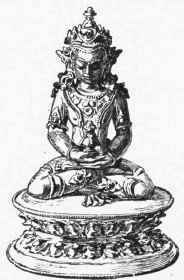
Statuette of Indian bronze, gilt and 8et with turquoises.
From India to Persia is but a step. Here, however, we meet with an art entirely different. Between Japan, China, and India existed a connecting chain due to the invasion of Buddhism. The influence which acted upon Persia and Asia Minor was one entirely distinct, it was that of the Arab conquerors, and of the new ideas implanted by Islamism. Like all other law-givers at the head of a people very impressionable and inclined to idolatry, Mahomet had to interdict the possession of images to his disciples. In his eyes it was sacrilege to attempt to rival the Almighty by the creation of forms resembling those which had received from him the breath of life, and especially the image of mankind. This prohibition modified the genius of the Arab race, directed all the efforts of its imaginative powers to geometrical combinations, and floral compositions, and gave birth to that charming style of decorative art, received everywhere with eager welcome, and to which has been rightly given the name of Arabesque. The Persians themselves adopted the new mode, and, thanks to their inventive and elegant imagination, combined to impart to it a tasteful and especially distinctive character. Under the influence of their old civilisation, and owing to a peculiar propensity of their essentially different constitutions, they could not entirely renounce the representation of the forms of men and of animals; and, consequently, we find a whole series of bronzes, and pieces of brass-work, in which men are represented on horseback, and with hawk on wrist pursuing hares or birds; others, in which they bear behind them on horseback, cheetahs trained to the chase of antelopes and of the swift gazelle. It is in the huge flambeaux, especially with bases in form of a truncated cone resting upon hollow basins with narrow rims, and on large dishes technically known as "Chinese vases" that we find these scenes constantly repeated amid the most curious ornamental combinations. One plainly sees, in fact, the various sources whence the artists have drawn their mosaic grounds analogous to those of China; again superb floral patterns with foliage, reminding us of their national designs, and especially those of their carpets and earthenware; and, lastly, delicate interweavings of tiny flowers such as we see in Indian paintings. The Persians, however, in their imitations, never attain the delicacy of their originals.
We have just mentioned the Chinese vases. It is essential to explain exactly what is meant by this term. They were large dishes upon which were placed the covers for all the guests at a banquet, and which the servants carried round upon their heads, distributing in their progress, to each guest, the plate containing his allotted portion. Now this custom, borrowed from the Chinese, derived its name from them, although as regards both material and decoration, there is a striking difference between the brass waiter and the porcelain dish.
Among the Persian antiquities of especial interest, inasmuch as they bear the impress of the singular superstitions of Islamism, are those magic cups, the uses of which, and the meaning of the inscription found on them, M. Reinaud has explained in his account of the Blacas collection.
The most remarkable of these preclaims its own merits, and runs as follows: "This blessed talisman, worthy a place among the treasures of kings, is of infallible efficacy against every kind of poison, and unites in itself numerous valuable properties, as has been proved by experience. It may be used as a remedy against the bites of serpents or of scorpions, against the bites of mad dogs, fevers, pains of childbirth, impure milk of nurses, pains in the stomach, colic, headaches, wounds, philters, and dysentery." In the centre are the figure of the Caaba, and twelve medallions, six whereof contain texts from the Koran, the others, figures personifying the maladies to be cured.
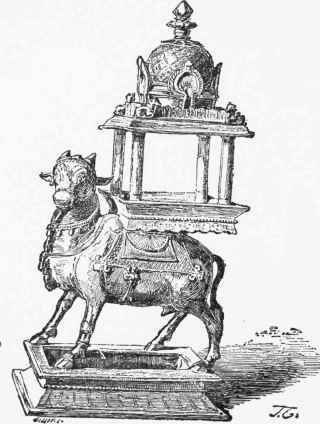
Sacred Bull, antique Indian bronze. (Former collection of the Baron de Monvillc.).
Continue to:


My Books

