


Oriental Bronzes. Part 2
Description
This section is from the book "A History Of Furniture", by Albert Jacquemart. Also available from Amazon: A History Of Furniture.
This section is from the "" book, by .
Oriental Bronzes. Part 2
To describe, as they deserve, all these forms, and the ingenious subterfuges to which the artists had recourse in order to conceal their conventional harshness under an agreeable guise, we should need an entire volume. The Yeou vase was one to be suspended by its handle over the altar, so that the officiating priest might, in the sacrifices, pour the scalding liquor into the cup (tsio) used for the libations : of which we have an example representing a swan, and serving a double purpose as an ornament of the temple. The lings, adapted, some to contain the heated wine, some to consume incense, present greater variety, inasmuch as the sacred law divided them into two classes, the former of which, in shape round or oval and supported on three feet, devoted to sacrifices of the first importance, were destined to the use of the highest dignitaries of the empire; the latter, invariably rectangular and four-footed, were employed only in the offering of inferior rites, and appropriated to the functionaries of more humble rank.
Nor is this all. In China, as elsewhere, vicissitudes have not been unknown; and wars and revolutions have brought in their train eclipses and revivals of her civilisation. The epoch of the Song Dynasty, which corresponds to the tenth century of our era, is one of these periods of revival : the second is to be attributed to the effort made by the Youen Mongols in the thirteenth century, to prove that their conquest of China had not resulted in her intellectual abasement: and when, a century later, the Mings, Chinese in race themselves, recovered the sovereign power, they sought to restore the arts to their ancient high estate by a return to the forms which had achieved their renown. Lastly, when, in 1616, the Mantchou Tartars dethroned the Mings, they made fresh efforts to equal, or even to outshine, the works of the earlier races. We see, then, how necessary it is that the connoisseur should use his utmost acumen in the investigation of Chinese bronzes. In later times, research is facilitated by the care which artists took to inscribe on the under side of their works the nien-hoa or name of the period of the reign in which the article was manufactured. We have described elsewhere the method of reading these "nien-hao," and given also the chronology of the more recent dynasties. We may, however, observe that, as regards the Ming ascendancy, Siouen-te (1426 to 1435) is the most brilliant epoch; and that for the Tai-tsing is Kien-long (1736 to 1743).
Great variety of form, delicacy of workmanship and of style, embellishment by the use of the precious metals and even of painting, skill in casting and in chasing, may all be found in the Chinese bronzes; and, by the exercise of an enlightened discrimination, we may find, among their number, works as beautiful and as full of interest as any people of the Western world have ever exhibited for the admiration of the virtuoso.
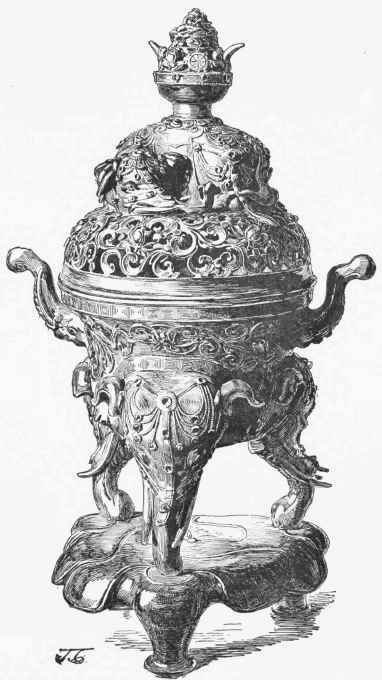
Perfume or Incense-burner, in bronze, studded with precious stones, upon a stand of carved iron wood.
(Collection of M. J. Jacquemart).
Japan, too, offers her quota, which is no less remarkable : but here selection is more difficult, since the elements are wanting for defining epochs and schools. Some few articles of sacred character in the temples, or intended for purposes in connection with their worship, have on them the "nengo," analogous to the "nien-hao" of the Chinese, or the cyclical dates which enable us to tell their age: but, a peculiarity which should make the observer extremely cautious, the most recent dates are frequently to be met with on works of antique aspect. Japanese art being essentially individual, scarcely any one but a native can distinguish the mannerisms of their celebrated artists, or decipher their signatures.
In point of conception, the Japanese bronzes are even more varied than those of China; and, if we find among them the greater number of forms customary in the celestial empire, such as the vases and the tings dedicated to sacred uses, we have also numbers of little gems which might lead us to suppose that the fashion of etageres reigned among them as with ourselves; and all these effects are obtained by the employment of various metals admirably adapted to the purposes they are made to serve, and frequently enhanced by rich incrustations of gold, silver, and coloured stones. Amongst others is a silky grey bronze of incomparable texture, from the surface of which stand out designs, incrusted in silver thread of incredible delicacy. We know also how the Japanese have turned to good account that particular mixed metal called by the old Dutch "sowaas," in which the bas-reliefs stand prominently forth from a black ground, brilliant as gold. They have produced in this material the most elegant objects from jewellery to vases.
But it is in the application of bronze to vases of grandiose ornamentation that the Japanese artists are most admirable. They seem to have known and studied everything from the Grecian and Etruscan forms down to the fantastic conceptions of the France of Louis XV. and Louis XVI. Outlines, slender or solid, and well-balanced accessories; forms drawn from nature and applied to the reproduction of symbolical fruits; vases with moveable envelopes in imitation of network or basket-ware, which enable the vessel, though full of boiling liquids, to be transported without risk; lamps, or cups for sacred worship, which, apart from their symbolical character, would be interesting for their designs alone; all these they have made, and that with a marvellous superiority of execution. There are certain large pieces from which stand forth in bold relief dragons, and trees with their leafage, the casting of which, "a cire perdue," would seem an insurmountable difficulty: and yet in practice is such mere child's play to the Japanese, that they multiply details to positive excess, and even trangress the limits of good taste.
Continue to:


My Books

