


Oriental Bronzes
Description
This section is from the book "A History Of Furniture", by Albert Jacquemart. Also available from Amazon: A History Of Furniture.
This section is from the "" book, by .
Oriental Bronzes
The taste for Oriental bronzes is of quite recent date; nor is the time yet remote at which a distinguished professor of archaeology wrote that there was nothing to be found amongst the products of China but grotesque and monstrous objects.
These a priori opinions ought long since to have been abandoned, for they prove a most lamentable fact, either the backwardness of science or a deficiency in the education of the man who gave them utterance. It is so easy to preserve silence upon topics whereof one is ignorant. Let us admire the Greeks, by all means; but that is no reason why we should disparage others.
Happily the subject is now cleared from the mists of theory, so far as the art of the extreme East is concerned; the collection of bronzes formed by M. Henri Cernuschi enables us to discuss seriously the age, and the aesthetics of Chinese productions, and it is with the pieces themselves before us, that we shall boldly sketch the teaching to be derived from this marvellous collection.
In China, the art of casting metals attained full perfection under the second, or Chang, Dynasty, that is to say about the year 1766 B.C. There are some relics certainly of older date, and a "yeou" vase (used to hold the sacrificial wine) in this collection, bears, in our opinion, characteristic marks of the primitive art of the Hia Dynasty which reigned from 2205 to 1783 B.C. But it is among the vases dedicated to sacred worship of the Chang era that the most attractive forms are found, accompanied frequently by inscriptions, the formula of which enable us to fix the dates. We should greatly exceed the limits of this work were we to describe and analyse these legends; and must be content with a mere mention of the special treatise of Mr. Thorns: "A dissertation on the ancient Chinese vases of the Shang Dynasty," and our own articles on the exhibition of the Cernuschi collection published in the "Gazette des Beaux-Arts" of 1873.
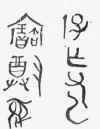
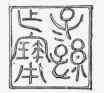
However, with a view to assist the connoisseur, in such matters to distinguish the features (fades) of the inscriptions in question, which are invariably written in the ancient or so-called "ta tchouan" character, we shall reproduce two of them. The first is dedicated to the Emperor I, who reigned about 1496 B.C., and reads as follows: "The grandson has caused to be made for his ancestor I this precious honorific vase (to hold the wine during the great sacrifice." This piece is an exquisite oval cup, with lid and two rounded ears, and is covered with incrusted bas-reliefs in silver, of the most remarkable workmanship. The second, in the form of a seal surrounded by a rim, runs thus: "Precious vase, for the use of the sons and grandsons." This work, no less highly embellished than the former, is composed of two parallel cylinders, borne by an enormous dragon, which seems almost crushed beneath their weight. Above this monster is a fantastic bird, the outstretched wings of which connect the two cylinders, whilst its talons control the dragon. This composition has certainly a symbolical meaning, since we find it reproduced, of all sizes, and in every various material including jade and rock-crystal, from the time of the Chang Dynasty to the present day. Should we recognize in this strife between the bird, child of the air, and the reptile, engendered of earth, an analogy with those combats so frequently represented in other Oriental countries? Has Arabian art, in showing us a bird of prey striking a gazelle sought to express the same idea? A more profound study of the Chinese theogony will doubtless solve these questions; but thus much we may, in the present state of our knowledge, positively affirm that, in the Chinese compositions, nothing is matter of indifference; that the forms and the decorations, far from being mere results of caprice, correspond to the manners and customs of the people, and to the fixed rules laid down in those ancient writings which constitute both their civil and religious law.
We must here remark that the ancient sovereigns of the hundred tribes would appear to have been acquainted with, perhaps even to have subdued, those monstrous animals destroyed in the later changes of the globe, the existence of which, Cuvier, reconstructing them with the help of their fossilized bones, has revealed to us. The gigantic saurians, the pterodactyls, the strange pachydermata would thus naturally take their place upon the Chinese vases as recollections of these forgotten epochs; and, far from being grotesque fancies, the offspring of disordered imaginations, would be to us precious witnesses of pre-historic ages thus unexpectedly brought to light. The Tcheou Dynasty, inaugurated by King Wen in 1134 B.C., produced certain articles which it is difficult to distinguish, inasmuch as it, according to Confucius, devoted itself to the reproduction of the works of the Chang epoch. Now the Li-Ki, one of the sacred books, describes among the vessels having religious uses of the Tcheou, those which, in their shapes, "recalled" the figure of an ox statant. If the vase recalls the form of an ox, the animal, as here represented, certainly possesses no single one of its characteristics: the head, less square, with most peculiar ears, and sometimes armed with an upright horn, indicates far more some unknown antediluvian pachyderm allied to the rhinoceros than a ruminant of the bovine species. The thick-set body, the short and stout limbs establish this conclusively. As for the mythical character of this kind of vessel, the richness of the ornamentation, in which gold, silver, and precious stones are lavishly employed, would place that beyond all doubt.
But these figurative vases representing, now unwieldy animals, and again birds reduced to conventional forms, are exceptional. From the earliest dawn of oriental civilisation, the studied grace of forms and also their embellishment followed by a regular progression. The elegant cups are completed by well-balanced accessories, in which suitability is combined with richness. There symbolism asserts itself in the whimsical heads, with yellow eyes, which hold a place midway between the real head of the tortoise and those chimerical or pre-historic conceptions, whereof we have already spoken. We see also an insect of fanciful shape, a rude animal outline suggested by the tadpole, and symbolising nature giving birth to living beings. And again, as it were, to demonstrate more clearly the law which ordains that all peoples should, at identical points in their advance, pass through the same stages of mental development in Art, the background of the decorative designs is formed of those geometrical figures styled Greek or meander, which are found alike on the antique vases of America, and in the first attempts of the savages of Oceania. Other vases, with lids of elongated campanulated shape, which developed into the form afterwards known as "potiches," present us with elegant proportions even so far back as the early years of the Chang Dynasty. There are some on which gilded depressions indicate the spots where the sacrificing priest was to place his hands whilst elevating the vessel during the consecration of the perfumed wine. Others of cognate forms, surmounted by a moveable handle, are suspended within a Kia-tse of delicately carved wood; and some of a lobate shape with lateral and flattened handles, would seem to have supplied the models for the Grecian vases of Nicosthenes, or, better still, for certain of the Etruscan vessels in black terra-cotta. As for the lagenae, or bottles with or without stems, and provided with handles, large or small, resembling the heads of elephants, or issuing from fantastic heads, one would have to see the whole connected series fully to appreciate their elegance and variety.
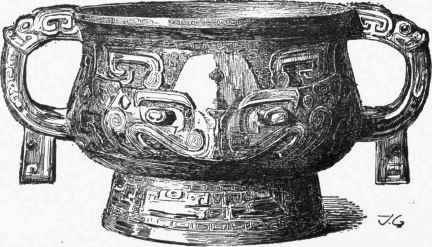
Bronze Cup of the Chang epoch embossed with gold, silver, and malachite. (Collection of M. J. Jaequemart.).
Continue to:


My Books

