


Objects Of Ornamental Art. Chapter I. Ornamental Bronzes. Part 4
Description
This section is from the book "A History Of Furniture", by Albert Jacquemart. Also available from Amazon: A History Of Furniture.
This section is from the "" book, by .
Objects Of Ornamental Art. Chapter I. Ornamental Bronzes. Part 4
Under Louis XV. and the Regency, as we have already stated, a complete transformation took place. With household furniture, we note the commencement of the era of endive and "rocailles," contemporaneous with the most perfect chasing. Among the promoters of this style we must mention Meisscnier, who perhaps carried his capricious fancy to exaggerated lengths: but other artists of rare excellence flourished at the same time - as Philippe Caffieri, whose address, Rue des Canettes, we find in the Almanacs; sprung from a race of distinguished sculptors, himself a sculptor, he impressed upon his works a stamp of good taste and remarkable elegance. Among his best productions may be noted the pieces of furniture, with bronze ornaments, which we have already noticed, one in the collection of Sir Richard Wallace, the other now the property of Baron Gustave de Rothschild. To protect these from being confounded with the mass of fraudulent imitations, he stamped them with a C surmounted by a coronet, which distinctive mark he also affixed to the objects in his own collection. We have seen it upon a superb Florentine bronze, and on a group of the Laocoon, in bronze also, now to be found in the collection of M. Charles Mannheim. Caffieri had a rival - Cressent - whose bronzes are also very remarkable. As for Martincourt, his praiseworthy works would be better known had not his fame been eclipsed by that of his pupil Gouthiere, of whom we shall speak presently.
We must not omit Gallien, whose merit the researches of M. Louis Courajod have revealed to us. "This Gallien," says he, "from whom Duvaux ordered an iron railing, was truly a genuine artist; his modest title of ' maitre fondeur,' has prevented his meeting with due recognition; his contemporaries, however, rightly appreciated his excellence. He modelled, and executed for the king, several clocks of great size and showy design, intended for the decoration of the state apartments of the royal palaces. It was to him that the keepers of the king's privy-purse gave the order to design, cast, and chase the superb clock on the mantel-piece of the council-chamber at Versailles, when that apartment was being restored in 1756. It represented France governed by Wisdom and crowned by Victory, extending her protection to the Arts. For this the artist was paid 6,500 livres. We have an authentic account of the admiration it excited in the 'Memoirs of the Due de Luynes.'"
After these masters we must note the "fondeurs-ciseleurs" who put their names upon the faultless works executed in the palaces. In January, 1751, the Varins, father and son, received 4,761 livres 15 sous for the bronze-work, bas-reliefs, vases, figures, etc., executed by them at Versailles in the years 1747 and 1748. Lucas and Martin wrought at Fontainebleau. Deprez, in 1755, executed chasings for the king. Gobert, gilt and chased work at Versailles, Choisy, the Tuileries, at the Luxembourg, the Muette, etc.; Leblanc worked at the same palaces, and also at Compiegne.
The charges of caprice and of exaggeration may, no doubt, be urged against the bronzes of the Regency, and of Louis XV. The abuse of contorted endive, of medallions in curled fantastic curves, of shells rolled in curious undulations, is apparent; but we have, in the flambeaux and in the candelabra, in the branches for wall-lights, in the fire-dogs, and ornaments of the fire-places, a rich whole, and details so happily treated and so s-pirituel in their whimsical eccentricity that the voice of criticism is silenced. We reach a time, however, when all this exuberance of fancy was disciplined and toned down; when dreams of the antique harassed Madame de Pompadour, and at her suggestion, appeared the first germs of that reform which we mark in progress under Louis XVI., a change so marked that it was thought worthy of a specially distinctive name, and the artistic favourite had the prudence to choose that of "genre a la reine." It is at this epoch that were impressed the influence of Martincourt, and his pupil Gouthiere, who, in 1771, resided on the Quai Pelletier, at the Boule d'Or, and assumed the title of chaser and gilder to the king, as may be seen upon a clock in the collection of Sir Richard Wallace. With the exception of this superb specimen, it is very difficult to distinguish the authentic works of Gouthiere, as his name has been bestowed on all those marvellous chasings of the style of Louis XVI., which are, as everyone knows, extremely numerous. Among these are certainly compositions by Martincourt, and very charming they are, as we may judge from the flambeaux signed with his name, in the collection of M. Leopold Double. There are, too, some undoubtedly by Robert le Lorrain, and by Sautray, his pupil, both very clever in the composition of groups, statuettes, and bas-reliefs, although they are generally classed along with Vassou, as simple mounters of vases, because they had, with genuine talent, embellished those in the collection of M. Blondel de Gagny.
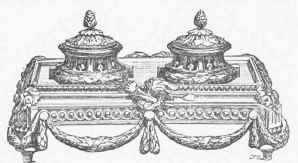
Inkstand in chased metal, formerly belonging to Queen Marie .Antoinette. (Collection of M L. Double.).
The Louis XVI. bronzes require no description; they are to be recognized among all others, by the least experienced, with their delicate groups entwined to support the numerous stems which unroll their foliated scrolls, and bloom into flowers that serve as sconces for innumerable lights. These cherubs sporting amid garlands of flowers and the acanthus, whose numerous folds have the pliant grace of vegetable fibres, all this fine ornamentation rivalling the work of the jeweller, and made still more soft by the use of dead-gold which subdued the metallic glare, were just in harmony with these polished and refined manners which Marie Antoinette sought to introduce. Placed upon the tables and delicate consoles, and upon mantelpieces of white marble, these bronzes accorded admirably with the dainty porcelains of Sevres, Dresden, and the Indies. There is a wide difference indeed between this triviality and the robust science of the sixteenth century, but in it we read a polished gallantry, and see the last smiles of that society about to disappear in storm and bloodshed.
In 1775, the coronation of the king offered to the court artists an opportunity for display. Jean Louis Prieur distinguished himself by the embellishment, in chased and gilded bronze, of the carriage intended for the conveyance of the sovereign. It would be tedious to enumerate all the men who then rose to eminence, and facilitated the transition from the eighteenth to the nineteenth centuries. We shall be content to include their names in the list appended below.
We must, however, mention one special industry due to the invention of the soft paste French porcelain, and which speedily received an unexpected expansion - the mounting of porcelain flowers. We borrow once more from M. Courajod the curious picture which he has drawn of this singular fashion. "This extravagant mania (for porcelain)," he tells us, "caused an entire Flora to spring into existence. Whole beds of flowers, and every variety of plant issued from the furnaces of Vincennes, and bloomed life-like under the hands of skilful workmen who forged for these enamelled blossoms a leafage of bronze. Duvaux took an active part in this fashionable movement, which consisted in scattering upon lustres, branches, and girandoles, bouquets of porcelain flowers, and in introducing them into every detail of the furniture. To judge from the personages who gave him commissions to mount these flowers of Vincennes, and by examining the description of his works, we are led to say positively that Duvaux was among the first to make these branches of ormoulu, or 'vernis au naturel,' those plants of bullion, those factitious bouquets which for a time gave to our apartments the appearance of gardens or conservatories. To render the illusion complete, nothing was wanting to these bouquets, not even the perfume, which the artists knew how to impart by artificial means".

Salon of the Eighteenth Century, at M. L. Double's.
Those bronze vases are familiar to us, the bodies generally of an exquisite blue, which served as supports for girandoles of painted flowers with gilded leaves; and we have seen even more admirable still; it was an immense bouquet for the centre of the table, formed of the most varied flowers blooming in their porcelain basket. Nothing more elegant than this rare piece can possibly be conceived.
Here is a list of the principal artists who have wrought in bronze, omitting the Italians, whose names have been previously given, because among them, figures and ornamentation were the work of the same hands.
Jehan Scalkin, 1468, chandeliers.
Meister Riquin or Rinik, Sclavonic.
Meister Awram or Iabram, Russian.
Meister Waismuth or Baismouti, Russian, author of the bronze gates of the Cathedral of Novogorod. Petrus Cheineus 1573, handbell. Andrieu Munier, founder of the bell at Poix. Dominico Cucci, attached to the Gobelins. Ballard. 1676, cannon presented to Louis XIV. Mazarolli, 1688, culverin, with reliefs Philippe Caffieri.
Martincourt, the master of Gouthiere. Gouthiere, chaser and gilder to the King. Gallien. state clocks, and candelabra. Robert le Lorrain, master of Sautray. Sautray, statuettes and mountings of vases. Vassou. mounter of vases.
Jean-Louis Prieur, coronation coach of Louis XVI. Delarche, sculptor and chaser of bronze.
Hervieux, ornaments of the chapel of the Virgin at St. Sulpice. Varins, father and son, vases, figures, etc. Leblanc, - Gobert, - Lucas, - Martin, - Desprez. Haure, the crowning of Voltaire. L. Demenet, bas-reliefs. P. Bautret, medallion portrait.
Ravrio, Rue de la Ferronerie, sign of the Lion d'Or, sculptor and chaser. Vinsac, chaser.
Continue to:


My Books

