


Objects Of Ornamental Art. Chapter I. Ornamental Bronzes. Part 3
Description
This section is from the book "A History Of Furniture", by Albert Jacquemart. Also available from Amazon: A History Of Furniture.
This section is from the "" book, by .
Objects Of Ornamental Art. Chapter I. Ornamental Bronzes. Part 3
Shall we speak of these various caskets, some copies from the antique, others flowing in their outlines like marriage-coffers; of the scent-boxes, the writing-desks, the innumerable trifles which abounded in domestic furniture, and are in cur own day so eagerly sought out by amateurs? No; for we should lose ourselves in endless description, and, after all, leave much unsaid. One word, however, on the fire-dogs or chenets, which used to grace those monumental fire-places of sculptured marble, enriched with Florentine mosaics. Substituted for the huge iron fire-dogs of the Middle Ages, these of the Renaissance were of proportions which harmonised with the surroundings they served to complete. Most frequently the bracket-shaped base, with volutes and grotesque masks, served as pedestal for a statue of moderate size, of bold design, and broad and clever in treatment. The figures were, in almost all cases, borrowed from mythology: Venus, Apollo, Mars, Pluto, and sometimes personifications of the sun and moon are met with; and several of these statues, detached from their bases, figure in our museums at the present day, as specimens of the bronze sculptures of the sixteenth century.
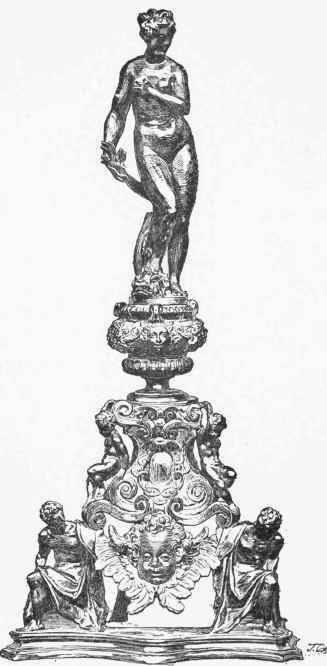
Bronze Fire-dog (Italian). Sixteenth Century. (Collection of M. Spitzer.).
A form of heating-apparatus of more common use in Italy than the fireplace, is the brazier (brasero), which could be employed anywhere, and carried from room to room. It is not possible to enumerate the infinite variety of these charcoal-holders: ovals, with lion's heads and moveable handles, the mouldings and the surfaces of which received every kind of ornamentation, medallions with figures and complex bas-reliefs, emblazoned escutcheons; grounds guilloche, with delicate foliage borrowed by the Venetians from the patient chasings and inlaying of the Orientals, all are here; and render these works fit to be converted by us into the most graceful jardinieres that can be imagined.
As we have spoken of the Venetians, let us notice, in passing, those extremely beautiful basins and ewers which they too ornamented in arabesque styles, to which we shall revert again when treating of damascened works. We must, however, examine these ewers with the utmost care, as a certain number are in existence, of French origin, and in the purest style of the time of Henry II., the devices on which, and a comparative unskilfulness in the workmanship of the bronze, are indications of their nationality. It is natural to suppose that the example of Italy was not lost upon ourselves, and that our artists, to some extent at least, should have followed that example. If the Louvre shows us a charming hand-bell surmounted by the form of a woman kneeling, Cluny has preserved another with figures and ornaments signed, "Petrus Cheineus me fecit, 1573." A French founder, Andrieu Munier, stamped his name upon a passing-bell, cast for the church of Poix, in Picardy. We shall not seek to multiply these examples by descending to the night-lights and other utensils of common use, it must suffice that we have directed the attention of connoisseurs to our own bronzes of the Renaissance, to induce them to seek for and to collect them.
But it is in the seventeenth century that bronze, in its application to articles of furniture, assumed with us pre-eminent importance. We find it contributing to the sumptuous adornments of palaces, and vieing with the massive goldsmith's work then in vogue. Can the examples of both arts be referred to the same hands? We may suppose it possible, when we observe that both start from a common central idea by virtue of the same impulsion.
The assemblage, first at the Louvre and afterwards at the Gobelins, of all those artists to whom was entrusted the furnishing of the royal residences, and the superintendence of the works confided to a single artist, a man of the highest eminence, must have had the effect of harmonising and inspiring their several individualities with a unique idea. Accordingly, if it be possible still to catch some touch of the past in the bronzes of the times of Henry IV., and of Louis XIII., the reign of Louis XIV. asserts itself in fullest force, with its style, somewhat stiff and formal, it is true, but full of grandeur, dominated by the forms of contemporary architecture, and by the genius of Lebrun. Who were the interpreters of that unique idea? Upon that point no documentary evidence casts any light. We only know that the Italian Domenico Cucci worked at the Gobelins at the same time as Boule, and that the latter, described in certain deeds as "ciseleur et doreur du roi," must have supplied, in part at least, the models for the bronzes intended to accompany his furniture. What we have said and represented of the furniture made by Boule, enables us to guess at the style and dignity which marked accessory bronzes of the time of Louis XIV.
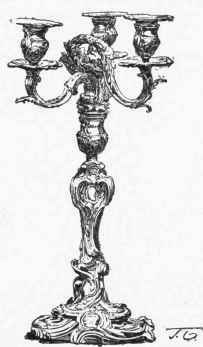
Candelabra, with the Arms of Bouillon. (Collection of M. Leopold Double.).
At the exhibition of the Sechan collection (now dispersed) there was to be seen a magnificent looking-glass, with pediment, surmounted by a palm-tree and graceful fronds of the acanthus, in which the just balance of the parts, the delicate interweavings of the angles, the developments of the base, ornate and full of grandeur, combined to form a faultless composition altogether worthy of the majestic architecture of the period. It was more than a mere frame - it was a monument, of which a large majority of contemporary frames in carved and gilded wood appear to be but imitations.
The candelabra, the flambeaux -often emblazoned, are composed with the same thoughtful exuberance, and in their ingenious combinations we still recognise the spirit and the elevation of the architectural conceptions of Le Vau, d'Orbay, and Claude Perrault.
Continue to:


My Books

