


Objects Of Ornamental Art. Chapter I. Ornamental Bronzes. Part 2
Description
This section is from the book "A History Of Furniture", by Albert Jacquemart. Also available from Amazon: A History Of Furniture.
This section is from the "" book, by .
Objects Of Ornamental Art. Chapter I. Ornamental Bronzes. Part 2
We have, elsewhere, alluded to a statuette of Charlemagne, a rude work, but one which yet bears far more strongly the impress of the Roman traditions than of the Byzantine deviation. In the twelfth century again, we meet with knight crusaders, even more barbarous in their almost shapeless outlines, but clearly allied, at least by the working of the brass, to the curious flambeaux, formed of small equestrian figures, in the Spitzer collection. These latter, thoroughly national in character, are analogous to the two-light candlestick of the fourteenth century, representing a bearded man in the costume of the period of Charles V., wearing the poulaines or peaked shoes, and supporting with both hands vases which serve as nozzles; as also another, wherein a man in laced jerkin, his head covered with a hood, extends both arms, also designed to carry lights. This disposition, to which Byzantine works present no analogy, we shall meet with again in the Germany of the fifteenth century. That youth on horseback, holding the branch of a shrub, the flower upon which forms the nozzle, is it not an application of the same idea as the horseman of the Spitzer collection? Surely, as M. Alfred Darcel truly says, we must acknowledge that Germany has had an Art of her own, original and distinct; and yet we'may trace its origin far enough back to show that it flows from the same source as French Art - offspring of Carlovingian civilisation.
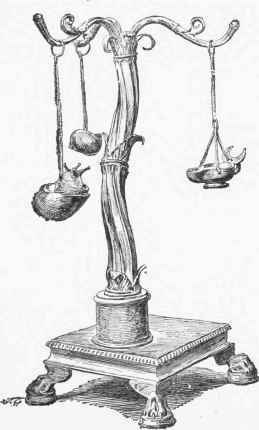
Candelabra, in antique bronze, from Pompeii. (Museum of Naples.).
It is also undoubtedly true that artists everywhere knew how to seize upon ideas susceptible of adaptation, and that in their search for these they went even to the far East. Were proof required, we need but instance that precious ewer in the Louvre collection, in the shape of a peacock, and to which one would assign an Indian origin, but for the inscription which proves the author: OPUS SALAMONIS FRAT (ris). This bird which stands firmly by the aid of a horse-shoe-shaped appendage soldered to its feet, is fitted with a curved syphon, placed upon its back and surmounted by a small tube, with lid, through which it can be filled; an arrangement which we find common in all warm countries, and especially in America, securing the drinker from all possible intrusion of noxious animals into the receptacle. Now, this ewer of the thirteenth century is only a modification of those in the forms of lions, fantastic animals, or even of groups, as in the " Lai d'Aristotle," wherein the philosopher is represented as a steed, on whose back is mounted the syren whose charms have subdued him.
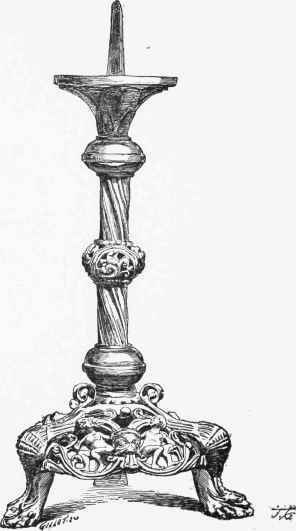
Candlestick copper gilt, of the Thirteenth Century. (Collection of Count Basilewskl.).
Let us, however, turn from these specimens, curious in their rude designs, and examine productions more congenial to our tastes, and more in conformity with our manners, giving a passing notice of hanging chandeliers, especially that one with numerous branches, which the catalogue informs us was made in 1468 by Jehan Scalkin, and which carries back to a remote period the invention of lustres.
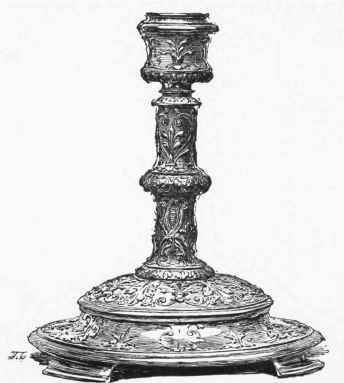
Brunze Candlestick. Italian work of the Sixteenth Century. (Collection of M. de Nolivos.).
It was when Andrea Riccio composed the famous candelabrum in the church of Saint Stephen of Padua, that admiring Italy entered into the new path, in which were to be developed all the beauties of which bronze is susceptible; this solid and majestic architecture, this rich and bold ornamentation, wherein the most graceful scroll-work, and the foliage of the vegetable world, forming a natural frame for figures real or ideal, offered a theme the endless variety of which two centuries have not been able to exhaust.
Torch-holders, flambeaux, fire-dogs (chenets), hand-bells, caskets, were multiplied without repetition; and while groups and figures appeared upon the carved furniture of apartments, every accessory vied with each other as masterpieces of Art. And this is so true, that the most common utensils invested with this imposing decoration sought, by modifications of their names, a higher place in the language of the country. Look at that tiny circular temple in the Louvre, supported by six pilasters, the panels of which are of chased and perforated work, as is also the cupola which surmounts it. It is a mortier a cire, in plain and simple words, a night-light, - nothing more, the name and the uses of which likewise Brantome has explained for us ("Histoire des dames galantes"). Isabella of Austria, consort of Charles IX, he tells us, "tres devote et nullemont bigotte, passoit une partie des nuits en priere, pensant que ses femmes ne s'en apercevoient, mais elles la voioient par l'ombre de la lumiere de son mortier plein de cire, qu'elle tenoit allumee en la ruelle de son lict pour lire et prier Dieu dans ses Hcures au lieu que les autres princesses et roynes le tiennent sur le buffet." The majority of these "mortiers a cire" are of exquisite workmanship, and some arc surmounted by truly charming miniature figures.
The flambeaux present two essentially different types. The most ancient are beyond doubt, in all their general features, copies of the torch-holders of Persia: a base in the section of a cone, supports a flat stand, usually either gadrooned or fluted, from the centre of which arises the baluster-shaped shaft, terminating in the nozzle; in others, the stem is simply inserted in a flat stand with mouldings, and in some examples supported upon three lion's claws. Masks, garlands, and foliage enrich the various parts of this composition.
Continue to:


My Books

