


Objects Of Ornamental Art. Chapter I. Ornamental Bronzes
Description
This section is from the book "A History Of Furniture", by Albert Jacquemart. Also available from Amazon: A History Of Furniture.
This section is from the "" book, by .
Objects Of Ornamental Art. Chapter I. Ornamental Bronzes
It is solely with a view to facilitate the study and classification of the numerous subjects treated of in this book, that we have separated the statuettes and bas-reliefs from the ornamental bronzes. It is clear, that the same hands have wrought upon both descriptions of work, and it is entirely owing to a modern aberration, against which we must protest, that some persons have sought to separate into distinct groups, the various productions of intelligence, and to set up a so-called "high art" by the side of what they term "industrial art." What? was Cellini an artist only while modelling the Perseus or the Nymph of Fontainebleau? The marvellous cup of the Louvre, the enamelled goldsmith's work, the peerless jewels which have immortalised his name - were these mere industrial works ?
The absurdity of such a distinction, it is needless to demonstrate; it must strike the least intelligent. Let us visit in the Louvre, the gallery devoted to ancient bronzes. Figures here are certainly in the minority. the fine masks, the palmettes, the acanthus, elegant models which successive ages, ever reproducing, have handed down to us, are no others than the fragments of tripods, chariots, seats, vase-handles, nay, even appendages of culinary utensils. Shall we refuse to see in these the traces of ancient Art? We have seen that mask of Bacchus, crowned with ivy and with flowing beard; the ring surmounting which determines its place among the handles of pateras. Is it on this account to be less admired as one of the finest specimens of Grecian Art? Let us bear in mind that, with the exception of the sacred statues in the temples, the greater portion of the treasures of genius brought to light by modern excavations, were no more than objects of household furniture escaped, by being buried, from the rapacity of barbarian invaders.
Let us not then be surprised if, in the following descriptions, we meet with names elsewhere alluded to. They are these of men who were not afraid to display the variety and pliability of their talent, by applying it to diverse objects: a further proof that, in remote ages, artists did not hesitate to inscribe their names upon works even of a secondary order. We find that Publius Salvius Cincius engraved his own upon the bronze fir-cone, which crowns the mausoleum of Adrian; Januarius, chaser in bronze, signed a cup with the attributes of Minerva, Mercury, Mars, and Vulcan; and Kircher has preserved the name of G. Critonius Dassus, "sculptoris vasclari" (chaser of bronze vases). We do not attempt to give any idea of the numerous specimens in bronze contained in our museums, from the tripods, and instruments of sacrifice, pyxes, candelabra, lamp-stands, lamps for suspension, and others, to the pateras and vases; the one adorned with representations of combats between genii and wild beasts, the other resembling in form, the heads of men and women, their hair arranged in various styles. We refer the connoisseur to the special gallery in the Louvre, and to the cabinet of antiquities at the National Library : at the latter they may admire also those marvellous Etruscan mirrors, which still retain traces of incrustations in gold and silver.
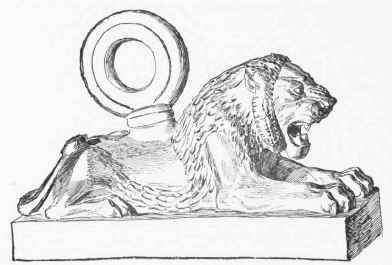
Antique Bronze. Recumbent Lion bearing a ring. From the threshold of a gate of the Palace of Khorsabad.
( Museum of the Louvre).
From antiquity to the Middle Ages what evolutions has European society undergone! What violent shocks have broken the chain of civilisation! Once it was thought enough to establish the existence of a gap of several centuries and pass onwards. Archaeology has no such easy modes of procession now; wherever she feels her ignorance, she seeks for, and invokes light; little by little the gaps are filled and the truth appears.

Antique Table, of bronze, from Pompeii. (Museum of Nnrles .).
There is no doubt that Byzantium long retained traces of her old ascendancy; and, even unknown to herself, exerted a certain influence over the peoples who maintained relations with her; and yet, by the exercise of a little intelligence, can we not, amongst the mass of so-called Byzantine works, detect numerous characteristics foreign to Romano-Greek ideas, the sources of which we should have to seek far from Constantinople? The France of Charlemagne, that vast empire which comprised the greater part of Europe, must she not have created an art of her own, perhaps inspired by what the great conqueror may have gathered in his kingdom of Lombardy, or by what he had seen amongst the Normans during their descent upon our shores in 808? If we examine carefully these curious bronzes, low candlesticks formed by intricate twisting of vegetable stalks, from which issue animals and chimeric birds, drinking-vessels in the form of lions, unicorns, and of winged monsters, often mounted by grotesque horsemen, is there not the closest analogy between these and the paintings in the Carlovingian Manuscripts, and does it not appear as if these latter had been copied from the ancient carvings in the wooden churches of Norway?
These barbarous countries, given up to the worship of Odin, bore far closer affinity with Gaul and Germany, covered with forests and peopled by wild beasts, than they could possibly have had with an enervated and expiring civilisation. Christianity? it may be said. Assuredly; and this is one argument the more. What has Byzantine Christianity, with its regular and unvarying images, fixed by an immutable canon law, in common with this faith still unenlightened, dominated by the fear of monsters and hideous demons? The snakes, the dragons which the exercising power of saints alone availed to overcome, are surely the apparitions natural to those gloomy forests, the conceptions of a people yet young, whose faith required to be enlightened in order to root out childish superstitions.
Continue to:


My Books

