


Stucco And The Ceroplastic Art. Continued
Description
This section is from the book "A History Of Furniture", by Albert Jacquemart. Also available from Amazon: A History Of Furniture.
This section is from the "" book, by .
Stucco And The Ceroplastic Art. Continued
Nor is there anything surprising in the statement that Michael Angelo himself worked in wax, and left us the Descent from the Cross figuring under his name in Munich, such being then the usual custom of those who intended to cast their works in bronze. We accordingly find Leonardo and Luca della Robbia mentioned amongst ceroplastic artists. Sansovino also made the wax copy of the group of the Laocoon said to have been praised by Raffaelle. 11 Tribolo, a pupil of Sansovino, was specially famous for his statuettes, and we know what skill was displayed by Benvenuto Cellini in this art, as the little model of his Perseus is more celebrated than the statue itself. For their medallions and portraits, Alfonso Lombardi of Ferrara, Rosso de'Giugni of Florence, Giovanbattista Pozzini and Pastorino of Siena acquired a well-earned reputation, while in the seventeenth century we still meet with the names of Gio Bernardino, Azzolino of Naples, and others.
Nor had France remained indifferent to this movement. In the fifteenth century wax had served here, as in Italy, to represent ex voto offerings of individuals in the churches and monasteries celebrated for their sanctity. Need we add that it was also used for those sorceries, or pretended incantations at that time practised by charlatans, on the credulity of the age? By no means, for such things have, fortunately, nothing in common with Art.
But we find Anthoine de Just, "ymagier," in 1510 modelling a hind in wax to adorn the chateau of Blcis. Others must have been able to do better than this, and it is impossible not to recognise a French hand in a series of portraits exhibited at Cluny, beginning with Louis XII. and Anne of Brittany, and coming down to Henry III. and his wife, Louise of Lorraine, and embracing the celebrities of the times, conspicuous amongst whom is Clement Marot. The style of the workmanship answers very well to the last thirty years or so of the sixteenth century. The legends also are in French, and even the cases in leather relieved with ornamental die work, are identical with contemporary bindings. We should, doubtless, be well pleased to discover a signature attached to these works; but the Italians themselves were not in the habit of signing their names in these cases, so that the greater part of works executed in wax are anonymous.
We know how zealously Henry IV. exerted himself in favour of French Art and industries. How then conies it that the Italian Giovanni Paulo or Paolo is employed in 1604 to execute in wax the portraits of the little Dauphin and his nurse? Later on, Louis XIV. attached sufficient value to ceroplastics to create the office of wax modeller and statuary to the king in favour of Antoine Benoist. It was in this capacity that this artist executed, in 1706, the official portraits preserved in the galleries of Versailles.
To the seventeenth century also belongs Abr. Drentuet, author of a group of Leda and the swan. Lastly, although this description of Art was no longer much in vogue, the eighteenth century produced some remarkable works in wax, as may be seen by the display in the ancient Sauvageot collection. Curtius, one of the last adepts in this branch, acquired a singular celebrity outside the sphere of Art. His salon of criminal and dangerous notorieties is now better known than his serious productions. It would, however, be unfair not to remember that to the exhibition of the Salon in 1791 Curtius contributed a bust of the Dauphin in coloured wax. But the application of this Art to historical figures is no invention of his, for Benoist, modeller in wax to Louis XIV., had practised it before his time.
Let us retrace our steps and see what was the attitude of Germany towards a movement evidently originated, as above stated, to emulate the success of her medallions in wood. Men of talent applied their hand to it, for it is no more difficult to model in wax than it is to carve wood or Pappenheim stone. Such were Lawrence Strauch and Wenceslas Mailer, of Nuremberg and Weil-henmeyer, who soon vied with the most famous names in Italy. Princes and nobles, distinguished men of every sort came to sit to these eminent ceroplastic artists; and in the seventeenth century, C. Rapp Chevalier, a celebrated worker in ivory, Raymond Faltz and Braunin upheld the reputation of the earlier masters.
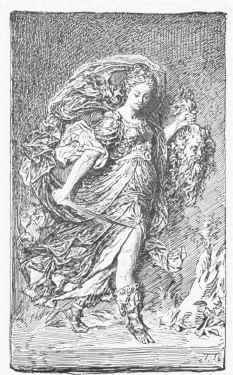
Judith, full relief figure in coloured stucco; sixteenth century. (Former Nieuwerkerke Collection.).
If we so earnestly urge the claims of this branch of Art, it is because of its extreme interest from the point of view of iconography, and because it offers charming means of embellishing choice collections. Even the series, incomplete as it was, of the Sauvageot collection, was sufficient to enable us to realise the grace of those pretty little effigies, miniature products of the modeller. But after admiring the various series possessed by MM. Dreyfus and Wasset, we begin to covet such treasures and to appreciate their full merit. Here we are able to contemplate, through the magnifying glass, the speaking likenesses of those who were the glory and the pride of past generations - the illustrious rivals, Francis I. and Charles V.; the Montmorencys, the Guises, the della Rovere; and then such matchless beauties as Marguerite of Valois, Queen of Navarre - all the Valhalla of the old French wit, genius and loveliness.
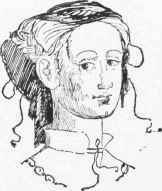
Female head, from a Oubbio Plate.
Continue to:


My Books

