


Chapter VI. Stucco And The Ceroplastic Art
Description
This section is from the book "A History Of Furniture", by Albert Jacquemart. Also available from Amazon: A History Of Furniture.
This section is from the "" book, by .
Chapter VI. Stucco And The Ceroplastic Art
AMONG the accessory materials of sculpture one of the most important from its antiquity is stucco. Pliny tells us that an artist modelled in stucco a Jupiter, which was considered so beautiful that it was awarded a niche in the Capitol. And if the temples and palaces of the ancients borrowed a part of their decoration from this material, we find it held in no less honour during the sixteenth century. Its composition, had no doubt somewhat varied, and in his "Pirotecnia" Vannuccio gives us the receipt for making it.
According to the "Piazza Universale" the most distinguished artists in this field, were II Bombarda, Alessandro Vittoria, Camillo Mantoano, Alcssandro da Udine, Federico Zuccato, Battista Franco, Alfonso Lombardi, Paolo Milanese, Thomaso Lombardo, and later on several others, amongst whom should be mentioned Pastorino of Siena, Pulidoro of Perugia and Mario Capccaccia, author of the portrait of Paul V. France was at that time tributary to Italy, and in 1533 and 1535 we find the names of Bartolommeo di Miniato and Francesco Primadici, the last, director of the works executed by order of Francis I. at Fontainebleau. Is it owing to the taste of this king for everything which came from beyond the Alps, that we find these workers in stucco completing the list of Italian artists entrusted with the official works? One might think so, when we remember that ancient Gaul had already been familiar with this artificial sculpture, Pompeius Catussa of Sequania having earned for himself a name amongst the stucco-workers whose memory has been preserved in history. And yet, even in the reign of Louis XIV., when Poussin was commissioned to decorate the galleries of the Louvre, it was again Italians, such as Ponti, Tritani, Bianchi, Arudini and Diego Borzoni who execute the figures and ornaments in stucco.
But this question does not here concern us. What we are more especially interested in is the use of this material in little coloured bas-reliefs and delicate medallions, representing the effigies of distinguished persons in the sixteenth century. These somewhat rare pieces were evidently produced to compete with the fine wood medallions, in the carving of which Germany at that time excelled. They seem to have been also the work of Italians. One of the most striking, is the Judith which has passed from the Nieuwerkerke collection to that of Sir Richard Wallace. In this figure there is a dignified attitude, a boldness of movement, and a delicacy in the treatment of the details, that incline us readily to refer its modelling to one of the artists invited to France, and employed on the works at Fontainebleau.
How came stucco to be relinquished for objects of small size, and especially for portraiture? Doubtless, because its manipulation required an amount of care, and presented difficulties calculated to prevent its use from becoming general, more especially, as there existed in wax a material by which it might be replaced to advantage.
Neither was modelling in wax itself a new invention. It was known to the ancients, and amongst artists distinguished in ceroplastics Cicero mentions Hiero of Cibyra, brother of Tlepolemus. Pliny further tells us that among the ancient Romans there were to be seen in the houses neither bronzes, nor marbles, nor statues made by foreign artists; but busts of wax, arranged in order, each in a separate niche, preserved the image of departed members of the family, and were brought forth only on the occasion of funeral obsequies. On these occasions, if the deceased had distinguished himself in war, there were displayed the gifts and crowns he had earned as well as the standards and spoils he had gained from the enemy, and his bust in wax with those of his ancestors and kinsmen formed part of the procession. This privilege, known as the jus imagimim, was however reserved to the patricians.
In the Middle Ages the illustrious dead were laid out with uncovered face, and clothed in their garments till the moment of burial. But when they had been disfigured by illness their features were covered with a wax mask, modelled to their likeness.
The custom of taking portraits after nature reappeared in Italy with the revival of art, and so early as the fifteenth century, wax was used to preserve the very features of those who had distinguished themselves in life. One of the masterpieces of this description is the bust in the Lille Museum, which was at first taken for an antique, although acquired in Italy by Wicar as a work of Raphael. Now, however, all doubt has vanished, and a brilliant critique by Jules Rencuvier shows that this bust is of Florentine workmanship, and was one of those it was customary to present as votive offerings in the churches of Tuscany. The image was usually completed by means of costly robes and ornaments imitated from nature. There existed a family of artists devoted to the preparation of such images. Its head Jacopo Benin-tendi, his son Zanolese and his nephew Orsino, had thence taken the name of Sallimagini or del Cerajuolo. The connection Benintendi formed with Andrea del Verocchic, contributed not a little to urge him to perfect his art, and Vasari tells us, that it was under the direction of this last master that the last-cited artists produced the votive images of Lorenzo de' Medici, dedicated by his friends after he had escaped from the conspiracy of the Pazzi in 1478. Hence, Renouvier has no difficulty in attaching the name of Orsino to the beautiful bust in Lille, describing him as one of the best workers in this branch, that the fifteenth century has left us.
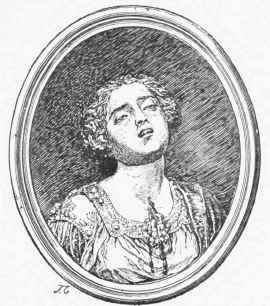
Medallion in coloured wax; sixteenth century. (H. Barbet de Jouy's Collection.).
In the following century the art of the "Ceraiuoli" was still further developed, and amongst the most noted modellers the "Piazza Universale" mentions Martino del Sfrizio, his son-in-law, Giovanbattista, Martinello "Sarego," and especially Leone Leoni, author of a wonderful Diana. To Leoni is also due the beautiful wax representing the bust in profile of Michael Angelo, recently described by Mr. Drury Fortnum in a monograph inserted in the Archaeological Journal. This piece, which bears under its frame the legend, "Portrait of Michael Angelo Buonarotti, made from life by Leone Aretino, his friend," seems according to Fortnum, to have been the model on which Leone Leoni composed the celebrated medal of the immortal sculptor in his eighty-eighth year.
Continue to:


My Books

